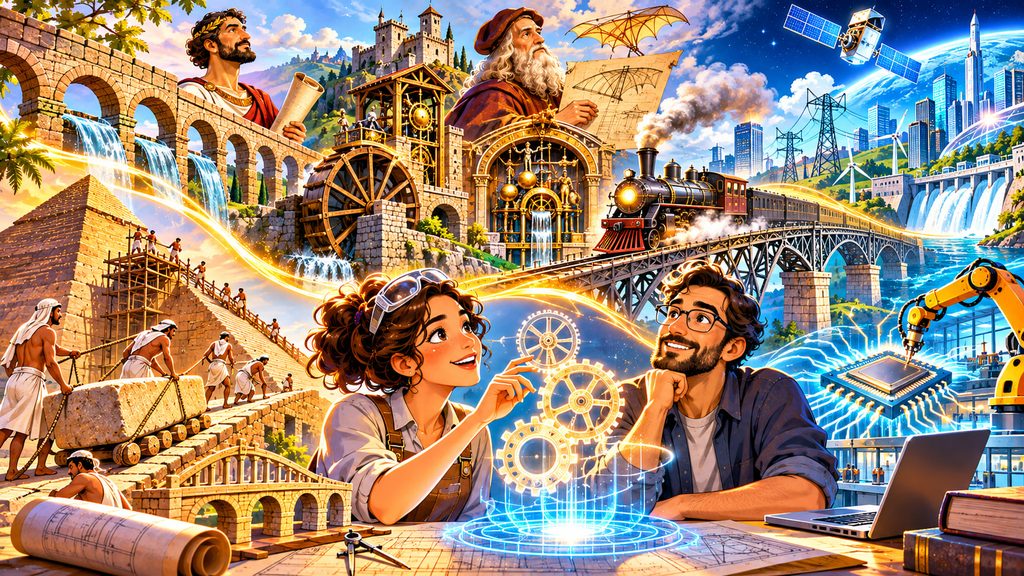
A stone arch holds up a Roman aqueduct. A steam engine drives a nineteenth-century factory. A microchip coordinates the movements of a robotic surgical instrument. All began with the challenge of turning knowledge and materials into practical solutions. The history of engineering is the story of humanity learning to build, measure, power, and connect its world.
Long before engineering became a formal profession, communities experimented with tools, structures, and systems that made daily life safer and more productive. Success depended on observation and learning from failure. Science and mathematics eventually improved predictions. Engineers still face the limits of materials, energy, and physics.
Ancient Civilizations: Building on a Monumental Scale
Ancient engineers organized extraordinary projects without modern cranes. Egyptian builders raised massive pyramids using precise surveying, stoneworking, and carefully planned labor. In Mesopotamia, canals and embankments helped farmers manage river water, while settlements of the Indus Valley developed sophisticated drainage arrangements. Managing water was as transformative as building monuments, because reliable supplies enabled cities to grow.
These achievements required more than large workforces. Workers needed techniques for moving materials, aligning structures, and distributing loads safely. Methods improved through experience and the transmission of craft knowledge. Some construction details remain debated, but surviving structures reveal practical expertise.
Greek Mechanics and the Roman Infrastructure Revolution
Greek thinkers helped explain mechanics mathematically. Archimedes investigated levers, buoyancy, and other physical relationships, and the screw pump associated with his name remains a recognizable device. A lever multiplies the effect of an applied force by changing the distances over which forces act. Such principles make lifting and moving heavy objects easier without violating the laws of physics.
Roman engineers became famous for building infrastructure that connected settlements across enormous distances. Roads, bridges, harbors, and aqueducts depended on durable materials and careful gradients. Many aqueducts carried water largely by gravity, not by continuously powered pumps. Roman concrete and the arch enabled spacious structures, though they differ from modern reinforced concrete.
Medieval Innovation Across Continents
Engineering progress continued across Asia, the Islamic world, Africa, and Europe throughout the medieval period. Chinese engineers developed advanced canal infrastructure, printing technologies, and complex mechanical clocks. In the Islamic world, specialists designed astronomical instruments, water-lifting systems, and ingenious automated devices. Engineering history belongs to many civilizations.
Around 1206, engineer Ismail al-Jazari described water clocks, pumps, and mechanical automata in a richly illustrated technical book. His designs used interacting wheels, valves, and movement-converting devices. A crank mechanism can transform rotation into back-and-forth motion, an idea central to many later machines. Medieval builders also advanced masonry techniques, allowing bridges and cathedrals to span increasingly ambitious spaces.
The Renaissance: Drawing Machines Before Building Them
During the Renaissance, detailed drawings became powerful tools for exchanging engineering ideas. Leonardo da Vinci sketched bridges, machines, lifting devices, and mechanisms inspired by anatomy and nature. Many of his proposals remained concepts rather than working inventions, but his notebooks illustrate the value of visual experimentation. Drawings helped designers compare options before construction.
Gradually, engineering drawing became more standardized and mathematically precise. Developments in measurement, geometry, and mechanics helped designers calculate dimensions and forces. Experiments brought theory closer to workshop practice. This mattered as machines began exploiting stronger energy sources.
Steam Power and the Industrial Revolution
In 1712, Thomas Newcomen’s atmospheric steam engine offered a practical way to pump water from mines. It consumed considerable fuel, but it addressed a problem that had limited mining operations. James Watt’s separate condenser, patented in 1769, substantially improved steam-engine efficiency. Further improvements made steam power useful in factories, transport, and industry.
The Industrial Revolution had multiple causes. Coal, ironmaking, textile machinery, and transportation reinforced one another. Engineers increasingly tested components, measured performance, and designed repeatable production processes. Power that once depended on rivers or muscle could now be supplied wherever suitable fuel and machinery were available.
Steel, Railways, and the Rise of Modern Cities
The nineteenth century enabled larger, stronger structures. Improved iron and steel production made railways, bridges, and tall buildings more practical. The Bessemer process, introduced in the 1850s, helped make mass-produced steel more affordable, although later methods also became important. Steel’s combination of strength and workability reshaped construction and transportation.
Railways required coordinated advances in locomotives, track design, tunnels, signaling, and maintenance. Urban engineers developed sewer networks and drinking-water systems that reduced exposure to many infectious diseases. Skyscrapers later combined steel frames, elevators, and improved foundations. Modern cities depended on several engineering disciplines.
Electricity and the Birth of Global Communication
Electricity created another transformation by allowing energy to move through wires and power equipment far from its source. The nineteenth century saw major advances in generators, motors, electric lighting, and long-distance transmission. Engineers developed electrical grids to connect generating stations with factories, streets, and homes. Reliable supply required voltage control and safety systems.
Communication technology evolved alongside electric power. Telegraph networks transmitted messages over long distances before telephones and radio became widespread. New infrastructure allowed businesses and governments to coordinate activity much more quickly. Computing and the internet later expanded this connectivity.
From Airplanes to the Microchip
In 1903, the Wright brothers demonstrated powered, controlled flight with a heavier-than-air aircraft. Aircraft engineering combined aerodynamics, engines, and lightweight structures. During the twentieth century, rockets and spacecraft pushed engineering into environments with extreme temperatures and almost no atmospheric pressure. Each advance required testing and theory.
A different revolution happened on much smaller scales. The transistor emerged from Bell Laboratories research in 1947, and Jack Kilby demonstrated an early integrated circuit in 1958. Robert Noyce’s subsequent work helped establish a practical route to manufacturing chips. Miniaturized electronics made modern computers, satellite systems, medical devices, and smartphones possible.
Engineering Today: Designing for a Changing Planet
Modern engineers use computer simulations, sensors, robotics, and advanced materials to tackle complex problems. computer-aided design allows teams to model components before manufacturing, while digital twins can represent physical systems using continuously updated information. Artificial intelligence helps optimization, but models need real-world validation. A promising digital design does not automatically become a safe physical product.
The priorities of engineering have also changed. Low-carbon energy, resilient infrastructure, accessible medical technology, and efficient resource use now influence many design decisions. Engineers assess products from materials to disposal. The greatest achievements may come not from building more, but from building responsibly.
Every bridge, water pipe, circuit, and medical instrument carries centuries of accumulated knowledge. Ancient builders asked how to lift stone and move water; today’s engineers ask how to deliver clean energy and maintain complex systems. Both questions demand creativity grounded in physical reality. Which engineering breakthrough has changed human life the most: ancient water systems, steam power, electricity, or the microchip? Share your thoughts in the comments.
Interesting Facts
- The Archimedes screw remains useful for moving water and other materials.
- Many Roman aqueducts transported water by gravity over long distances.
- Al-Jazari described sophisticated mechanical devices in a book completed around 1206.
- Newcomen’s early steam engine was operating in 1712, decades before Watt’s improvements.
- The Bessemer process helped expand industrial steel production during the nineteenth century.
- The Wright brothers made their first sustained, controlled powered flight in 1903.
- An early integrated circuit was demonstrated by Jack Kilby in 1958.
Glossary
- Lever — A rigid bar that pivots around a support to transmit or multiply force.
- Arch — A curved structural element that transfers loads toward its supports.
- Crank Mechanism — A device that converts rotary motion into reciprocating motion, or the reverse.
- Engineering Drawing — A technical representation used to communicate a component’s form, dimensions, and construction details.
- Industrial Revolution — A period of major changes in production driven by mechanization, new energy sources, and industrial organization.
- Bessemer Process — A nineteenth-century method of producing steel by blowing air through molten iron.
- Electrical Grid — A connected system for producing, transmitting, and distributing electrical power.
- Integrated Circuit — An electronic circuit with multiple components formed on a small semiconductor substrate.
- Computer-Aided Design — The use of digital tools to create and modify engineering designs.
- Digital Twin — A digital representation of a physical asset or process, connected to information about its state or operation.