When we ask how much the Earth “weighs,” we’re really asking about its mass. Weight, in physics, depends on gravity and varies depending on where an object is located. Since…
A planetary alignment, often called a "planet parade," occurs when several planets of the solar system appear to line up in the sky from Earth's point of view. While they…
Stars are massive spheres of glowing gas that shine with energy produced by nuclear fusion. Every star—including our Sun—was born from cosmic clouds in deep space. The process of star…
The Solar System is a complex and dynamic system of planets, moons, asteroids, comets, and other celestial bodies orbiting our central star—the Sun. It’s our cosmic neighborhood, and its structure…
The universe is vast, mysterious, and full of wonders—from stars and planets to invisible forces we can barely comprehend. But what exactly is it made of? Modern astrophysics tells us…
Mercury is the closest planet to the Sun and the smallest in our solar system. Despite its proximity to the Sun, it's not the hottest planet—Venus holds that title. However,…
Theia is a hypothetical ancient planetary body believed to have collided with Earth over 4 billion years ago. While Theia no longer exists as a separate planet, scientists suggest that…
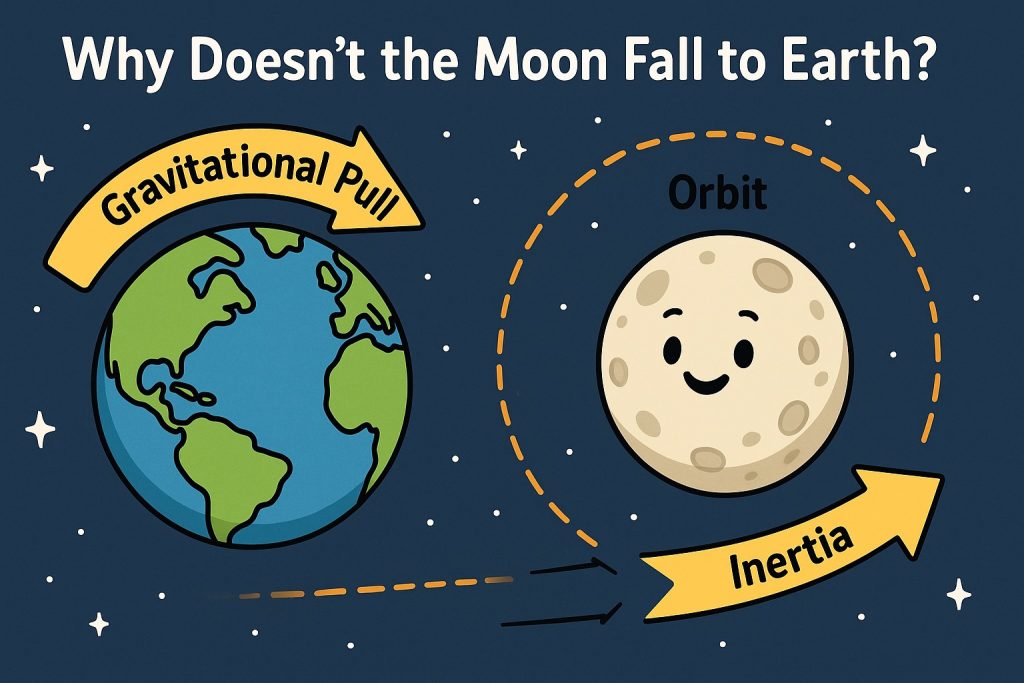
At first glance, it might seem logical to assume that the Moon should eventually fall to Earth due to gravity. After all, gravity pulls objects toward each other—and the Earth…
The Moon is Earth’s only natural satellite, orbiting our planet at an average distance of about 384,400 kilometers. It is the fifth-largest moon in the solar system and the second-densest,…