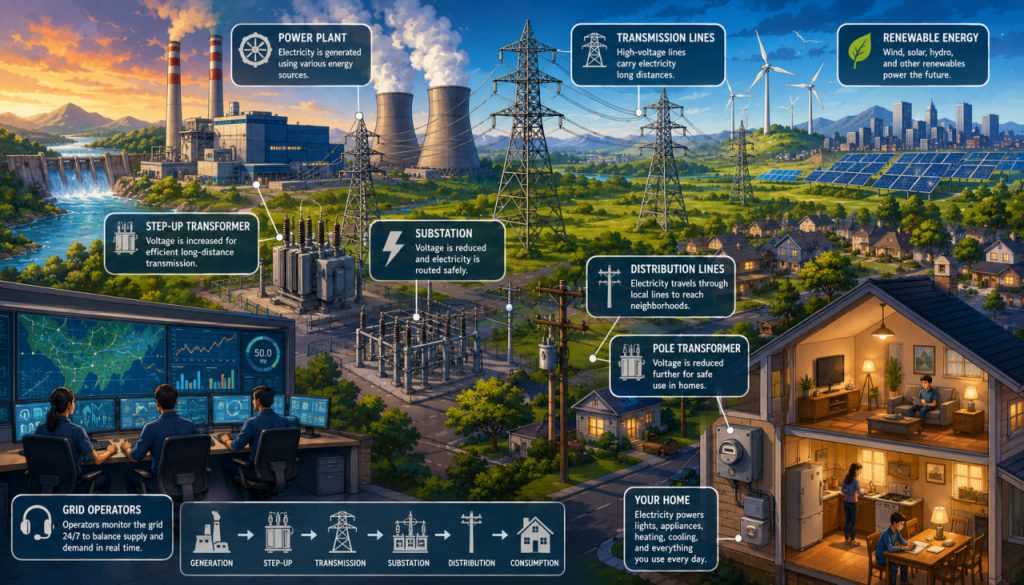
Electricity powers nearly every aspect of modern life. We rely on it for lighting, heating, cooling, communication, transportation, healthcare, manufacturing, and countless digital technologies. Yet most people rarely think about the complex system that delivers electricity to their homes every second of the day.
Modern power systems are among the largest and most sophisticated engineering achievements ever created. Millions of power lines, thousands of substations, and hundreds of generating facilities work together to maintain a delicate balance between electricity production and consumption. Unlike many other resources, electricity must usually be generated at the exact moment it is needed, making the electrical grid a remarkable example of real-time coordination.
This article explains how modern electricity supply works, where electricity comes from, how it travels across long distances, and how engineers keep the grid stable and reliable around the clock.
Electricity Begins at Power Plants
Every electrical system starts with power generation.
Different countries use different combinations of energy sources depending on their natural resources, climate, economy, and energy policies.
Today’s electricity may come from:
- Hydroelectric power plants
- Nuclear power plants
- Coal-fired power stations
- Natural gas power plants
- Wind farms
- Solar power plants
- Geothermal stations
- Biomass facilities
Regardless of the energy source, the objective remains the same: convert another form of energy into electrical energy.
Many power plants use large turbines connected to generators.
As the turbines rotate, they spin powerful magnets inside generators, producing electricity through electromagnetic induction.
Although energy sources differ, the fundamental principle of electricity generation remains remarkably similar.
Why High Voltage Is Essential
Electricity is rarely delivered directly from a power plant to homes.
Instead, it first passes through step-up transformers, which increase the voltage to extremely high levels.
High-voltage transmission provides several important advantages:
- Lower energy losses
- Greater transmission efficiency
- Reduced heating of power lines
- Lower operating costs
- Ability to transport electricity over hundreds of kilometers
Some transmission lines operate at hundreds of thousands of volts.
Without high-voltage transmission, supplying electricity to large cities would be far less efficient.
Increasing voltage allows more electricity to travel longer distances while minimizing energy losses.
The Power Grid: One Giant Connected Network
Electricity travels through an interconnected system known as the electrical grid.
The grid consists of:
- Power plants
- High-voltage transmission lines
- Electrical substations
- Distribution networks
- Local transformers
- Homes
- Businesses
- Factories
Rather than operating as isolated systems, many regions connect multiple power plants together.
This interconnected design improves reliability because electricity can often be rerouted if one generating station or transmission line experiences a problem.
Modern grids are among the largest machines ever built by humanity.
Substations: The Hidden Hubs of the Grid
Electrical substations play a critical role in power delivery.
Although they often receive little public attention, substations perform several essential functions.
They:
- Change voltage levels
- Route electricity
- Protect equipment
- Monitor system conditions
- Isolate faults
- Improve reliability
As electricity moves closer to consumers, substations gradually reduce voltage until it reaches levels suitable for neighborhoods and buildings.
Without substations, electricity could not be delivered safely or efficiently.
From Distribution Lines to Your Home
After leaving a local substation, electricity enters the distribution network.
These are the power lines commonly seen along roads or underground in urban areas.
Before entering a home, electricity passes through a neighborhood transformer.
This transformer reduces voltage to the level used by household appliances.
Inside the building, electricity flows through:
- The electric meter
- The main service panel
- Circuit breakers
- Individual household circuits
These systems distribute electricity safely throughout the home.
The electricity powering a simple light bulb has often traveled hundreds of kilometers before reaching your wall outlet.
Why Supply and Demand Must Always Stay Balanced
Unlike water or natural gas, electricity is difficult to store in large quantities using traditional infrastructure.
This means that electricity generation must closely match demand every second.
Grid operators continuously monitor:
- Electricity demand
- Power plant output
- Grid frequency
- Weather conditions
- Equipment status
- Renewable energy production
If demand suddenly increases, additional generators may need to start operating.
If demand falls, generation must decrease accordingly.
Maintaining this balance is one of the most challenging tasks in modern power engineering.
Renewable Energy Is Transforming the Grid
Renewable energy has become an increasingly important part of electricity generation.
Major renewable sources include:
- Solar energy
- Wind energy
- Hydropower
- Geothermal energy
- Biomass
Unlike fossil-fuel power plants, some renewable sources depend on weather conditions.
For example:
- Solar panels generate less electricity at night.
- Wind turbines require sufficient wind speeds.
This variability has encouraged investment in:
- Battery storage systems
- Smart grids
- Flexible power plants
- Improved forecasting
- Advanced grid management software
Modern electricity systems are becoming increasingly adaptable as renewable energy grows.
Smart Grids and Digital Technology
Today’s electrical networks are becoming more intelligent.
Smart grid technologies include:
- Digital sensors
- Automated switching
- Smart electricity meters
- Real-time monitoring
- Artificial intelligence
- Advanced forecasting systems
These technologies help utilities:
- Detect outages more quickly
- Improve reliability
- Reduce energy losses
- Integrate renewable energy
- Optimize maintenance
- Respond to changing demand
Digitalization is transforming electricity networks into highly responsive systems capable of adapting almost instantly to changing conditions.
Protecting the Grid from Failures
Modern power grids include multiple layers of protection.
Safety systems include:
- Circuit breakers
- Protective relays
- Backup transmission lines
- Emergency generators
- Automatic shutdown systems
- Cybersecurity monitoring
Engineers design grids so that a single equipment failure does not automatically cause widespread blackouts.
Nevertheless, severe storms, wildfires, earthquakes, cyberattacks, or major equipment failures can occasionally disrupt electricity supplies.
Building resilient infrastructure has become an increasingly important priority.
A reliable electrical grid depends not only on generating electricity but also on protecting the network that delivers it.
Expert Perspective
According to the International Energy Agency (IEA), electricity systems are undergoing one of the most significant transformations in their history as renewable energy, electrification, battery storage, and digital technologies expand rapidly. The IEA emphasizes that modern power grids will require greater flexibility, stronger transmission networks, advanced storage solutions, and smarter management systems to maintain reliable electricity supplies while supporting the transition to cleaner energy sources.
This expert perspective highlights an important reality: the future of electricity depends not only on generating more power but also on building smarter and more resilient grids capable of balancing increasingly complex energy systems.
The Future of Electricity Supply
Electricity demand is expected to continue growing as transportation, heating, and industry become increasingly electrified.
Future power systems are likely to include:
- More renewable energy
- Larger battery storage facilities
- Expanded transmission networks
- Smart homes
- Electric vehicles
- Artificial intelligence for grid management
- Microgrids
- Improved energy efficiency
While the technologies continue to evolve, the fundamental mission remains unchanged: delivering safe, reliable, and affordable electricity whenever people need it.
Modern electricity supply is one of the world’s greatest engineering achievements, quietly supporting nearly every aspect of everyday life.
Interesting Facts
- Electricity travels through power lines at nearly the speed of light, even though the electrons themselves move much more slowly.
- The world’s largest interconnected power grids supply electricity to hundreds of millions of people simultaneously.
- High-voltage transmission significantly reduces energy losses compared with transmitting electricity at lower voltages.
- Large electrical grids must continuously balance electricity generation and consumption, often adjusting output within seconds.
- Some modern battery storage facilities can help stabilize the electrical grid by responding almost instantly to sudden changes in demand.
- Smart meters allow utilities and consumers to monitor electricity usage in much greater detail than traditional meters.
Glossary
- Electrical Grid – An interconnected network of power plants, transmission lines, substations, and distribution systems that delivers electricity to consumers.
- Generator – A machine that converts mechanical energy into electrical energy using electromagnetic induction.
- Transformer – An electrical device that increases or decreases voltage for efficient transmission and safe distribution.
- Substation – A facility that changes voltage levels, routes electricity, and protects sections of the power grid.
- Transmission Line – A high-voltage power line used to transport electricity over long distances.
- Distribution Network – The local system of power lines and transformers that delivers electricity from substations to homes and businesses.
- Smart Grid – A modern electricity network that uses digital technologies, sensors, and automation to improve efficiency and reliability.
- Electromagnetic Induction – The process of generating electricity by moving a conductor through a magnetic field or changing the magnetic field around it.