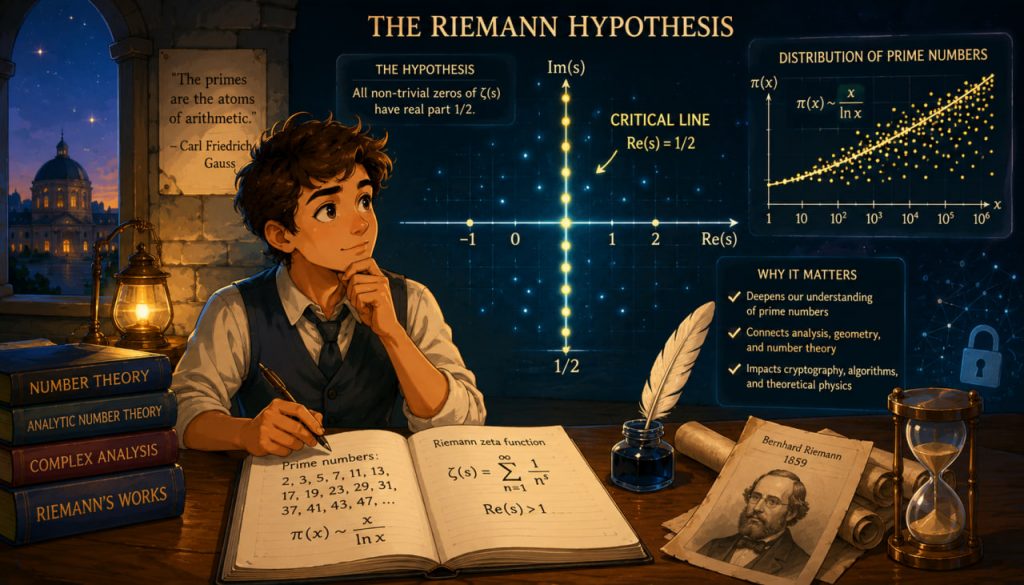
Prime numbers are among the most fundamental objects in mathematics. They are the “building blocks” of whole numbers because every positive integer can be expressed as a unique product of prime numbers. At first glance, primes appear to be scattered randomly along the number line. Sometimes they occur close together, while at other times enormous gaps separate them.
For more than 160 years, mathematicians have tried to answer one of the greatest unanswered questions in mathematics: Is there a hidden pattern behind the distribution of prime numbers? This question lies at the heart of the Riemann Hypothesis, a mathematical conjecture that has influenced number theory, cryptography, computer science, and mathematical physics.
Although millions of zeros have been tested and found to agree with the hypothesis, no complete proof or counterexample has ever been discovered. Today, the Riemann Hypothesis remains one of the most famous unsolved problems in mathematics and is one of the seven Millennium Prize Problems, carrying a prize of $1 million for a correct proof.
This article explains what prime numbers are, what the Riemann Hypothesis states, why it matters, and how it continues to shape modern mathematics.
What Are Prime Numbers?
A prime number is a whole number greater than 1 that has exactly two positive divisors:
- 1
- Itself
The first few prime numbers are:
- 2
- 3
- 5
- 7
- 11
- 13
- 17
- 19
- 23
- 29
Prime numbers become less frequent as numbers grow larger.
However, they never disappear completely.
In fact, the ancient Greek mathematician Euclid proved more than 2,300 years ago that there are infinitely many prime numbers.
Prime numbers may appear unpredictable, but mathematics suggests they follow surprisingly deep patterns.
Why Is the Distribution of Prime Numbers So Mysterious?
If you write the prime numbers in order, no obvious pattern emerges.
For example:
- 2, 3, 5, 7
- then 11, 13
- later 17, 19
- then much larger gaps begin to appear.
Mathematicians have long searched for a formula capable of predicting exactly where the next prime number will occur.
So far, no simple formula exists.
Instead, researchers study the overall statistical behavior of primes rather than individual cases.
Understanding this distribution is one of number theory’s greatest challenges.
Bernhard Riemann’s Revolutionary Idea
In 1859, German mathematician Bernhard Riemann published a remarkably short paper that transformed mathematics.
Instead of studying prime numbers directly, he investigated a remarkable mathematical object known as the Riemann zeta function.
Although the function appears unrelated to prime numbers at first glance, Riemann discovered that its properties are deeply connected to how primes are distributed.
His insight revealed an unexpected bridge between analysis and number theory.
This connection remains one of the most beautiful discoveries in mathematics.
What Does the Riemann Hypothesis Actually Say?
The Riemann Hypothesis concerns the zeros of the Riemann zeta function.
Without introducing advanced mathematics, its main claim can be summarized as follows:
Every non-trivial zero of the Riemann zeta function lies on a specific vertical line in the complex number plane, where the real part equals 1/2.
This statement may sound highly abstract.
However, if it is true, it would provide extraordinarily precise information about the distribution of prime numbers.
In mathematics, seemingly abstract structures often reveal powerful truths about real numerical patterns.
Why Does the Hypothesis Matter?
The Riemann Hypothesis affects much more than theoretical mathematics.
A proof would improve our understanding of:
- Prime number distribution
- Number theory
- Mathematical analysis
- Cryptography
- Computational mathematics
- Random matrix theory
- Quantum physics
Many existing mathematical results already assume the hypothesis is true.
If it were eventually disproven, numerous theorems would require careful reexamination, although many would remain valid in modified forms.
The Riemann Hypothesis serves as one of the central organizing ideas in modern mathematics.
Has Anyone Proven It?
Despite enormous effort, no proof currently exists.
Over the decades, mathematicians have verified that billions of computed non-trivial zeros satisfy the hypothesis.
Computers continue extending these calculations.
However, checking individual cases can never replace a complete mathematical proof.
A proof must establish the statement for infinitely many cases simultaneously.
This distinction lies at the heart of mathematical rigor.
Connections to Cryptography
Prime numbers play a crucial role in modern digital security.
Many encryption systems, including RSA cryptography, rely on properties of large prime numbers.
It is important to note, however, that the security of RSA does not depend on the Riemann Hypothesis being true.
Instead, a proof would improve theoretical understanding of prime number distribution and could lead to more efficient algorithms in computational number theory.
The practical consequences remain an active area of research.
Why Complex Numbers Appear
One surprising feature of the hypothesis is that it uses complex numbers.
Complex numbers extend ordinary numbers by introducing the imaginary unit i, where:
i² = –1
Although they may seem artificial, complex numbers are fundamental throughout modern mathematics, engineering, signal processing, quantum mechanics, and electrical engineering.
The Riemann zeta function naturally operates within this broader numerical framework.
Sometimes solving real-world mathematical problems requires expanding the very idea of what a number can be.
Expert Perspective
British mathematician Sir Michael Atiyah once described the Riemann Hypothesis as one of the deepest and most beautiful problems in mathematics, reflecting its extraordinary influence across many branches of science. Likewise, Fields Medalist Terence Tao has emphasized that understanding the distribution of prime numbers remains one of mathematics’ central challenges, with the Riemann Hypothesis providing a guiding framework for much of modern analytic number theory.
Their perspectives illustrate why this conjecture continues to inspire generations of mathematicians: it is not merely an isolated puzzle, but a gateway to understanding the hidden structure of numbers themselves.
Why the Riemann Hypothesis Continues to Fascinate
More than a century and a half after its publication, the Riemann Hypothesis remains unsolved.
Its endurance reflects the extraordinary depth of mathematics.
The problem demonstrates that even seemingly simple questions about whole numbers can lead to profound discoveries involving infinite series, complex analysis, geometry, probability, and physics.
Whether the hypothesis is eventually proven true or false, the search itself continues to generate new mathematical ideas and techniques.
Some of humanity’s greatest scientific advances begin with questions that appear deceptively simple.
Interesting Facts
- The Riemann Hypothesis is one of the seven Millennium Prize Problems, each carrying a $1 million prize for a correct solution.
- Bernhard Riemann’s original 1859 paper introducing the hypothesis was only a few pages long but became one of the most influential papers in mathematical history.
- Billions of non-trivial zeros have been verified by computers, and every one examined so far lies on the predicted critical line.
- Prime numbers become less common as numbers grow larger, but there are infinitely many of them.
- The Riemann zeta function unexpectedly connects number theory with quantum physics, chaos theory, and random matrix theory.
- Many mathematicians believe the hypothesis is true, although belief is never considered proof in mathematics.
Glossary
- Prime Number – A whole number greater than 1 that has exactly two positive divisors: 1 and itself.
- Number Theory – The branch of mathematics that studies integers and their properties.
- Riemann Zeta Function – A complex mathematical function whose properties are deeply connected to the distribution of prime numbers.
- Complex Number – A number consisting of a real part and an imaginary part involving the unit i, where i² = –1.
- Non-Trivial Zero – A value at which the Riemann zeta function equals zero, excluding its obvious (“trivial”) zeros.
- Critical Line – The vertical line in the complex plane where the real part of a number equals 1/2, which the Riemann Hypothesis predicts contains all non-trivial zeros.
- Cryptography – The science of securing information using mathematical methods.
- Millennium Prize Problems – Seven famous unsolved mathematical problems identified by the Clay Mathematics Institute, each carrying a substantial monetary prize for a correct solution.