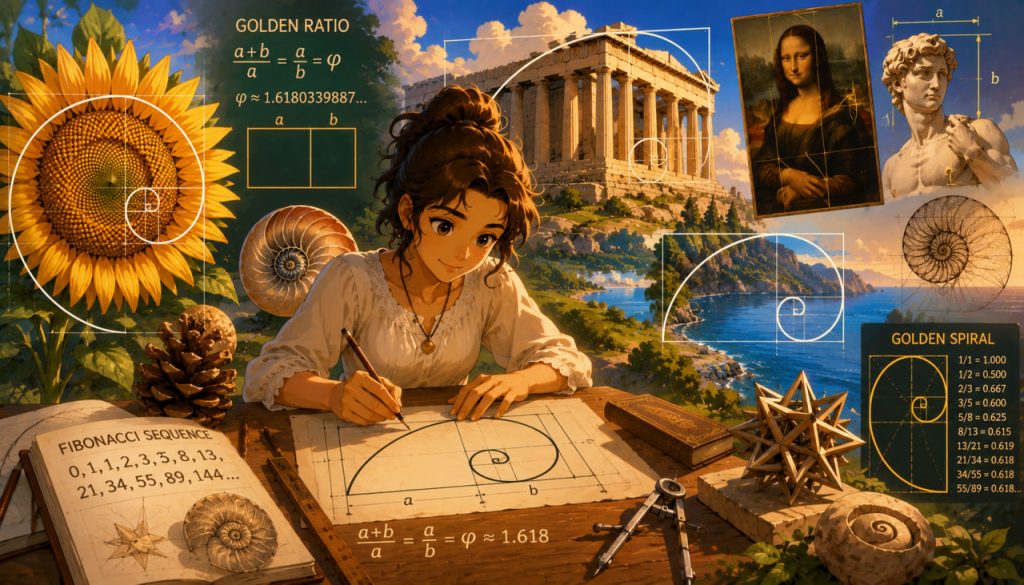
The Golden Ratio is one of the most fascinating concepts in mathematics. For centuries, mathematicians, artists, architects, scientists, and designers have been intrigued by this unique proportion, often represented by the Greek letter φ (phi) and approximately equal to 1.6180339887…
Some people describe the Golden Ratio as the “perfect proportion” because it appears in geometry, certain natural growth patterns, architecture, and works of art. However, while the Golden Ratio is undeniably important in mathematics and design, modern science also warns against exaggerating its presence. Not every beautiful object or natural phenomenon follows this ratio exactly.
Understanding what the Golden Ratio truly is—and what it is not—helps separate scientific fact from popular myths.
What Is the Golden Ratio?
The Golden Ratio describes a special mathematical relationship between two lengths.
A line is divided into two parts so that:
- The ratio of the whole length to the longer part
- Equals the ratio of the longer part to the shorter part
This relationship produces the number:
φ ≈ 1.6180339887
Unlike many simple fractions, phi is an irrational number, meaning its decimal expansion continues infinitely without repeating.
Its unique mathematical properties have fascinated researchers for over two thousand years.
A Brief History of the Golden Ratio
The concept dates back to ancient Greece.
Greek mathematician Euclid described this special proportion in his famous work Elements around 300 BC.
Centuries later, Renaissance mathematician Luca Pacioli referred to it as the “Divine Proportion”, emphasizing its mathematical elegance.
Artists and architects became increasingly interested in its possible applications.
Over time, the Golden Ratio became associated with beauty, harmony, and balance, although many historical claims remain debated among scholars.
The Connection Between the Golden Ratio and the Fibonacci Sequence
The Golden Ratio is closely connected to one of mathematics’ most famous numerical patterns—the Fibonacci sequence.
The sequence begins:
0, 1, 1, 2, 3, 5, 8, 13, 21, 34…
Each number equals the sum of the two previous numbers.
As the sequence continues, the ratio between consecutive numbers approaches 1.618, the Golden Ratio.
This remarkable relationship appears naturally in many mathematical models involving growth and branching patterns.
The Fibonacci sequence provides one of the most elegant pathways to understanding the Golden Ratio.
Does the Golden Ratio Appear in Nature?
Nature contains many patterns that can be described mathematically.
Researchers have observed Golden Ratio relationships in certain biological structures, although not every example is exact.
Possible examples include:
- Spiral arrangements of sunflower seeds
- Pinecones
- Pineapple scales
- Some shells
- Certain branching patterns in plants
- Leaf arrangements in some species
These structures often maximize efficient packing or exposure to sunlight rather than intentionally following the Golden Ratio.
Scientists emphasize that nature frequently approximates the Golden Ratio instead of reproducing it perfectly.
The Golden Ratio in Art and Architecture
Perhaps no topic generates more discussion than the Golden Ratio’s role in art.
Many famous works have been claimed to incorporate phi, including:
- The Parthenon
- Renaissance paintings
- Classical sculptures
- Modern graphic design
- Photography
- Logo design
However, historians caution that many of these claims lack direct historical evidence.
While some artists intentionally use Golden Ratio proportions, others achieve beautiful compositions without relying on it at all.
Today, designers often use the Golden Ratio as a practical guideline for creating visually balanced layouts.
Modern Applications of the Golden Ratio
The Golden Ratio remains useful across many professional fields.
Applications include:
- Graphic design
- User interface (UI) design
- Web design
- Product design
- Photography
- Typography
- Architecture
- Industrial design
Designers sometimes use Golden Ratio proportions when determining:
- Layout spacing
- Image placement
- Font sizing
- Logo construction
- Page composition
Although it is not a universal rule, it provides a reliable starting point for creating harmonious visual relationships.
Is the Human Body Based on the Golden Ratio?
A popular belief suggests that the human body perfectly follows the Golden Ratio.
Modern scientific evidence paints a more nuanced picture.
Some body proportions may approximate phi in certain individuals.
Examples sometimes studied include:
- Forearm to hand length
- Finger bone proportions
- Facial measurements
However, these relationships vary considerably among individuals.
There is no single “perfect” Golden Ratio human body, and human beauty cannot be reduced to one mathematical number.
Biological diversity is far greater than popular myths often suggest.
Common Myths About the Golden Ratio
Because the Golden Ratio has become famous, many exaggerated claims circulate online.
Common misconceptions include:
- Every flower follows the Golden Ratio.
- Every beautiful face is based on phi.
- All famous paintings use it.
- Every galaxy forms a Golden Spiral.
- Ancient architects designed every monument using phi.
Scientific research does not support many of these sweeping claims.
The Golden Ratio is genuinely important, but its influence is often overstated in popular culture.
Understanding its real mathematical significance is more interesting than believing myths.
Expert Perspective
Professor Mario Livio, astrophysicist and author of The Golden Ratio: The Story of Phi, the World’s Most Astonishing Number, has carefully examined both the mathematics and the myths surrounding the Golden Ratio.
Livio argues that the Golden Ratio is unquestionably one of mathematics’ most elegant constants, but many claims about its universal presence in art, architecture, and human beauty are not supported by historical or scientific evidence.
His work encourages readers to appreciate phi for its genuine mathematical importance while remaining skeptical of unsupported claims. This balanced perspective reflects the consensus of many mathematicians and historians today.
Why the Golden Ratio Still Fascinates Scientists
More than two thousand years after its discovery, the Golden Ratio continues to inspire research.
Scientists investigate its role in:
- Geometry
- Fractals
- Computer graphics
- Biological growth
- Optimization algorithms
- Financial mathematics
- Architecture
- Design theory
Its elegance lies not in magical properties but in the surprising ways a simple mathematical relationship appears across multiple disciplines.
The Golden Ratio reminds us that mathematics often reveals hidden patterns connecting science, nature, and human creativity.
P.S. The more you learn about the exact sciences, the more you understand the beauty of God’s creation and the more doubts disappear…
Interesting Facts
- The Greek letter φ (phi) is used to represent the Golden Ratio in honor of the ancient Greek sculptor Phidias, although the association was made many centuries after his lifetime.
- The decimal expansion of the Golden Ratio never ends and never repeats because it is an irrational number.
- Ratios of consecutive Fibonacci numbers become increasingly close to the Golden Ratio as the sequence grows.
- Many modern logo and graphic designers use Golden Ratio grids to help organize visual compositions.
- Spiral patterns in sunflowers and pinecones are more closely related to efficient packing than to aesthetic beauty.
- The Golden Ratio appears naturally in several areas of advanced mathematics, including continued fractions and certain geometric constructions.
Glossary
- Golden Ratio (φ) – A mathematical constant approximately equal to 1.6180339887, representing a special proportional relationship between two quantities.
- Phi (φ) – The Greek letter commonly used to symbolize the Golden Ratio.
- Fibonacci Sequence – A sequence of numbers in which each term equals the sum of the two preceding terms.
- Irrational Number – A number that cannot be expressed as a simple fraction and has an infinite, non-repeating decimal expansion.
- Geometry – The branch of mathematics that studies shapes, sizes, angles, and spatial relationships.
- Golden Spiral – A logarithmic spiral that grows according to the Golden Ratio and is often used in mathematical illustrations and design.
- Fractal – A geometric pattern that repeats similar structures at different scales.
- Proportion – The relationship between the sizes or lengths of different parts of an object or figure.