Animal cloning is one of the most fascinating and controversial achievements of modern biotechnology. Once considered the realm of science fiction, cloning became a scientific reality in 1996 with the birth of Dolly the sheep, the world’s first mammal cloned from an adult body cell. Since then, scientists have successfully cloned dozens of animal species, including cattle, horses, cats, dogs, rabbits, wolves, and endangered animals.
But what exactly is animal cloning? Can it help save endangered species? Does a clone behave exactly like the original animal? And could this technology one day transform conservation, agriculture, and medicine?
The answers are more complex than many people realize. Animal cloning is a powerful scientific tool, but it is neither a method for creating identical personalities nor a simple solution to biodiversity loss.
What Is Animal Cloning?
Animal cloning is the process of creating a new animal that carries nearly identical nuclear DNA to another animal.
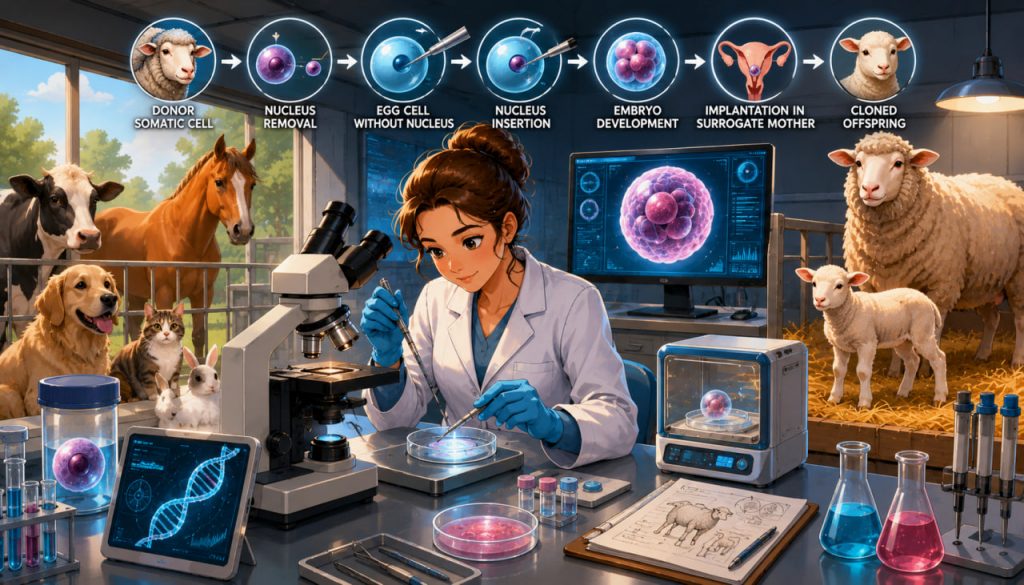
The most common cloning technique is called Somatic Cell Nuclear Transfer (SCNT).
The process involves several steps:
- Scientists collect a body (somatic) cell from the donor animal.
- The nucleus, which contains the donor’s DNA, is removed.
- An egg cell from another animal has its own nucleus removed.
- The donor nucleus is inserted into the empty egg.
- The reconstructed egg is stimulated to begin developing.
- The embryo is implanted into a surrogate mother.
If development is successful, the offspring shares almost the same nuclear genetic information as the donor animal.
A clone is genetically very similar to the donor, but it is not an exact biological or behavioral copy.
Dolly the Sheep Changed Biology Forever
The birth of Dolly in Scotland in 1996 marked one of the most important milestones in modern biology.
Before Dolly, scientists believed that adult body cells could no longer produce an entirely new organism.
Dolly proved otherwise.
Researchers at the Roslin Institute demonstrated that DNA from a mature mammary gland cell could be “reprogrammed” to direct the development of a complete animal.
This discovery transformed developmental biology and eventually contributed to advances in stem cell research and regenerative medicine.
Which Animals Have Been Cloned?
Since Dolly, researchers have successfully cloned many species.
These include:
- Sheep
- Cattle
- Goats
- Pigs
- Horses
- Cats
- Dogs
- Rabbits
- Mice
- Camels
- Wolves
- Ferrets
- Deer
- Primates (for biomedical research)
Some commercial companies even offer pet cloning services for cats, dogs, and horses, although the process remains expensive and raises ethical questions.
Can Cloning Help Save Endangered Species?
One of the most promising applications of cloning is wildlife conservation.
Scientists hope cloning may help preserve valuable genetics from endangered animals.
Potential uses include:
- Preserving rare genetic lines
- Supporting captive breeding programs
- Restoring lost genetic diversity
- Protecting critically endangered species
Researchers have already cloned several endangered animals, including the black-footed ferret and Przewalski’s horse, using preserved genetic material.
However, cloning alone cannot save a species if its natural habitat has disappeared.
Healthy ecosystems remain essential for long-term conservation success.
Are Cloned Animals Completely Identical?
This is one of the biggest misconceptions.
Although cloned animals have nearly identical nuclear DNA, they are not perfect copies.
Differences arise because of:
- Epigenetic changes
- Mitochondrial DNA from the egg donor
- Prenatal development
- Nutrition
- Environment
- Learning and experience
Just as identical twins develop unique personalities, cloned animals also develop individual behaviors.
Genes influence development, but they do not determine every aspect of an animal’s life.
Challenges and Limitations of Animal Cloning
Despite major scientific progress, cloning remains difficult.
Many embryos fail to develop normally.
Challenges include:
- Low success rates
- Pregnancy loss
- Developmental abnormalities
- High costs
- Technical complexity
- Animal welfare concerns
Fortunately, cloning success rates have gradually improved as techniques have advanced.
Researchers continue refining laboratory methods to reduce risks for both surrogate mothers and cloned offspring.
Cloning in Agriculture and Medicine
Beyond conservation, cloning has important applications in agriculture.
Farmers and researchers may clone animals with valuable characteristics such as:
- High milk production
- Disease resistance
- Superior breeding traits
- High-quality meat production
Biomedical researchers also use cloned animals to:
- Study genetic diseases
- Develop new medicines
- Produce pharmaceutical proteins
- Improve regenerative medicine research
Cloning can create genetically consistent research animals, making scientific experiments more reliable.
Ethical Questions Surround Cloning
Animal cloning raises important ethical debates.
Some concerns include:
- Animal welfare
- Low efficiency
- Cost
- Commercial pet cloning
- Biodiversity
- Genetic diversity
- Responsible scientific use
Supporters argue that cloning offers powerful tools for medicine and conservation.
Critics emphasize that protecting habitats, improving breeding programs, and reducing biodiversity loss should remain higher priorities.
Most scientists agree that cloning should complement—not replace—traditional conservation and responsible animal management.
Expert Perspective
Professor Sir Ian Wilmut, who led the team that created Dolly the sheep, frequently emphasized that the greatest importance of cloning was not producing identical animals but understanding how adult cells can be reprogrammed into entirely new forms of life.
His work helped lay the scientific foundation for modern stem cell biology and regenerative medicine. Wilmut also noted that cloning technology should be used carefully and responsibly, recognizing both its scientific potential and its ethical challenges.
Today, many developmental biologists share this view: the greatest legacy of animal cloning may be its contribution to medicine and biology rather than the widespread production of cloned animals.
What Does the Future Hold?
Animal cloning continues to evolve.
Future research may focus on:
- Improving cloning efficiency
- Conserving endangered species
- Restoring genetic diversity
- Producing organs for transplantation research
- Supporting precision agriculture
- Advancing regenerative medicine
At the same time, scientists emphasize that cloning is not a substitute for protecting natural habitats, reducing pollution, or preserving biodiversity.
Technology can support conservation, but healthy ecosystems remain irreplaceable.
Animal cloning demonstrates how powerful modern biotechnology has become, while reminding us that genetics is only one part of the complex story of life.
Interesting Facts
- Dolly the sheep was the first mammal cloned from an adult body cell and was born in 1996.
- Cloning does not create identical memories, behaviors, or personalities.
- The first successfully cloned endangered U.S. species was the black-footed ferret, created using frozen cells collected decades earlier.
- Some companies now offer commercial cloning of pets, although the procedure can cost tens of thousands of dollars.
- Identical twins are natural biological clones because they develop from the same fertilized egg.
- Scientists have preserved genetic material from many endangered animals in specialized biobanks for future conservation research.
Glossary
- Cloning – The process of creating a genetically very similar copy of an organism or its cells.
- Somatic Cell Nuclear Transfer (SCNT) – A cloning technique in which the nucleus from a body cell is transferred into an egg cell whose own nucleus has been removed.
- Somatic Cell – Any body cell except reproductive cells (sperm and egg).
- DNA – Deoxyribonucleic acid, the molecule that carries genetic information in living organisms.
- Epigenetics – Changes in gene activity that occur without altering the DNA sequence itself.
- Embryo – An early stage of development after fertilization or cloning.
- Surrogate Mother – A female animal that carries and gives birth to an embryo created from another individual’s genetic material.
- Regenerative Medicine – A field of medicine focused on repairing, replacing, or regenerating damaged tissues and organs using advanced biological technologies.