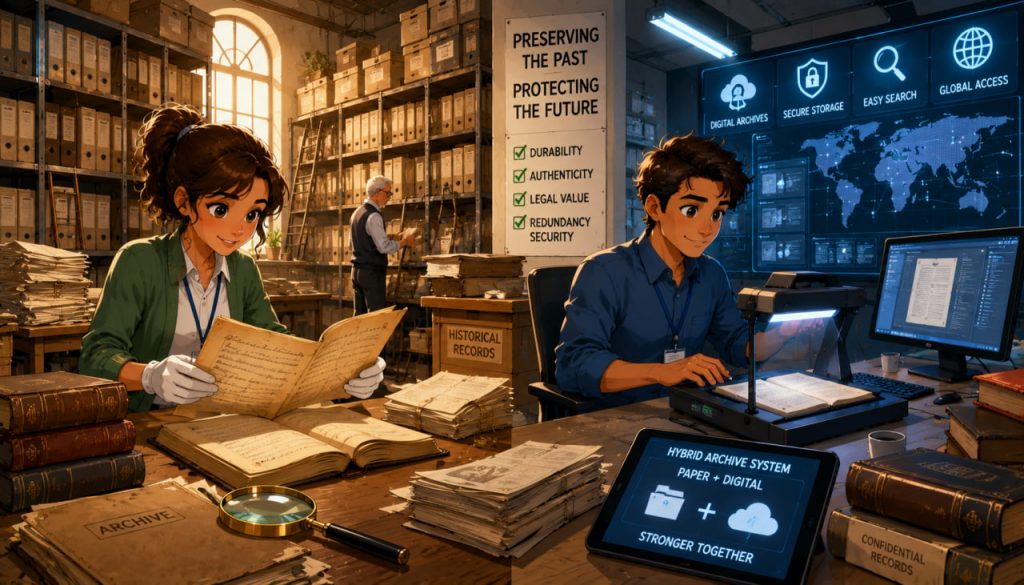
In an era of cloud computing, artificial intelligence, and digital records, it may seem surprising that governments, courts, hospitals, banks, museums, and national archives around the world continue to store enormous collections of paper documents. After all, digital files are easier to search, duplicate, and share.
Yet despite rapid technological progress, paper remains one of the most trusted and durable methods of preserving critical information. Many organizations rely on both physical and digital records because each format has unique advantages and limitations.
Rather than being outdated, paper archives continue to play an essential role in protecting history, legal rights, scientific research, and national security.
Paper Has Proven Its Longevity
One of paper’s greatest advantages is its remarkable lifespan.
Properly stored archival-quality paper can survive for hundreds of years.
Many important historical documents remain perfectly readable today, including:
- Medieval manuscripts
- Royal decrees
- Scientific journals
- Government records
- Census documents
- Original constitutions
By comparison, digital storage formats change rapidly.
Hard drives fail.
Optical discs deteriorate.
Flash memory has a limited lifespan.
Even software becomes obsolete.
A sheet of paper requires no operating system, password, electricity, or software updates to remain readable.
Digital Files Can Become Inaccessible
People often assume that digital information lasts forever.
In reality, digital preservation is surprisingly complex.
Organizations must continuously migrate information to newer storage systems because:
- Hardware becomes obsolete.
- File formats change.
- Software is discontinued.
- Storage devices degrade.
- Cybersecurity threats evolve.
A document saved decades ago may become unreadable if modern computers no longer support its original format.
Digital preservation therefore requires continuous maintenance rather than simply saving a file once.
Paper Provides an Independent Backup
Many institutions intentionally maintain both paper and digital archives.
This strategy is known as redundancy, meaning that multiple copies exist in different forms.
Paper backups help protect against:
- Cyberattacks
- Ransomware
- Server failures
- Data corruption
- Power outages
- Human error
If digital systems become unavailable, paper records may still preserve critical information.
This is particularly important for hospitals, courts, land registries, and government agencies.
Independent backup systems greatly improve long-term information security.
Legal Documents Often Require Original Copies
Many countries continue to recognize original signed paper documents as the strongest legal evidence in certain situations.
Examples include:
- Property deeds
- Historical treaties
- Birth certificates
- Marriage records
- Court judgments
- Notarized agreements
- Original wills
Although electronic signatures are increasingly accepted, some legal systems still require original physical documents for specific procedures.
Paper originals also make forensic examination easier when authenticity must be verified.
National Archives Protect Cultural Heritage
Archives preserve much more than legal paperwork.
They also safeguard the history of entire nations.
National archives store:
- Maps
- Letters
- Military records
- Immigration documents
- Newspapers
- Architectural plans
- Scientific discoveries
- Historical photographs
These collections allow future generations to study politics, science, culture, economics, and everyday life.
Many archivists consider paper records to be irreplaceable cultural treasures.
Hospitals Still Depend on Paper in Some Situations
Modern hospitals increasingly use electronic health records.
However, paper continues to play an important role.
Healthcare facilities often keep printed documents for:
- Emergency procedures
- Disaster preparedness
- Legal compliance
- Patient consent forms
- Equipment instructions
- Backup during network failures
If computer systems become unavailable, medical staff must still be able to access essential patient information.
This became especially important after several hospitals around the world experienced major ransomware attacks in recent years.
Cybersecurity Is a Growing Concern
Digital information offers tremendous convenience, but it also creates new risks.
Cyber threats include:
- Hacking
- Data theft
- Malware
- Ransomware
- Insider attacks
- Accidental deletion
Unlike digital databases, paper documents cannot be hacked remotely.
Although physical archives require protection against fire, floods, and theft, they are immune to many forms of cybercrime.
For highly sensitive records, some organizations deliberately maintain offline paper copies as part of their security strategy.
Digital Archives Also Offer Powerful Advantages
Despite the importance of paper, digital technology has transformed record management.
Electronic archives provide:
- Instant searching
- Remote access
- Automatic backups
- Easy duplication
- Faster document sharing
- Space savings
Millions of pages can now be stored on servers occupying far less physical space than traditional archives.
Artificial intelligence is also helping archivists automatically classify, index, and search enormous collections of historical documents.
The future is therefore not paper versus digital—but intelligent integration of both.
Expert Perspective
Professor Luciana Duranti, one of the world’s leading experts in archival science at the University of British Columbia and founder of the internationally recognized InterPARES Project, has emphasized that long-term preservation is not simply about storing information—it is about maintaining the authenticity, reliability, and trustworthiness of records over time.
Her research demonstrates that digital records require continuous management, documentation, and verification to remain legally and historically reliable across decades. This is one reason many institutions continue using multiple preservation methods instead of relying exclusively on digital storage.
Her work highlights an important principle of modern archiving: preservation depends as much on trustworthy management as on technology itself.
Will Paper Archives Ever Disappear?
Probably not entirely.
Many experts expect hybrid archive systems to remain the global standard for decades.
Future archives will likely combine:
- Digitized historical collections
- Secure cloud storage
- Artificial intelligence for indexing
- Physical archival originals
- Automated preservation monitoring
- Multiple backup locations
This balanced approach offers the greatest protection against technological failure, cyber threats, and natural disasters.
The safest archive is one that exists in more than one form.
Interesting Facts
- The original Magna Carta, created in 1215, is still preserved more than 800 years later.
- High-quality archival paper stored under proper conditions can remain readable for several centuries.
- The world’s largest national archives collectively preserve billions of individual documents.
- Many historical records are now scanned using artificial intelligence to improve handwriting recognition and digital search.
- Some governments store especially valuable archives in underground facilities designed to resist fire, flooding, earthquakes, and even armed conflict.
- Digital preservation specialists regularly migrate files to newer storage technologies to prevent information loss caused by obsolete hardware and software.
Glossary
- Archive – A collection of documents or records preserved because of their historical, legal, scientific, or cultural value.
- Digital Preservation – The process of maintaining digital information so it remains accessible and usable over long periods.
- Redundancy – The practice of storing multiple copies of important information in different locations or formats to improve security and reliability.
- Electronic Health Record (EHR) – A digital version of a patient’s medical history and healthcare information.
- Ransomware – Malicious software that encrypts digital files and demands payment to restore access.
- Authenticity – The quality of being genuine, original, and trustworthy.
- Archival Paper – Specially manufactured paper designed to resist aging and deterioration for long-term preservation.
- Metadata – Descriptive information about a document, such as its creator, date, format, and history, used to organize and preserve records.