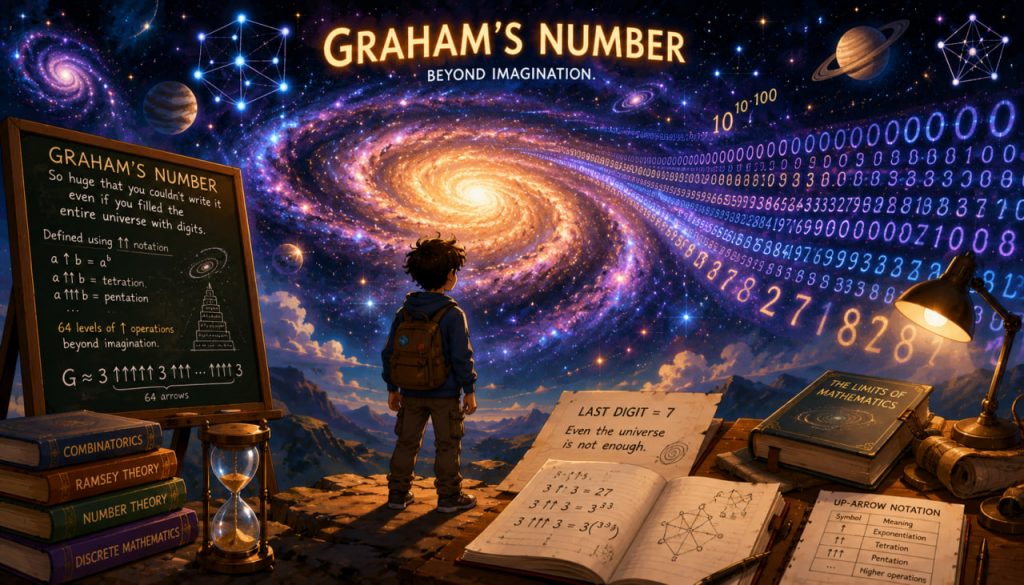
Some numbers are so large that they challenge the limits of human imagination. A million seems enormous. A billion feels almost unimaginable. Even numbers like a googol (10¹⁰⁰) and a googolplex (10^(10¹⁰⁰)) are far beyond anything we encounter in everyday life.
Then comes Graham’s Number—a number so unimaginably vast that it cannot be written in ordinary decimal notation, even if every atom in the observable universe were somehow transformed into a storage device for digits. Yet despite its incredible size, Graham’s Number is not science fiction. It arose from a genuine mathematical proof in an area known as Ramsey theory.
Perhaps the most surprising fact is that mathematicians can define Graham’s Number precisely, even though they can never fully write it down.
What Is Graham’s Number?
Graham’s Number is an extraordinarily large integer introduced by mathematician Ronald Graham in 1977.
It appeared as an upper bound in solving a complex problem in combinatorics and Ramsey theory.
Unlike numbers invented purely for curiosity, Graham’s Number emerged naturally from legitimate mathematical research.
Although later work produced much smaller upper bounds for the original problem, Graham’s Number remains famous because of its extraordinary size and because it demonstrates how quickly numbers can grow in higher mathematics.
Why Ordinary Large Numbers Are Tiny by Comparison
To understand Graham’s Number, it helps to compare it with familiar large numbers.
Consider:
- One million = 10⁶
- One billion = 10⁹
- One trillion = 10¹²
- A googol = 10¹⁰⁰
- A googolplex = 10^(10¹⁰⁰)
These numbers already exceed anything physically countable in the observable universe.
For comparison, physicists estimate there are roughly 10⁸⁰ atoms in the observable universe.
A googol is already vastly larger than this estimate.
Yet Graham’s Number is incomparably larger even than a googolplex.
The difference is not merely thousands or millions of times larger—it is beyond comparison using ordinary exponential notation.
How Is Graham’s Number Defined?
Writing Graham’s Number directly is impossible.
Instead, mathematicians define it using Knuth’s up-arrow notation, a system invented by mathematician Donald Knuth to describe extremely fast-growing operations.
Ordinary arithmetic grows like this:
- Addition
- Multiplication
- Exponentiation
Knuth’s notation extends this idea by introducing repeated exponentiation and then repeated repetitions of those operations.
For example:
- ↑ represents exponentiation.
- ↑↑ represents tetration, or repeated exponentiation.
- ↑↑↑ grows even faster.
- Additional arrows increase the growth rate dramatically.
Graham’s Number is constructed through 64 successive stages, with each stage using the previous unimaginably large result to determine the number of arrows in the next stage.
The explosive growth comes not from ordinary multiplication or powers, but from repeatedly increasing the operation itself.
Why Can’t We Write Graham’s Number?
People often ask whether Graham’s Number could simply be written with enough paper.
The answer is no.
Even if:
- Every atom became a digit,
- Every star became a computer,
- Every galaxy became a gigantic hard drive,
there would still be nowhere near enough physical space to write every digit.
The observable universe simply does not contain enough matter.
Even if storage technology improved infinitely within physical limits, Graham’s Number would remain far beyond any possible representation.
The limitation is not technological—it is fundamental to the size of the observable universe itself.
Does Graham’s Number Have a Last Digit?
Surprisingly, yes.
Although almost every digit of Graham’s Number is impossible to compute directly, mathematicians have successfully determined its final digits using advanced modular arithmetic.
The last decimal digit of Graham’s Number is 7.
Researchers have also calculated several of its final decimal digits without ever writing the entire number.
This remarkable achievement illustrates one of mathematics’ greatest strengths:
You do not always need to know an entire number to prove important facts about it.
Is Graham’s Number the Largest Number in Mathematics?
No.
This is one of the most common misconceptions.
Mathematicians routinely work with numbers far larger than Graham’s Number.
Examples include numbers defined using:
- Busy Beaver functions
- TREE(3)
- Fast-growing hierarchy functions
- Large countable ordinals
- Certain proof-theoretic constructions
Some of these numbers grow so rapidly that Graham’s Number becomes tiny by comparison.
However, Graham’s Number remains one of the largest numbers ever used in a published mathematical proof that can be explained to a broad audience.
Why Mathematicians Study Such Huge Numbers
Enormous numbers are not created simply to impress people.
They often arise naturally when studying:
- Combinatorics
- Logic
- Computer science
- Graph theory
- Ramsey theory
- Proof theory
Large numbers frequently describe the complexity of certain mathematical structures rather than physical quantities.
Understanding these numbers helps researchers explore the limits of computation, logical reasoning, and mathematical proof.
Can the Universe Ever Contain Graham’s Number of Objects?
No.
Current cosmology indicates this is physically impossible.
The observable universe contains approximately:
- 10⁸⁰ atoms
- Around 10²⁴ stars (order of magnitude estimate)
- A finite amount of matter and energy
Even if every particle represented an entire universe filled with additional particles, the total would remain unimaginably smaller than Graham’s Number.
This comparison demonstrates the enormous gap between physical reality and abstract mathematics.
Mathematics places no upper limit on how large numbers can become, while the physical universe does.
Expert Perspective
Professor Ronald Graham, after whom Graham’s Number is named, was one of the world’s leading mathematicians in combinatorics and discrete mathematics. His work demonstrated that extremely large numbers often emerge naturally when proving general mathematical statements, even if the final answer to the problem is much smaller.
Computer scientist and mathematician Donald Knuth, who introduced the up-arrow notation used to define Graham’s Number, emphasized that new mathematical notation is essential because conventional decimal notation becomes completely impractical for describing rapidly growing functions.
Their work reminds us that mathematics is not limited by human intuition—new ideas often require entirely new ways of thinking and writing.
Graham’s Number and the Limits of Human Imagination
Graham’s Number has become famous because it forces us to confront the limitations of intuition.
Human brains evolved to estimate distances, quantities, and objects encountered in everyday life—not numbers generated by advanced combinatorics.
Even our largest familiar numbers represent only a tiny corner of mathematics.
Graham’s Number teaches an important lesson:
Infinity is not the only concept beyond imagination. Even finite numbers can become so enormous that they completely exceed our ability to visualize them.
Interesting Facts
- Graham’s Number is finite, meaning it has a definite value, even though it is impossible to write out in full.
- It originally appeared as an upper bound in a Ramsey theory problem, not as a recreational mathematics puzzle.
- The last digit of Graham’s Number is 7.
- Later mathematical research found much smaller upper bounds for the original problem, but Graham’s Number remains historically important.
- Knuth’s up-arrow notation was specifically developed to describe numbers far beyond ordinary exponential notation.
- Numbers such as TREE(3) and values related to the Busy Beaver function are vastly larger than Graham’s Number.
Glossary
- Graham’s Number – An extraordinarily large finite integer introduced by Ronald Graham in a combinatorial mathematics proof.
- Ramsey Theory – A branch of mathematics studying the conditions under which order or structure must appear within sufficiently large systems.
- Combinatorics – The mathematical study of counting, arrangements, combinations, and discrete structures.
- Knuth’s Up-Arrow Notation – A notation introduced by Donald Knuth for representing extremely rapidly growing operations beyond ordinary exponentiation.
- Exponentiation – A mathematical operation in which a number is raised to a power, such as 25=322^5 = 3225=32.
- Tetration – Repeated exponentiation, often represented using double up-arrows (↑↑).
- Googol – The number 1010010^{100}10100, equal to 1 followed by 100 zeros.
- Busy Beaver Function – A function from theoretical computer science that grows faster than any computable function and produces values enormously larger than Graham’s Number for sufficiently large inputs.