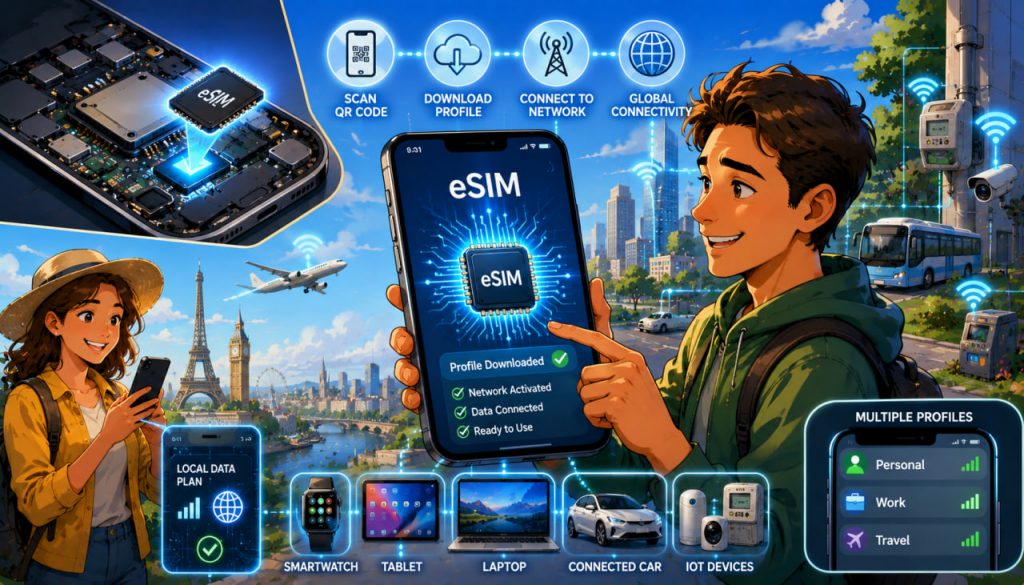
For decades, every mobile phone relied on a small plastic SIM card that identified the user on a cellular network. Whether it was a standard SIM, micro-SIM, or nano-SIM, the principle remained the same: insert a physical card, activate the service, and connect to your mobile operator.
Today, that process is rapidly changing. The embedded SIM, better known as eSIM, eliminates the need for a removable plastic card. Instead, the subscriber profile is downloaded digitally and securely onto a chip already built into the device.
eSIM technology is making mobile connectivity faster, more flexible, and easier to manage while opening new possibilities for smartphones, smartwatches, laptops, connected vehicles, and billions of Internet of Things devices.
What Is an eSIM?
An eSIM (Embedded Subscriber Identity Module) is a programmable chip permanently soldered inside a device. Unlike a traditional SIM card, it cannot be physically removed.
Instead of inserting a new card, users download a mobile operator’s profile over the internet or by scanning a QR code, entering an activation code, or using an operator’s mobile application.
The technology follows specifications developed by the GSMA, the global mobile industry association responsible for interoperability standards for mobile operators and manufacturers.
Although many people call eSIM a “software SIM card,” the description is only partly correct. The chip itself is physical hardware, while the subscriber profile is installed digitally.
How Does eSIM Work?
Inside every eSIM-enabled device is a secure embedded chip similar in purpose to a traditional SIM.
Instead of storing one permanently programmed mobile profile, the chip securely stores downloadable operator profiles.
The activation process typically works like this:
- Purchase a mobile plan
- Receive a QR code or activation information
- Download the operator profile
- Verify activation
- Connect to the mobile network
Some manufacturers also support automatic profile transfer when setting up a new phone.
Once activated, the device authenticates with the mobile network exactly like a traditional SIM card.
From the network’s perspective, an eSIM behaves almost the same as a removable SIM. The biggest difference lies in how profiles are installed and managed.
Why Manufacturers Are Adopting eSIM
Removing the SIM tray may seem like a small design change, but it provides several engineering advantages.
Without a removable tray, manufacturers gain:
- More internal space
- Better water resistance
- Improved dust protection
- Fewer moving parts
- Simplified device assembly
- Greater durability
The saved internal space can be used for:
- Larger batteries
- Improved cameras
- Additional antennas
- Cooling systems
- More compact device designs
These advantages become especially important in smartwatches, fitness trackers, wireless sensors, and ultra-thin laptops where every cubic millimetre matters.
Switching Mobile Operators Becomes Easier
One of eSIM’s biggest consumer benefits is the ability to change mobile providers without waiting for a new physical SIM card.
Many users can simply:
- Choose a new plan
- Download a new profile
- Activate the service within minutes
Some phones even support several stored operator profiles simultaneously, allowing users to switch between them whenever needed.
This flexibility is especially useful for:
- Frequent travellers
- Business users
- Remote workers
- People using separate work and personal numbers
- Temporary local mobile plans
Changing networks becomes a software operation instead of a hardware replacement.
eSIM and International Travel
International travellers often spend time searching for local SIM cards after arriving in another country.
With eSIM, many providers allow users to purchase regional or country-specific data plans before departure.
Upon arrival, the phone simply activates the downloaded profile.
Benefits include:
- No physical SIM swapping
- No risk of losing the original SIM
- Faster activation
- Multiple travel plans
- Lower roaming costs in many situations
However, pricing varies significantly between providers. Some international eSIM packages remain more expensive than buying a local physical SIM, depending on the destination.
eSIM for Smart Devices
Smartphones are only part of the eSIM ecosystem.
The technology is particularly valuable for devices that are difficult or impossible to equip with removable SIM cards.
Examples include:
- Smartwatches
- Tablets
- Laptops
- Connected vehicles
- Smart utility meters
- Industrial sensors
- Medical monitoring devices
- Agricultural equipment
- Logistics trackers
- Smart-city infrastructure
Many Internet of Things devices may remain installed for years without human access.
A remotely programmable mobile connection dramatically reduces maintenance costs for these systems.
Security Advantages of eSIM
Many users wonder whether eSIM is safer than a traditional SIM card.
In several situations, it offers practical security benefits.
Because the chip is permanently installed, a thief cannot simply remove the SIM card to disable cellular tracking.
Remote profile management also allows operators to provision or deactivate subscriptions securely.
The secure element inside the eSIM is designed with strong cryptographic protection comparable to traditional SIM technology.
However, eSIM does not eliminate every security risk.
Users still need protection against:
- Phishing attacks
- Stolen passwords
- Social engineering
- SIM swap fraud initiated through customer support
- Malware
- Weak account authentication
Good account security remains just as important as before.
Does eSIM Have Any Disadvantages?
Although adoption continues to grow, eSIM is not perfect.
Potential limitations include:
- Not every mobile operator supports eSIM.
- Some older smartphones lack compatibility.
- Device transfer procedures vary by manufacturer.
- Certain business systems still expect physical SIM cards.
- International compatibility differs between regions.
Some users also prefer removable SIM cards because they can quickly move them between devices without internet access.
In emergency situations, a physical SIM may sometimes be simpler to exchange than downloading a new digital profile.
eSIM and the Future of Smartphones
Several smartphone manufacturers are already moving toward designs that rely entirely on eSIM in selected markets.
Removing the physical SIM tray simplifies manufacturing while improving water resistance and internal space utilization.
As operator support expands worldwide, purely digital activation may eventually become the standard method for connecting mobile devices.
The transition is expected to happen gradually because billions of devices using traditional SIM cards remain in service.
eSIM in the Internet of Things
One of the largest long-term markets for eSIM is not smartphones—it is machine-to-machine communication.
Factories, transport companies, hospitals, farms, utilities, and cities increasingly rely on connected equipment.
Examples include:
- Traffic sensors
- Smart parking systems
- Environmental monitoring
- Electricity meters
- Connected medical devices
- Shipping containers
- Fleet management
- Autonomous robots
Remote profile management allows organizations to change network operators without physically visiting every installed device.
For companies operating thousands of connected devices across multiple countries, this flexibility can significantly reduce operating costs.
Expert Perspective
The GSMA identifies eSIM as a key technology for the future of connected devices because it enables secure remote SIM provisioning while supporting global interoperability between operators and manufacturers.
Industry experts also note that eSIM becomes increasingly valuable as Internet of Things deployments continue expanding. Instead of replacing millions of physical SIM cards manually, organizations can remotely provision, update, or switch network profiles throughout a device’s lifetime.
The greatest impact of eSIM may not be on smartphones but on the billions of connected devices expected to operate in smart cities, transportation, healthcare, manufacturing, and agriculture.
Will Physical SIM Cards Disappear?
Probably—but not immediately.
Physical SIM cards remain reliable, inexpensive, and universally supported. Many mobile operators continue to provide them alongside eSIM services.
Over time, however, digital activation is likely to become the preferred solution as more devices, carriers, and countries fully support embedded SIM technology.
For consumers, this means greater convenience. For manufacturers, it enables better device design. For businesses, it simplifies managing large fleets of connected equipment.
eSIM represents one of the most important changes in mobile connectivity since the introduction of the SIM card itself, replacing physical hardware exchanges with secure digital management.
Interesting Facts
- The “e” in eSIM stands for embedded.
- An eSIM chip is permanently soldered onto the device’s motherboard.
- Many smartphones can store several eSIM profiles simultaneously.
- Smartwatches were among the first consumer devices to adopt eSIM technology widely.
- eSIM makes waterproof device design easier because it eliminates the removable SIM tray.
- Many international travellers activate local mobile plans before boarding their flight.
- eSIM is becoming increasingly important for connected vehicles and Internet of Things devices.
- Billions of future IoT devices are expected to rely on remote SIM provisioning rather than physical SIM replacement.
Glossary
- eSIM — An embedded programmable SIM chip that stores downloadable mobile operator profiles.
- SIM Card — A Subscriber Identity Module used to authenticate a device on a cellular network.
- Subscriber Profile — Secure information that identifies a customer to a mobile network.
- Remote SIM Provisioning — The secure downloading and management of mobile profiles over a network.
- GSMA — The international organization that develops standards for the global mobile communications industry.
- QR Code Activation — A common method of installing an eSIM profile by scanning a code provided by a mobile operator.
- IoT (Internet of Things) — A network of connected devices that exchange information over the internet or cellular networks.
- Cellular Network — A mobile communication system that connects devices through radio base stations.
- SIM Swap Fraud — A type of identity theft in which an attacker fraudulently transfers a victim’s mobile service to another SIM or eSIM profile.
- Embedded Chip — A permanently installed electronic component integrated directly into a device’s hardware.