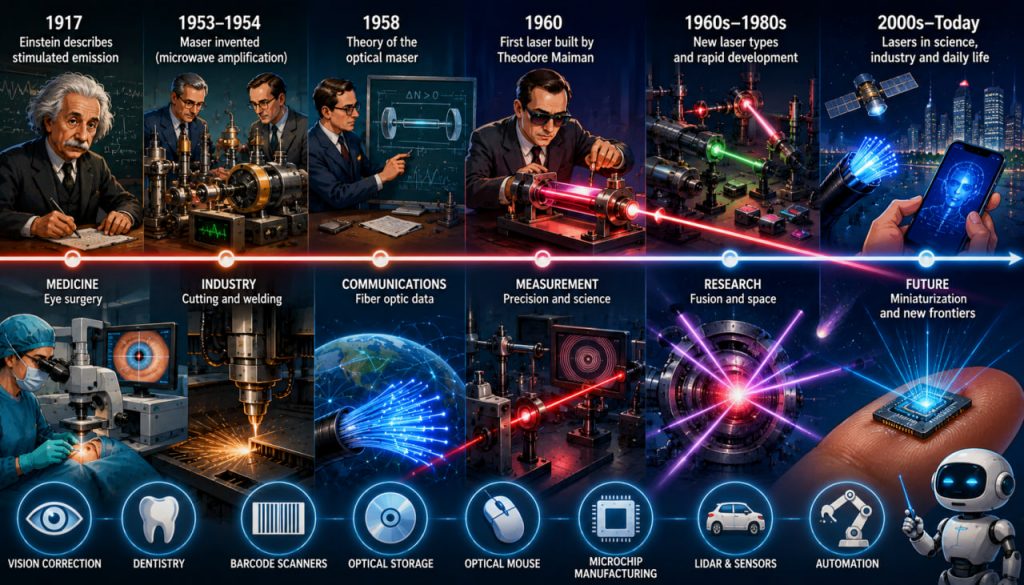
The laser is one of the most influential inventions of the modern era. It can cut steel, correct vision, transmit internet data, measure microscopic distances, scan barcodes, manufacture computer chips, analyse distant planets, and support experiments in nuclear fusion.
Yet when the first working laser appeared in 1960, many people struggled to imagine what it would be useful for. It was sometimes described as a brilliant solution waiting for a problem.
Today, the opposite is true. Lasers have become essential tools in medicine, communications, science, industry, navigation, entertainment, and everyday electronics.
What the Word “Laser” Means
The word laser originated as an acronym for Light Amplification by Stimulated Emission of Radiation.
A laser produces a highly controlled beam of electromagnetic radiation. Depending on its design, that radiation may be visible light, infrared, ultraviolet, or even shorter wavelengths.
Unlike light from an ordinary lamp, laser light is usually:
- Highly directional
- Concentrated into a narrow beam
- Dominated by a limited range of wavelengths
- Coherent, meaning its light waves maintain a coordinated relationship
These properties allow laser energy to be transmitted over long distances, focused onto extremely small areas, or measured with exceptional precision.
Einstein and the Idea of Stimulated Emission
The scientific foundation of the laser appeared decades before the device itself.
In 1917, Albert Einstein described stimulated emission, a quantum process in which an excited atom can be triggered to release a photon matching an incoming photon in energy and other important properties.
At the time, this was mainly a theoretical insight. Its practical significance became clearer in the early 1950s, when researchers explored how stimulated emission could amplify microwave radiation. This led to the maser, whose name means Microwave Amplification by Stimulated Emission of Radiation.
The maser demonstrated that quantum amplification could work in a real device. The next challenge was extending the principle from microwaves to much shorter optical wavelengths.
From Maser to Optical Maser
American physicist Charles Townes and his colleagues developed the first operating maser in the 1950s. At roughly the same time, Soviet physicists Nikolay Basov and Alexander Prokhorov independently developed essential theoretical ideas for quantum oscillators and amplifiers.
In 1958, Townes and Arthur Schawlow published a design concept for what they called an optical maser. Their work explained how mirrors and an energized material could support the amplification of visible or infrared light.
The basic principle required several elements:
- An active medium containing atoms, molecules, or electrons
- An energy source that excites that medium
- A population inversion, with more particles in excited states than lower-energy states
- Mirrors forming an optical resonator
- A partially transmitting mirror that releases part of the amplified light
This combination would allow photons to pass repeatedly through the active material, stimulating the release of additional matching photons.
Theodore Maiman Builds the First Working Laser
The race to construct the first laser involved several research groups, but Theodore Maiman succeeded first at Hughes Research Laboratories in California.
On May 16, 1960, Maiman demonstrated a laser using a synthetic ruby crystal surrounded by a powerful flashlamp. The ends of the ruby rod were reflective, creating the optical cavity needed for amplification.
The device produced pulses of deep red light.
Maiman’s ruby laser was compact compared with many competing designs and proved that optical stimulated emission could be achieved in practice.
The first laser did not emerge from one isolated discovery. It combined Einstein’s quantum theory, maser research, optical-resonator concepts, material science, and experimental engineering.
Why the First Laser Changed Science
Scientists quickly realized that laser light could be controlled far more precisely than ordinary light.
Soon after Maiman’s demonstration, researchers developed new laser types using gases, semiconductors, liquids, and different solid materials.
Important early designs included:
- Helium-neon lasers
- Carbon dioxide lasers
- Semiconductor diode lasers
- Neodymium-doped solid-state lasers
- Dye lasers
Each design offered different wavelengths, power levels, efficiencies, and operating modes.
This variety transformed the laser from one experimental machine into a broad technology platform.
Lasers in Communication and Everyday Electronics
Semiconductor lasers became fundamental to modern communications.
Tiny laser diodes transmit information through fibre-optic cables as rapid light pulses. These networks carry internet, telephone, video, and financial data across cities, countries, and oceans.
Related optical technologies appear in:
- Barcode scanners
- Optical computer mice
- Laser printers
- CD, DVD, and Blu-ray drives
- Distance sensors
- Smartphone facial-mapping systems
- Fibre-optic internet equipment
Laser light is particularly useful for communications because it can be modulated rapidly and guided through thin optical fibres with low signal loss.
How Lasers Transformed Medicine
Lasers allow doctors to deliver energy to carefully selected tissue while limiting damage to nearby areas.
The US Food and Drug Administration lists laser applications in refractive eye surgery, dentistry, tumour removal, cosmetic procedures, cataract treatment, plastic surgery, and many other surgical fields.
Different wavelengths interact differently with water, blood, pigments, and other tissues. This allows physicians to select lasers for specific purposes, including:
- Cutting or vaporising tissue
- Sealing blood vessels
- Reshaping the cornea
- Breaking kidney stones
- Removing tattoos
- Treating certain skin lesions
- Activating light-sensitive medicines
- Performing precise retinal procedures
Medical lasers are powerful instruments, not harmless beams of light. Their use requires suitable equipment, training, protective eyewear, and regulatory controls.
Manufacturing With Light
Industrial lasers can cut, drill, weld, mark, clean, and modify materials with exceptional speed and accuracy.
A focused laser beam can process steel, aluminium, ceramics, polymers, glass, and delicate electronic components. Because the beam does not require a conventional cutting edge, there may be less mechanical wear and physical contact.
Lasers are central to:
- Automotive manufacturing
- Aerospace production
- Electronics
- Additive manufacturing
- Semiconductor fabrication
- Precision measurement
- Surface hardening
- Laser peening
Laser peening uses powerful pulses to create compressive stresses in a material’s surface, helping components resist cracking and fatigue. Modern high-repetition laser systems have expanded its industrial use.
Lasers Redefined Precision Measurement
Laser stability and coherence made possible extremely accurate measurements of distance, time, frequency, and motion.
NIST research using stabilised lasers contributed to increasingly accurate frequency measurements and eventually to defining the metre through the speed of light.
Laser interferometers can detect tiny changes in distance by comparing light waves. These instruments are used in manufacturing, geophysics, gravitational-wave observatories, and scientific laboratories.
Optical frequency combs, created through ultrafast laser pulses, provide a precisely spaced series of optical frequencies. They support advanced atomic clocks, spectroscopy, and measurements of fundamental physical constants.
Ultrafast and High-Power Lasers
Modern lasers can operate at radically different scales.
Ultrafast lasers produce pulses lasting only picoseconds, femtoseconds, or even attoseconds. These pulses can capture extremely rapid electronic and molecular processes or machine materials with a very small heat-affected zone.
At the opposite extreme, enormous laser installations deliver vast amounts of energy.
The National Ignition Facility at Lawrence Livermore National Laboratory directs powerful laser beams onto a small fusion target. LLNL reports that the facility achieved fusion ignition in 2022 and has subsequently repeated ignition experiments.
Such systems help scientists study matter under conditions similar to those found inside stars and nuclear explosions.
The New Generation of Lasers
Laser technology continues to become smaller, more efficient, more tunable, and easier to integrate into electronic systems.
In 2026, NIST researchers reported a chip-based method capable of generating many wavelengths by combining specialised materials with silicon photonic circuits. This approach could help replace large laboratory laser systems with compact integrated devices.
Emerging applications include:
- Quantum computing
- Quantum communication
- Autonomous vehicle sensing
- Portable medical diagnostics
- Environmental monitoring
- Satellite communication
- Advanced microscopy
- Photonic computer chips
The modern laser is no longer a single type of machine. It is an entire family of technologies operating from microscopic chips to building-sized scientific facilities.
Expert Perspective
NIST describes the laser as a technology that has transformed measurement, enabled new industries, and expanded scientific understanding since Maiman’s first demonstration. Its researchers have contributed to laser frequency standards, optical clocks, precision manufacturing, and quantum science.
The FDA adds an equally important perspective: lasers improve precision, reliability, communication, and data handling, but their radiation hazards must be properly controlled.
The expert view is clear: the laser’s value comes from extraordinary control over light, while its safe use depends on equally careful control over exposure.
Interesting Facts
- The first working laser used synthetic ruby as its active material.
- Theodore Maiman demonstrated it on May 16, 1960.
- The laser developed from earlier maser technology.
- Some lasers emit invisible infrared or ultraviolet radiation rather than visible light.
- Laser light helped make modern fibre-optic internet possible.
- Laser measurements contributed to redefining the metre through the fixed speed of light.
- Optical frequency combs contain thousands of precisely spaced light frequencies.
- Medical lasers can cut tissue, seal blood vessels, reshape the cornea, and treat skin conditions.
- High-powered laser beams are used to study fusion and matter under extreme conditions.
- Even a laser beam that appears dim can harm the eye if its wavelength or power makes it hazardous.
Glossary
- Laser — A device that amplifies light through stimulated emission.
- Stimulated Emission — The process in which an incoming photon causes an excited particle to emit a matching photon.
- Photon — A quantum unit of electromagnetic radiation.
- Active Medium — The material in which laser light is generated and amplified.
- Population Inversion — A condition in which more particles occupy excited energy states than lower-energy states.
- Optical Resonator — A system of mirrors that repeatedly reflects light through the laser medium.
- Coherence — A stable relationship between the phases of light waves.
- Wavelength — The distance between corresponding points of successive waves, associated with light colour or spectral region.
- Laser Diode — A compact semiconductor device that generates laser light.
- Interferometer — An instrument that uses wave interference to measure extremely small distances or changes.
- Ultrafast Laser — A laser producing extremely short pulses, often measured in picoseconds or femtoseconds.
- Optical Frequency Comb — A laser-generated spectrum containing many precisely spaced frequency lines.