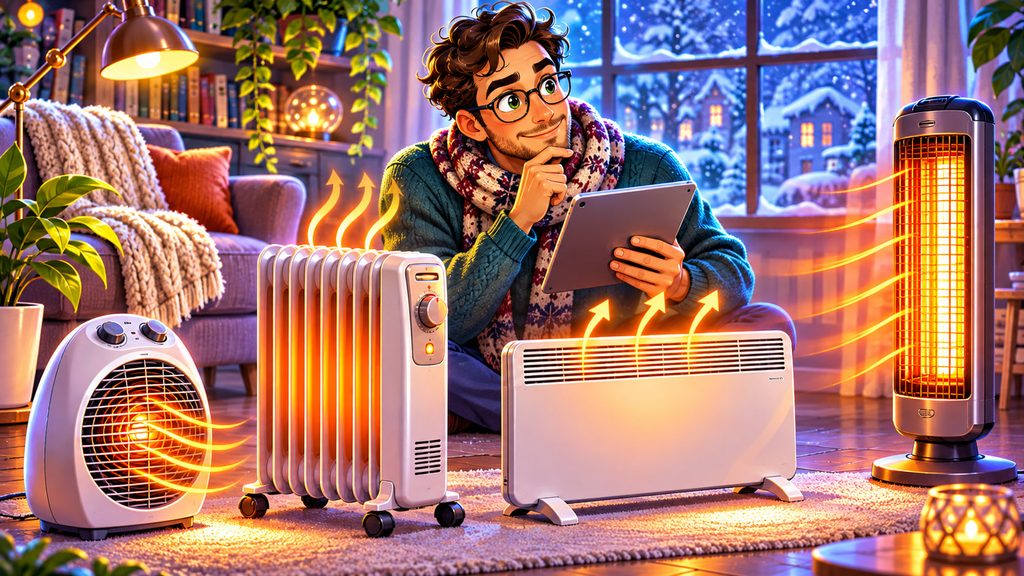
Winter arrives, the temperature drops, and suddenly your favorite room feels like a refrigerator. You start looking for an electric heater, only to discover dozens of options promising instant warmth, low electricity bills, and remarkable efficiency. Ceramic, oil-filled, infrared, and convector models all claim to offer something special.
But which heater actually works best? The answer depends on how heat moves through a room, how long you need warmth, and how much electricity you are prepared to use. Understanding the science behind different heaters can help you stay comfortable without paying for features that offer little practical benefit.
How Do Electric Heaters Actually Produce Heat?
Most portable electric heaters use resistance heating, a process in which electrical energy passes through a heating element and becomes thermal energy. Almost all the electricity consumed eventually turns into heat inside the room. That means a basic electric radiator and a sophisticated ceramic heater can deliver essentially the same amount of heat for the same electricity consumption.
The important difference is how they distribute that warmth. Some use convection, circulating heated air throughout a room, while others rely more heavily on infrared radiation, transferring energy directly to nearby people and surfaces. Many models combine both methods.
Ceramic Heaters: Fast Warmth for Small Spaces
Ceramic heaters are popular because they can produce noticeable warmth shortly after being switched on. Many use a PTC heating element, a ceramic component whose electrical resistance increases as its temperature rises. A built-in fan moves air across the heated element and distributes it into the surrounding space.
This makes ceramic fan heaters practical for temporarily warming a home office, living area, or other small room. Their compact dimensions are convenient, although the fan may generate noise during operation. Ceramic technology does not create extra heat from the same electricity; its advantage is responsive heating and convenient control.
Oil-Filled Radiators: Comfortable and Quiet Heating
An oil-filled radiator looks similar to a traditional central-heating radiator but contains electrically heated thermal oil. The oil remains sealed inside the appliance and normally requires no replacement. As it warms, the radiator transfers heat to the surrounding air and nearby objects.
The major advantage is thermal mass, the ability of a material to store heat. Oil-filled models generally take longer to warm up but continue releasing stored heat after the electrical element switches off. Their silent operation makes them attractive for reading, studying, or spending extended periods in one room.
However, stored heat is not free energy. The radiator must first consume electricity to accumulate that warmth, and its surface can become hot enough to cause burns.
Convector Heaters: Even Warmth Throughout a Room
Convector heaters mainly warm air rather than directing concentrated heat toward a person. Warm air rises naturally, and cooler air moves toward the heating element to replace it. This circulation gradually distributes heat through an enclosed space.
Many panel convectors are slim, lightweight, and relatively quiet, making them suitable for regular supplementary heating. Models equipped with an accurate thermostat can maintain a selected temperature by switching the heating element on and off. The main limitation is that warming the air throughout a large, poorly insulated room may require substantial electricity.
Infrared Heaters: Heating People Instead of Air
Infrared heaters work differently from conventional air-heating appliances. They emit electromagnetic radiation that is absorbed by people, furniture, floors, and other surfaces. The sensation resembles feeling sunlight on your skin, even when the surrounding air remains relatively cool.
This makes infrared heating useful for a specific seating area or workspace, particularly when heating an entire room would be unnecessary. However, warmth depends on positioning and exposure, so objects blocking the radiation can reduce its effectiveness. Infrared heaters can save energy through targeted heating, not because they produce more thermal energy per watt.
Which Electric Heater Uses the Least Electricity?
A heater’s electricity consumption depends primarily on its power and operating time. Power is measured in watts, while your electricity bill measures energy in kilowatt-hours. A 1,500-watt heater running continuously for one hour consumes 1.5 kilowatt-hours.
For example, at an illustrative electricity price of $0.20 per kilowatt-hour, that hour costs $0.30. Running at full power for five hours would cost $1.50. Real costs depend on local tariffs, heating settings, and how often the thermostat switches the appliance off.
A 1,000-watt heater consumes less electricity per hour than a 2,000-watt model at full power, but it also produces less heat. The lower-power model may need to run longer to reach the same temperature. Choosing a smaller heater does not automatically guarantee lower heating bills.
How Powerful Should a Heater Be for Your Room?
Room size is important, but floor area alone cannot determine the correct heating power. Ceiling height, insulation, outdoor temperature, window quality, and air leakage influence how quickly a room loses warmth. This energy escaping from the room is called heat loss.
A well-insulated bedroom may need considerably less heating power than an older room of identical size with drafty windows. Very small heaters may struggle to maintain comfort in large spaces, while powerful models can create unnecessary electrical demand if poorly controlled.
Before purchasing, check the manufacturer’s recommended room conditions and your electrical circuit’s capacity. Good insulation and sealing drafts can reduce the amount of heating required regardless of which appliance you choose.
What Safety Features Should You Look For?
Portable heaters are high-power electrical appliances, so safety deserves as much attention as performance. Look for recognized independent safety certification, overheat protection, and a tip-over switch that shuts down the heater if it falls over. A sturdy base and suitable surface-temperature protection are particularly important around children and pets.
The U.S. Consumer Product Safety Commission recommends keeping portable heaters at least three feet, approximately one meter, away from curtains, bedding, furniture, and other combustible materials. Plug heaters directly into suitable wall outlets rather than extension cords or power strips. Never leave a portable heater operating unattended or while sleeping.
Do not use ordinary electric heaters in bathrooms or other wet locations unless they are specifically approved for those conditions. Fuel-burning portable heaters involve additional ventilation and carbon monoxide hazards and should never be treated as interchangeable with ordinary electric models.
Are Heat Pumps More Efficient Than Portable Heaters?
There is one important exception to the rule that electric heating produces roughly one unit of heat per unit of electricity. A heat pump transfers existing heat from outdoors into a building rather than generating it solely through electrical resistance. Under suitable conditions, it can deliver several units of heating energy for every unit of electricity consumed.
The physicist David MacKay, author of Sustainable Energy – Without the Hot Air, explained this distinction by comparing heat pumps with refrigerators operating in reverse. His analysis illustrates why heat pumps can be substantially more energy-efficient than conventional electric resistance heaters.
For regular whole-home heating, a properly designed heat pump may therefore offer lower running costs, although installation expenses and building conditions matter.
Which Heater Should You Choose This Winter?
For fast, occasional warmth in a small room, a ceramic fan heater is a practical choice. An oil-filled radiator suits people who prefer quiet, steady heat, while a convector works well when the goal is to maintain a comfortable room temperature. Infrared heating is particularly attractive when warmth is needed in one specific location.
The most effective choice combines suitable heating power, reliable temperature control, appropriate safety features, and the way you actually use your home. Which type of heater has worked best for you during winter, and what matters most when choosing one: comfort, electricity costs, or quiet operation? Share your experience in the comments.
Interesting Facts
- Nearly all electricity consumed by a conventional resistance heater becomes heat inside the room.
- Oil-filled electric radiators contain permanently sealed oil and normally do not require refilling.
- Infrared heaters can warm people and surfaces without first heating all the surrounding air.
- A 1,500-watt heater operating at full power for four hours consumes six kilowatt-hours of electricity.
- Heating indoor air without adding moisture generally lowers its relative humidity, even though the absolute amount of water vapor remains unchanged.
- Heat pumps can deliver several times more heating energy than the electricity they consume because they transfer existing heat.
- Improving insulation reduces the amount of energy needed to maintain warmth, regardless of heater type.
Glossary
- Resistance Heating — The conversion of electrical energy into heat as electricity passes through a resistive element.
- Convection — Heat transfer through the movement of liquids or gases, including circulating indoor air.
- Infrared Radiation — Electromagnetic radiation that can transfer thermal energy directly to surfaces and people.
- PTC Heating Element — A component with a positive temperature coefficient, meaning its electrical resistance increases as temperature rises.
- Thermal Mass — The ability of a material to absorb, store, and release heat.
- Thermostat — A control device that regulates heating to maintain a selected temperature.
- Watts — Units measuring the rate at which energy is transferred or consumed.
- Kilowatt-Hours — Units of energy equal to using 1,000 watts of power for one hour.
- Heat Loss — Thermal energy escaping from a heated space into a cooler environment.
- Overheat Protection — A safety mechanism designed to interrupt operation when excessive temperatures are detected.
- Tip-Over Switch — A safety device that automatically turns off a heater when it is knocked over.
- Heat Pump — A heating system that uses electricity to transfer thermal energy from a cooler environment into a warmer space.