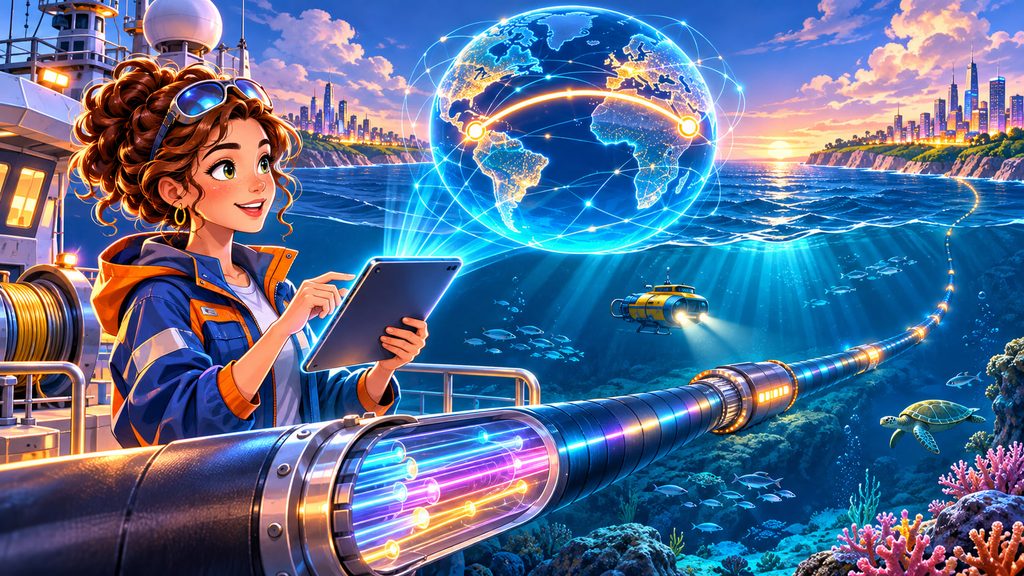
You tap a video from another continent, and it starts playing almost immediately. It seems to arrive through the air or from a satellite. Much of the journey actually takes place deep underwater.
The global internet runs largely on undersea fiber-optic cables, an enormous physical network that carries information as light. They connect continents, enabling messages, video calls, and payments. The simplest click can trigger a journey through several national networks.
The Ocean Floor Is Full of Internet Highways
Submarine communication cables stretch across the Atlantic, Pacific, Indian Ocean, and other seas, connecting coastal landing stations. According to international telecommunications estimates, they carry more than 99% of intercontinental data traffic. Satellites help remote areas, but cables offer enormous capacity.
Specialized ships lay cables along carefully surveyed routes. In deep water, a cable can be roughly as thick as a garden hose, with heavier protection near busy coastlines. Inside are glass fibers thinner than a human hair.
How Does Light Carry a Message Across an Ocean?
Every photo, email, and video is represented digitally as bits: zeros and ones. At a network transmitter, electronics turn those bits into precisely controlled optical signals produced by lasers. They travel through optical fiber, exceptionally pure glass that guides light.
The principle involves total internal reflection and the way the fiber confines light within its core. The signal remains inside the glass rather than escaping. A receiver at the other end converts the incoming light back into electronic data that computers can use.
How Can One Cable Handle So Much Information?
A fiber does not have to carry just one stream of information. Engineers use wavelength-division multiplexing to send multiple optical channels through the same strand, each using a different wavelength of light. Think of several conversations sharing one highway.
Modern systems combine multiple wavelengths with advanced signal processing and several pairs of fibers. The result is extraordinary bandwidth: some new cable systems are designed to transport hundreds of terabits of data per second across an ocean. That supports millions of simultaneous streams and file transfers.
Why Doesn’t the Light Fade Before Reaching Land?
Even extremely pure glass gradually weakens a light signal over thousands of kilometers. Long submarine systems therefore contain sealed optical repeaters placed at intervals along the route. These amplifiers strengthen light without decoding it at each stop.
The repeaters need electricity, which is supplied from cable landing stations through a conductor built into the cable. So the cable carries both information and electrical power. Components must withstand deep-water pressure for decades.
What Actually Happens When You Open a Website Abroad?
Suppose you visit a website hosted on another continent. Your phone sends a request over Wi-Fi or a cellular connection, and the traffic moves through local infrastructure into your internet provider’s network. A DNS lookup may first translate the website’s name into an internet address.
The information is divided into data packets, small units carrying destination information. Network devices called routers forward those packets toward their destination, and large networks exchange reachability information using the Border Gateway Protocol (BGP). Some cross undersea cables before the server replies.
Not every overseas-looking request crosses an ocean, however. Content delivery networks (CDNs) store copies of popular videos and webpages in regional data centers, often much closer to you. This improves speed and reduces congestion.
Why Is Sending Data Across the Atlantic So Fast?
Light travels through glass at roughly 200,000 kilometers per second, about two-thirds of its speed in a vacuum. On an idealized 6,000-kilometer fiber route, the light alone needs about 30 milliseconds to travel one way. Land routes and network equipment add delay, called latency.
This is why a message can cross an ocean almost instantly, yet a competitive online game may still feel less responsive when its server is far away. More bandwidth makes it possible to move greater amounts of information; lower latency makes interactions feel quicker. They are different challenges.
What Happens If a Submarine Cable Breaks?
These cables are robust, but they are not indestructible. Fishing equipment and ship anchors cause most accidental damage, particularly near shore; earthquakes and underwater landslides can also disrupt routes. Globally, submarine systems experience roughly 150–200 faults annually.
When one cable fails, operators may redirect traffic along other routes, a safeguard known as network redundancy. Users may notice nothing, or they may experience slower connections if alternative paths are crowded. Repair ships recover damaged sections, splice replacements, and redeploy cables.
University of California, Berkeley professor Nicole Starosielski, author of The Undersea Network, has highlighted how this largely invisible infrastructure depends on real coastlines, landing stations, and environmental conditions. Global connectivity is a physical achievement as well as a digital one. The supposedly virtual cloud ultimately has a very physical geography.
Are Satellites Going to Replace Undersea Cables?
Satellite networks can reach ships, isolated communities, and areas where building cables is difficult. Low-Earth-orbit satellites also offer much lower delays than traditional geostationary systems. Capacity constraints make satellites complements rather than replacements for fiber.
Next time a message arrives from across the world, remember the lasers, glass fibers, and seafloor infrastructure quietly making it happen. The internet may feel wireless, but its longest journeys often travel through a cable. Did you know that so much of the world’s digital communication flows beneath the ocean? Share your thoughts in the comments.
Interesting Facts
- Modern submarine cables carry more than 99% of intercontinental data traffic.
- The first transatlantic fiber-optic cable, TAT-8, entered service in 1988.
- The glass fibers transmitting information are much thinner than the protective cable surrounding them.
- Different wavelengths of light can carry separate data channels through the same fiber.
- Deep-sea cable repeaters receive electrical power from stations on land.
- Most cable faults are associated with fishing gear and ship anchors rather than marine animals.
- A website hosted abroad may still load from a nearby content delivery server.
Glossary
- Optical Fiber — A thin glass strand that carries digital information using light signals.
- Total Internal Reflection — An optical effect that helps confine light within a suitable transparent medium.
- Wavelength-Division Multiplexing — A technique that sends multiple channels of information along one fiber using different wavelengths.
- Bandwidth — The amount of information a connection can carry in a given time.
- Optical Repeater — A device installed along long fiber routes to amplify weakening optical signals.
- DNS — The Domain Name System, which helps translate website names into numerical internet addresses.
- Data Packet — A small unit of information transmitted across a computer network.
- Router — A network device that forwards packets toward their destinations.
- Border Gateway Protocol (BGP) — A protocol used by large networks to exchange internet routing information.
- Content Delivery Network (CDN) — A distributed system that serves content from geographically dispersed servers.
- Latency — The time taken for information to travel between points on a network.
- Network Redundancy — The use of alternative routes or systems to maintain connectivity when a component fails.