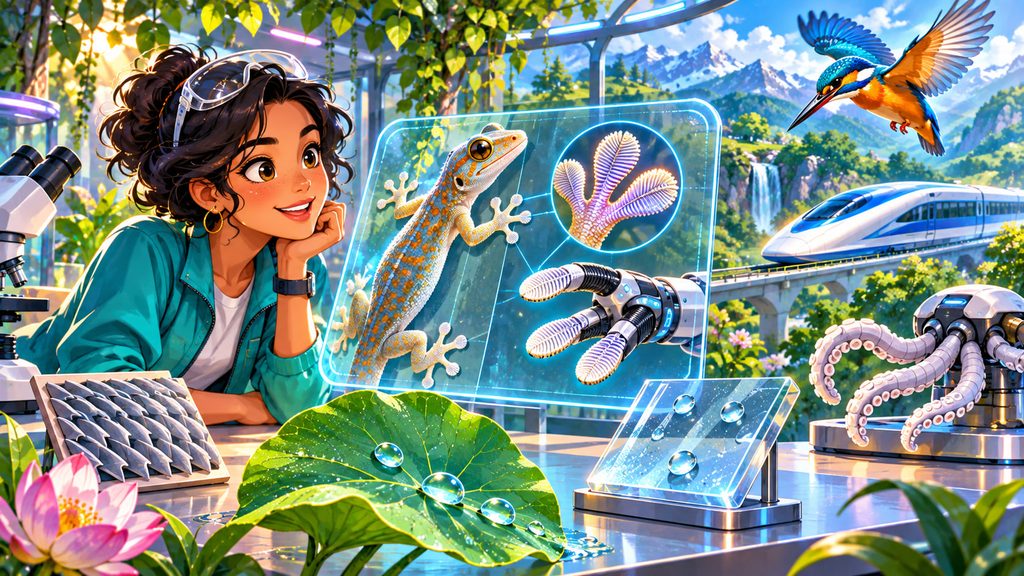
A kingfisher dives into water without a dramatic splash. A gecko runs up glass without glue. Rain rolls off a lotus leaf, taking dust with it. These everyday biological tricks are helping engineers imagine quieter trains, reusable adhesives, and cleaner surfaces.
The approach is called biomimicry: learning how living organisms solve problems and applying those strategies to human inventions. Nature is not a catalog of ready-made products, but an extraordinary collection of engineering ideas tested through evolution. Some have already reached everyday life, while others remain exciting laboratory experiments.
What Does Biomimicry Actually Mean?
Biomimicry begins with a question, not an animal: How could we attach something without permanent glue, or move through air with less resistance? Designers then investigate organisms that already perform a similar function. They identify the underlying physical or chemical principle and translate it into a material, machine, or system.
Biologist and author Janine Benyus popularized this approach in her 1997 book Biomimicry: Innovation Inspired by Nature. She also emphasizes learning from whole ecosystems, rather than merely copying their shapes. A truly successful nature-inspired design should work well without unnecessarily damaging the environment that inspired it.
How Burdock Seeds Inspired Hook-and-Loop Fasteners
Swiss engineer George de Mestral noticed plant burrs clinging stubbornly to clothing and his dog’s fur. Under a microscope, he discovered tiny hooks catching loops of fabric. That simple mechanism inspired the reusable hook-and-loop fastener familiar on shoes, bags, and equipment.
The breakthrough was not reproducing an entire plant. It was understanding a mechanical connection that could repeatedly attach and detach. This remains one of biomimicry’s most recognizable commercial successes.
Why a Kingfisher Helped Redesign a Bullet Train
Early Japanese high-speed trains could create loud pressure waves when emerging from tunnels. Engineer Eiji Nakatsu looked to the kingfisher, whose streamlined beak enters water with little splash. Its gradually widening shape suggested a better way to manage sudden changes in fluid pressure.
The resulting Shinkansen nose design helped reduce tunnel noise while improving efficiency. The lesson illustrates streamlining: shaping an object to guide air or water around it with less resistance. Here, an elegant bird adaptation inspired a practical transportation improvement.
What Makes Gecko Feet So Remarkably Sticky?
Geckos cling to smooth walls using countless microscopic hairs called setae on their toes. Their tiny contact points exploit van der Waals forces, weak molecular attractions that become powerful when multiplied across a large surface. The animal can grip and release rapidly without leaving conventional glue behind.
Researchers have used this principle to design reusable dry adhesives and gripping surfaces for robots. Such materials could help machines handle fragile objects or cling to surfaces where ordinary suction systems struggle. Matching a gecko’s adaptability under real-world conditions remains challenging.
How Lotus Leaves Keep Themselves Clean
A lotus leaf may look smooth, but microscopic and nanoscopic textures give its surface an unusual relationship with water. Droplets form rounded beads and roll away, carrying loose dirt. Scientists call this self-cleaning behavior the lotus effect.
The underlying property is extreme hydrophobicity, aided by both surface texture and wax-like chemistry. Engineers have developed lotus-inspired coatings for glass, textiles, and painted surfaces. Durability matters, however: a laboratory coating is less useful if abrasion quickly destroys its delicate structure.
Can Shark Skin Make Aircraft More Efficient?
Shark skin carries fine surface ridges that help regulate the flow of water along the body. Engineers imitate these riblets to reduce frictional drag. Unlike a smooth coating, the grooves deliberately shape tiny turbulent movements close to a surface.
The AeroSHARK film used on some commercial aircraft applies this principle to airflow. Its manufacturer reports fuel savings of roughly one percent in current installations. That sounds modest, but small efficiency gains matter when aircraft fly thousands of hours.
Why Mussels and Octopuses Interest Medical Engineers
Mussels attach securely to wet rocks using specialized adhesive proteins. Their chemistry, including molecules associated with DOPA, inspires experimental glues that can bond in moist conditions. Researchers are exploring these materials for tissue repair and other medical applications.
Octopuses offer a different lesson: flexibility. Their arms bend, reach, wrap, and grip without rigid joints. In soft robotics, engineers build flexible manipulators that may handle delicate produce or move through confined spaces more gently than traditional machines.
Is Copying Nature Automatically Sustainable?
A design inspired by an organism is not necessarily environmentally friendly. Manufacturing may still require energy-intensive processes, difficult-to-recycle plastics, or scarce materials. Its complete production, use, and disposal must be examined before claiming an environmental advantage.
This distinction matters because biomimicry can extend beyond shapes into processes and ecological relationships. An ecosystem recycles nutrients and uses local resources in complex networks. Learning those broader principles could help designers develop products that waste less and remain useful longer.
What Might the Next Generation of Biomimicry Bring?
Researchers are investigating artificial structures inspired by butterfly wings, flexible robotic limbs, plant surfaces, and underwater adhesives. Some concepts promise better medical devices, more efficient transport, or new ways to conserve materials. Their success will depend on cost, reliability, scalability, and environmental performance.
Biomimicry changes the first question an inventor asks. Instead of imagining a solution from scratch, researchers look for a similar problem already solved by a living organism. Which natural ability would you most like to see transformed into a useful invention? Share your ideas in the comments.
Interesting Facts
- Hook-and-loop fasteners were inspired by the microscopic hooks on plant burrs.
- Gecko feet adhere through molecular attractions rather than ordinary sticky glue.
- The lotus effect depends on both microscopic texture and surface chemistry.
- A kingfisher’s beak inspired a quieter, more streamlined Japanese bullet train.
- Sharkskin-inspired aircraft films can reduce fuel consumption by about one percent.
- Mussel-inspired adhesive chemistry is being investigated for bonding wet tissues.
Glossary
- Biomimicry — Designing technologies by learning from biological structures, processes, or systems.
- Hook-and-Loop Fastener — A reusable closure with tiny hooks that catch fabric loops.
- Streamlining — Shaping an object to reduce resistance as it moves through a fluid.
- Setae — Microscopic hairs that help geckos adhere to surfaces.
- Van der Waals Forces — Weak molecular attractions that collectively enable gecko adhesion.
- Lotus Effect — Self-cleaning behavior in which water beads and rolls off a textured surface.
- Hydrophobicity — The tendency of a surface to repel water.
- Riblets — Tiny grooves engineered to reduce certain kinds of fluid friction.
- DOPA — A chemical component found in mussel adhesive proteins that contributes to wet adhesion.
- Soft Robotics — Robotics based on flexible materials and deformable structures.