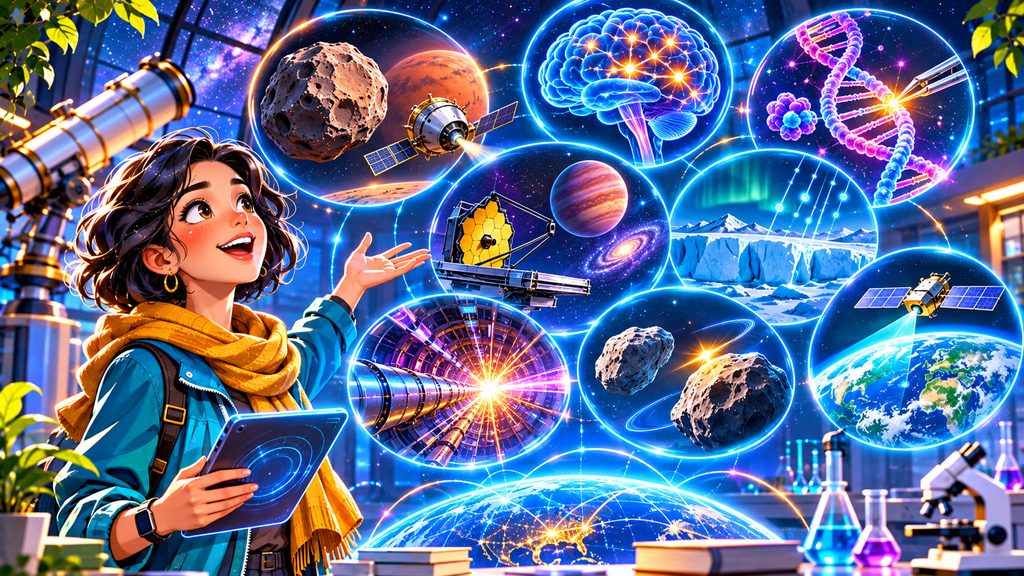
October 2026 brought Nobel-winning neuroscience, a spacecraft bound for a Martian moon, and a glimpse of the universe’s primordial matter. Gene editing also reached a milestone, while telescopes revealed distant worlds. It was a month when discoveries arrived from laboratories, observatories, and launchpads.
Some stories honored decades of research; others launched new missions. Together, they show how modern science moves from bold ideas to measurable results, often one carefully tested step at a time. Here are ten developments worth remembering.
1. Medicine Nobel Honors the Ability to Switch Neurons With Light
On October 5, the Nobel Prize in Physiology or Medicine was awarded to Karl Deisseroth, Peter Hegemann, and Georg Nagel for pioneering optogenetics. The technique uses light-sensitive proteins to activate or inhibit selected nerve cells, giving researchers remarkable control over living neural circuits. Algal proteins thus became tools for studying memory, movement, and emotion.
Its importance lies in revealing cause and effect rather than merely observing brain activity. Switching neurons on or off reveals their contributions to behavior. Possible therapies remain experimental.
2. Physics Nobel Celebrates Ghostlike Messengers From Space
On October 6, Francis Halzen was named the Nobel Prize in Physics laureate for decisive contributions to the IceCube Neutrino Observatory and the discovery of high-energy neutrinos of astrophysical origin. Neutrinos rarely interact with matter, traveling immense distances through space. Their unusual behavior makes them valuable messengers from distant cosmic events.
IceCube uses sensors buried deep within Antarctic ice to detect faint flashes produced when neutrinos occasionally interact with nearby particles. They reveal cosmic events invisible to ordinary telescopes. The prize recognized research accomplished over years, rather than a newly discovered particle in October.
3. Chemistry Nobel Explains How Molecules Choose a Hand
On October 7, Henri B. Kagan and Kenso Soai were awarded the Chemistry Nobel for advances in asymmetric synthesis. Many molecules possess chirality: two forms can resemble left and right hands, looking similar yet behaving differently in biological systems. Choosing the right form matters when developing medicines.
Their work helped explain how reactions can strongly favor one molecular orientation, including through autocatalysis, where a product helps drive its own formation. The discoveries illuminate molecular selectivity. They also help chemists think about how complex chemical systems can amplify tiny initial differences.
4. Japan Launches a Historic Mission to a Martian Moon
On October 20 in Japan, the Martian Moons eXploration spacecraft, or MMX, launched aboard an H3 rocket. Led by the Japan Aerospace Exploration Agency, this sample-return mission aims to study Phobos and Deimos and eventually bring material from Phobos back to Earth. The samples could clarify whether these moons formed from captured objects or Martian debris.
MMX is expected to reach the Mars system in 2027 and return collected samples around 2031 if the mission proceeds as planned. A small rover will explore Phobos. October’s breakthrough was the successful launch, not the collection of samples, which remains ahead.
5. Prime Editing Reaches a Human Patient
A striking biotechnology milestone was announced October 5 and drew wider attention later that month: the first patient received an experimental treatment using prime editing directly inside the body. The approach is designed to make precise DNA changes using an adapted CRISPR system and a molecular template. The initial trial targets a mutation associated with Wilson disease, a disorder of copper metabolism.
This differs from editing cells outside the body and returning them afterward. Researchers must establish its precision, safety, and lasting benefits. A first dose is an important clinical milestone, but it is not yet proof of a cure.
6. Webb Tracks a Radio Flash Across Cosmic History
On October 8, researchers announced that the James Webb Space Telescope had identified the host galaxy of the most distant known fast radio burst. These brilliant radio flashes can last mere milliseconds, yet release extraordinary amounts of energy. The new record-holder was seen from a time about three billion years after the Big Bang.
Locating the galaxy reveals the burst’s environment. The finding may help distinguish among possible sources of mysterious radio flashes, including highly magnetized neutron stars. It does not establish that every fast radio burst has the same origin.
7. NASA’s Planet Hunter Crosses 1,000 Confirmed Worlds
On October 8, NASA’s TESS team celebrated more than 1,000 confirmed planets found using its observations. TESS searches for exoplanets mainly through the transit method, detecting tiny, repeated dips in starlight when a planet passes in front of its star. By that date, the official archive listed 1,008 confirmed TESS discoveries.
Follow-up measurements turn candidates into confirmed planets. Some worlds are smaller than Earth; others are enormous, and their orbits differ widely. TESS discoveries give other instruments promising targets for investigating planetary masses and atmospheres.
8. CERN Observes a Wake in Primordial Matter
On October 29, CERN’s CMS collaboration reported direct observation of a wake produced by energetic particles moving through quark–gluon plasma. This extremely hot state of matter resembles conditions that existed during the universe’s earliest moments. Researchers recreate it briefly by smashing heavy atomic nuclei together at the Large Hadron Collider.
As a fast particle jet travels through the plasma, it transfers energy and momentum to its surroundings, much like a boat disturbing water. Identifying this response required separating other collision effects. The result offers a fresh way to measure how this extraordinary material behaves.
9. Hera Separates Two Asteroids in Its First Distant View
On October 27, the European Space Agency announced that its Hera spacecraft had distinguished the asteroids Didymos and Dimorphos as separate objects for the first time. The binary asteroid system was roughly 197 million kilometers away. Hera is traveling there to investigate the aftermath of NASA’s 2022 DART impact, which altered Dimorphos’s orbit.
This is part of planetary defense research: understanding whether a spacecraft impact could help divert an asteroid threatening Earth. October’s images were an early observational milestone, not yet the detailed close-up survey. Later measurements will reveal the impact’s consequences.
10. A New Satellite Begins Watching Earth’s Oceans
On October 8, ESA reported the first images and measurements from Copernicus Sentinel-3C, just two weeks after its launch. The satellite advances Earth observation with instruments monitoring large regions. Sentinel-3 missions measure features including sea-surface temperature, ocean color, and land properties.
Their data support climate research and environmental monitoring, complementing measurements collected at ground level. Early images mark progress toward routine scientific service, although calibration continues. For a warming planet, sustained measurements can be as valuable as spectacular one-time discoveries.
October’s headlines ranged from the deepest questions of the brain to distant planets and the health of our own world. Which development interests you most: precise gene editing, exploring Phobos, investigating the young universe, or learning how the brain works? Share your thoughts in the comments.
Interesting Facts
- IceCube looks for neutrino interactions using instruments buried in Antarctic ice.
- MMX aims to return at least 10 grams of material from the surface of Phobos.
- The TESS archive listed 1,008 confirmed discoveries on October 8, 2026.
- Fast radio bursts last milliseconds but can be detected from billions of light-years away.
- CERN’s particle-wake observation followed predictions made more than two decades earlier.
- Hera distinguished its two asteroid targets while still around 197 million kilometers away.
Glossary
- Optogenetics — Using light-sensitive proteins to control activity in selected cells, particularly neurons.
- Neutrinos — Elementary particles that interact extremely weakly with ordinary matter.
- Chirality — A property of structures whose mirror images cannot be perfectly superimposed.
- Autocatalysis — A reaction process in which a product helps accelerate its own production.
- Sample-Return Mission — A space mission designed to collect material and bring it to Earth.
- Prime Editing — A CRISPR-derived technique for making specified DNA changes.
- Fast Radio Burst — An extremely brief, powerful burst of radio emission from space.
- Exoplanets — Planets orbiting stars beyond our Sun.
- Transit Method — Detecting planets through temporary dips in a star’s brightness.
- Quark–Gluon Plasma — Hot matter in which quarks and gluons are not confined within individual hadrons.
- Particle Jet — A concentrated spray of particles produced in high-energy collisions.
- Binary Asteroid — A system of two asteroids orbiting a common center of mass.
- Planetary Defense — Efforts to detect, understand, and potentially prevent dangerous asteroid impacts.
- Earth Observation — Measuring Earth’s surface, atmosphere, and oceans using instruments such as satellites.