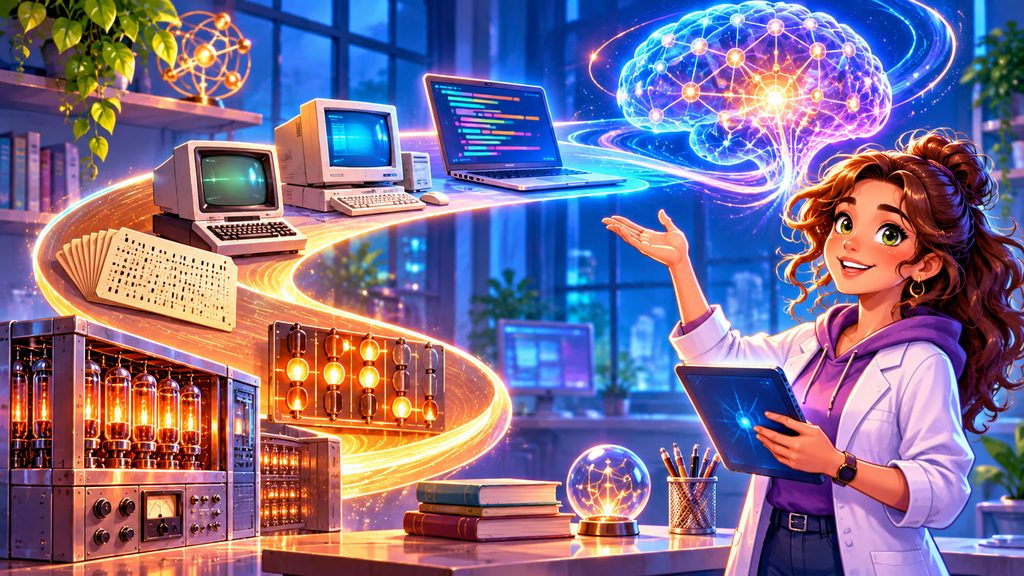
Imagine building a modern smartphone application by manually entering millions of zeros and ones. Every button, animation, and calculation would require an exhausting sequence of instructions. Fortunately, programming languages have transformed this process, allowing humans to communicate increasingly sophisticated ideas to machines.
The journey from early mechanical computers to today’s artificial intelligence systems is one of the most remarkable technological transformations in history. Programming has evolved from describing individual machine operations to designing complex systems that can recognize patterns, generate images, and even produce computer code. Yet beneath these advances, the fundamental principles of computation remain surprisingly familiar.
Why Do Computers Understand Zeros and Ones?
Digital computers fundamentally operate using binary code, a system built around two values: zero and one. Electronic circuits represent these values through distinguishable physical states, such as different voltage levels. Billions of tiny transistors work together to process and store information.
A single binary digit is called a bit, and eight bits form a byte. Combinations of bits can represent numbers, text, images, sound, and executable instructions. The computer does not understand the meaning of a photograph or a sentence in the human sense; it processes encoded information according to carefully designed rules.
The First Programming Languages Were Extremely Difficult
Early electronic computers were programmed using machine code, instructions directly associated with operations supported by their processors. Programmers had to understand the machine’s architecture, memory organization, and instruction formats. Even simple calculations could require considerable effort.
Assembly language made programming somewhat easier by replacing numerical instruction patterns with symbolic names. An assembler translated those symbols into machine instructions. Although assembly remains valuable for specialized applications, it still requires detailed knowledge of computer hardware.
The limitations of these early approaches encouraged researchers to develop languages that could describe problems without specifying every processor operation.
Ada Lovelace and the Origins of Computer Programming
The conceptual foundations of programming appeared before electronic computers existed. During the 1840s, mathematician Ada Lovelace studied Charles Babbage’s proposed Analytical Engine, a mechanical general-purpose computing machine. In 1843, she published notes containing a detailed method for calculating Bernoulli numbers.
Her work is widely recognized as an early published computer algorithm intended for implementation by a machine. Although the Analytical Engine was never completed in her lifetime, Lovelace understood that computers could potentially manipulate symbols as well as numbers. This insight anticipated applications extending far beyond arithmetic.
Grace Hopper and the Revolutionary Compiler
A major breakthrough arrived when programmers began creating software capable of translating human-readable instructions into machine operations. Such a program is called a compiler. This innovation made complex software considerably easier to develop.
American computer scientist Grace Hopper pioneered automatic programming and developed the A-0 system in 1952. Her work helped establish the foundations of modern compiler technology. Rather than forcing programmers to communicate entirely in machine-specific instructions, computers could increasingly perform the translation themselves.
The compiler transformed programming from a hardware-centered activity into a more accessible method of expressing logical ideas.
FORTRAN, COBOL, and the Rise of High-Level Languages
The 1950s introduced several influential high-level programming languages. FORTRAN, developed by an IBM team led by John Backus and released in 1957, made mathematical and scientific computing more practical. Scientists could express formulas without manually translating every operation into machine instructions.
COBOL emerged in 1959 to support business data processing, particularly accounting and record management. LISP, introduced by John McCarthy in 1958, became important in symbolic computation and early artificial intelligence research.
These languages demonstrated that programming could serve different industries and scientific disciplines. Remarkably, FORTRAN and COBOL remain in use today, proving that successful technologies can survive for generations.
How C Changed Modern Computing
In the early 1970s, Dennis Ritchie developed C at Bell Labs, where it became closely associated with the Unix operating system. C combined relatively high-level programming structures with extensive control over memory and hardware resources. This balance made it especially useful for building operating systems and performance-sensitive software.
Its influence extended to numerous later languages, including C++, Java, and JavaScript. Although these languages differ substantially, their syntax and programming conventions reflect aspects of C’s legacy.
C also helped establish the importance of portability, allowing software to be adapted to different computing platforms with less rewriting.
Object-Oriented Programming and Personal Computers
As software grew larger, organizing thousands of interconnected instructions became increasingly challenging. Object-oriented programming offered one approach by grouping data and related operations into reusable structures called objects.
Languages such as Smalltalk, C++, and later Java helped popularize this approach. Developers could construct complex applications from interacting components instead of maintaining enormous collections of unrelated procedures.
During the personal computer revolution, programming also became accessible to students, hobbyists, and independent developers. Languages such as BASIC introduced countless people to creating their own software.
How the Internet Created New Programming Languages
The rapid expansion of the World Wide Web in the 1990s changed software development again. HTML provided document structure, CSS controlled presentation, and JavaScript introduced interactive behavior within web browsers.
JavaScript, created by Brendan Eich in 1995, eventually grew far beyond simple webpage effects. Today, it powers sophisticated web applications and can run on servers through environments such as Node.js.
Other languages, including PHP, Java, and C#, became important for building online services and enterprise applications. Programming was no longer primarily about operating individual computers; it increasingly involved connecting millions of devices and users.
Why Python Became So Important
Python, created by Guido van Rossum and first publicly released in 1991, emphasized readability and relatively simple syntax. Its straightforward structure made it attractive to beginners while remaining powerful enough for professional software development.
The language expanded into automation, scientific research, data analysis, and machine learning. Libraries such as NumPy simplified numerical calculations, while frameworks including PyTorch and TensorFlow helped researchers develop neural networks.
Python’s success illustrates an important principle: a language does not need complicated syntax to support complicated ideas. Its extensive software ecosystem and integration with high-performance computing libraries have made it particularly valuable in artificial intelligence.
From Traditional Programs to Machine Learning
Traditional programs follow instructions explicitly written by developers. A conventional calculator, for example, applies predetermined mathematical rules to the numbers it receives.
Machine learning introduces another approach: algorithms identify statistical patterns from training data. Instead of manually defining every feature that distinguishes cats from dogs, developers can train a model using many labeled images.
Artificial neural networks perform this learning through interconnected computational units whose numerical parameters are adjusted during training. Modern deep learning systems use multiple layers to represent increasingly complex patterns.
These models still depend on programming languages, mathematical operations, and physical computing hardware. Their learned behavior emerges from training rather than from developers writing an individual rule for every possible input.
The Transformer Revolution and Generative AI
A major breakthrough occurred in 2017 when researchers introduced the Transformer architecture in the influential paper Attention Is All You Need. Its attention mechanisms enabled models to process relationships between different parts of input sequences efficiently.
Transformers became foundational to many modern large language models, including systems that generate text, summarize documents, translate languages, and assist with programming. Their development was supported by advances in graphics processors, specialized computing hardware, and large-scale datasets.
Unlike conventional software that executes explicitly defined responses, generative models produce outputs based on patterns learned during training. Nevertheless, the model’s calculations still ultimately run as ordinary machine instructions on digital hardware.
Can Artificial Intelligence Replace Programming Languages?
Modern AI coding assistants can suggest functions, explain unfamiliar code, identify possible errors, and generate prototypes from natural-language descriptions. This changes how developers interact with software, allowing some programming tasks to begin with everyday language rather than traditional syntax.
However, generated code still requires testing, security checks, and verification against real requirements. AI systems can produce plausible but incorrect solutions, and complex applications require architectural decisions that extend beyond generating individual functions.
Artificial intelligence is changing the process of writing software, but it has not eliminated the need for programming languages or sound engineering principles.
The progression from binary instructions to intelligent assistants reveals a consistent trend: computers become more useful as humans develop better ways to express their intentions. If future programmers can describe entire applications in ordinary language, which programming skills do you think will remain most important? Share your thoughts in the comments.
Interesting Facts
- Ada Lovelace published an algorithm for Charles Babbage’s proposed Analytical Engine in 1843, long before electronic computers existed.
- Grace Hopper’s A-0 system, completed in 1952, helped establish the foundations of compiler technology.
- FORTRAN was introduced in 1957 and remains useful for scientific and numerical computing.
- LISP, developed in 1958, became one of the foundational languages of artificial intelligence research.
- Python first appeared publicly in 1991, decades before the modern boom in generative AI.
- The Transformer architecture was introduced in 2017 and became central to modern large language models.
- Even the most advanced neural networks ultimately perform calculations using physical computing hardware and binary digital logic.
Glossary
- Binary Code — A representation of information using combinations of zeros and ones.
- Bit — The smallest conventional unit of digital information, representing one binary value.
- Machine Code — Instructions encoded in a form that a computer processor can execute.
- Assembly Language — A low-level programming language using symbolic representations of machine instructions.
- Compiler — Software that translates a program from one programming language into another representation, often executable machine code.
- High-Level Programming Language — A language that allows programmers to express operations without specifying every hardware-level instruction.
- Portability — The ability to adapt or run software across different computing platforms.
- Object-Oriented Programming — A programming approach that organizes software around objects combining data and behavior.
- Machine Learning — Computational methods that learn patterns from data to perform tasks or make predictions.
- Artificial Neural Networks — Computational models containing interconnected units with adjustable numerical parameters.
- Deep Learning — Machine learning using neural networks with multiple processing layers.
- Transformer Architecture — A neural-network design that uses attention mechanisms to process relationships within data.
- Large Language Models — Neural-network models trained on large quantities of data to process and generate language.