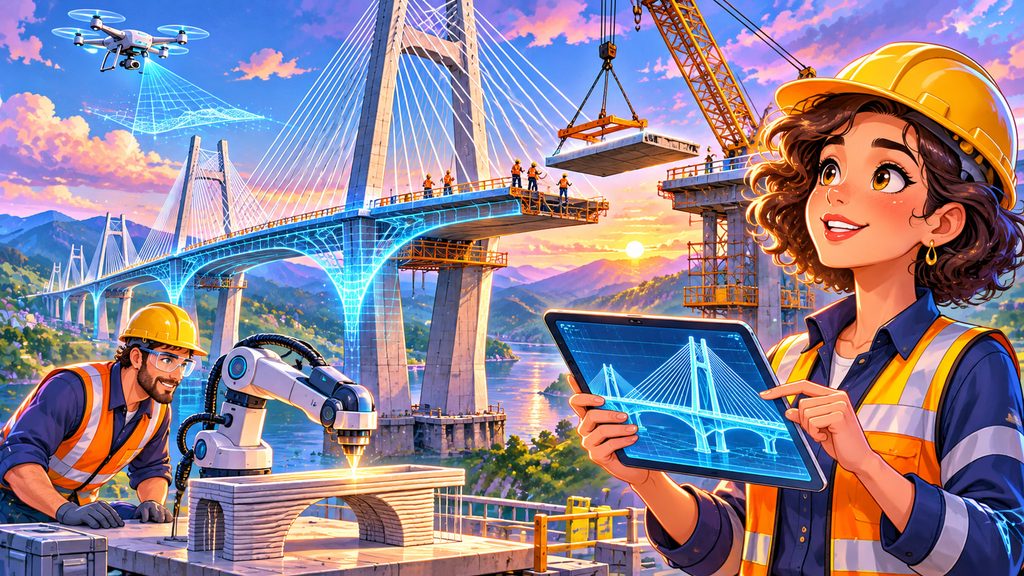
Imagine watching an enormous bridge glide into position on hundreds of computer-controlled wheels. Or picture a robotic printer creating a concrete structure layer by layer while intelligent sensors track its performance. These technologies might sound futuristic, but they are becoming part of modern civil engineering. Bridge construction is undergoing a remarkable transformation, combining advanced materials, digital intelligence, and innovative building methods.
For centuries, bridges have helped civilizations overcome rivers, valleys, and difficult terrain. Today, engineers also confront increasing traffic, extreme weather, and aging infrastructure. New technologies allow them to design structures more precisely and assemble them with less disruption. Some bridges can even provide information about their condition throughout their working lives.
How Computer Technology Is Transforming Bridge Design
Modern bridge construction begins long before foundations are built. Engineers use Building Information Modeling (BIM) to create detailed three-dimensional models containing structural components, materials, and construction information. These models help different teams coordinate their work and discover problems before construction begins. A conflict between a drainage system and a steel connection, for example, can be identified digitally instead of on-site.
Another powerful technique, finite element analysis, predicts how forces spread through a structure. Engineers simulate heavy traffic, earthquakes, strong winds, and temperature changes to evaluate a bridge’s response. Combined with drone surveys and laser scanning, these calculations support increasingly precise designs. Virtual testing helps engineers improve safety while reducing potentially expensive modifications.
Prefabricated Bridges: Faster Construction with Less Disruption
Traditional bridge construction can require months of work above busy roads or waterways. Accelerated bridge construction changes this process by manufacturing structural elements away from the final site. Concrete decks, steel beams, supporting columns, and sometimes complete spans can be prepared under controlled conditions. These components are transported to their destination and assembled, reducing disruption and improving construction efficiency.
One impressive innovation involves self-propelled modular transporters, enormous vehicles equipped with independently controlled wheels. They can move extremely heavy bridge sections and position them with exceptional accuracy. Some replacement spans can be installed during relatively short road closures, although preparation and foundation work take additional time. This approach can improve construction safety while reducing inconvenience for surrounding communities.
Ultra-Strong Concrete and Advanced Materials
Concrete remains essential in bridge construction, but modern formulations offer remarkable improvements. Ultra-high-performance concrete (UHPC) combines carefully engineered ingredients and often steel fibers to provide exceptional strength and durability. Its dense structure helps resist water penetration and deterioration, particularly in vulnerable connections. Engineers use it for bridge joints, protective overlays, and repairs to existing structures.
Modern steel grades and fiber-reinforced polymers provide additional possibilities. These composite materials can offer high strength relative to their weight and resistance to corrosion. However, engineers must balance material performance against cost, environmental impact, and long-term maintenance requirements. The best bridge materials are chosen for their specific purpose, not simply because they are technologically advanced.
3D-Printed Bridges Are Already a Reality
Additive manufacturing, commonly known as 3D printing, is introducing new possibilities in bridge construction. Instead of relying entirely on conventional molds, specialized equipment deposits construction material in successive layers. This approach can produce unusual geometries while potentially reducing material consumption. Engineers are investigating how printing methods can complement established construction techniques.
In 2017, the Netherlands opened a 3D-printed concrete bicycle bridge in the town of Gemert. Researchers from Eindhoven University of Technology helped develop six printed segments that were assembled using tensioned cables. Concrete engineering professor Theo Salet and his colleagues documented how structural testing and reinforcement helped establish safe performance. Amsterdam demonstrated another approach in 2021 with a pedestrian bridge manufactured using robotic metal printing.
How Engineers Build Record-Breaking Suspension Bridges
Constructing bridges across enormous waterways requires sophisticated structural systems. Suspension bridges support their roadways using vertical hangers attached to massive main cables carried over towers. These cables distribute enormous forces and make exceptionally long spans possible. Engineers must carefully evaluate wind effects, vibrations, and the behavior of foundations and cables.
The 1915 Çanakkale Bridge in Türkiye demonstrates these engineering achievements. Opened in March 2022, it features a 2,023-meter main span, the longest among completed suspension bridges. Another important design is the cable-stayed bridge, in which diagonal cables connect the roadway directly to towers. Modern simulations, carefully planned construction sequences, and wind-tunnel testing help engineers build such structures safely.
When Bridges and Underwater Tunnels Work Together
Sometimes a continuous bridge is less practical than combining several engineering solutions. The Hong Kong–Zhuhai–Macao crossing integrates elevated bridges, artificial islands, and an underwater tunnel. Its complete transport connection extends approximately 55 kilometers, including a 6.7-kilometer subsea tunnel in the main crossing. This configuration accommodates major shipping routes while respecting aviation-related height restrictions.
The tunnel uses immersed tube construction, in which large watertight sections are manufactured separately. Engineers transport these elements to the site and lower them into a prepared seabed trench. The sections are then joined and sealed to form a continuous passage. This technique demonstrates how bridge engineering can adapt to complicated geographical conditions.
Smart Bridges That Monitor Their Own Condition
Modern bridges can incorporate networks of sensors measuring temperature, strain, movement, and vibration. This technology, known as structural health monitoring, helps engineers evaluate how structures behave under changing conditions. Fiber-optic systems can detect extremely small changes in deformation, while drones help inspect difficult-to-reach surfaces. These measurements provide additional information alongside conventional inspections.
An especially promising development is the digital twin, a computer model updated using data from a real structure. In 2026, researchers demonstrated this approach on an operating railway bridge using sensor measurements, drone imagery, and structural models. Such systems can help identify unusual behavior and prioritize maintenance. The ultimate goal is to discover developing problems earlier and maintain bridges more efficiently.
Protecting Bridges Against Earthquakes and Extreme Weather
Modern bridges must withstand far more than ordinary traffic loads. Earthquakes, floods, severe winds, and temperature fluctuations influence their design and construction. Some structures use seismic isolation systems to reduce the transmission of earthquake motion into vulnerable components. Specialized bearings and expansion joints accommodate controlled movement under changing conditions.
Climate resilience is becoming increasingly important. Higher flood levels can increase erosion around foundations, while extreme temperatures create additional structural demands. Engineers respond through stronger protective systems, improved drainage, and careful evaluation of environmental risks. A resilient bridge must remain dependable under both everyday conditions and demanding natural events.
How Sustainable Technologies Are Changing Construction
Bridge construction consumes substantial amounts of concrete and steel, creating environmental challenges. Engineers increasingly emphasize efficient structural forms, durable materials, and components that can be repaired or replaced. Prefabrication may reduce construction waste, while optimized designs can sometimes lower material consumption. Longer service lives can also reduce the need for resource-intensive reconstruction.
Sustainability requires considering the entire life cycle assessment of a structure. This includes manufacturing, transportation, construction, maintenance, and eventual replacement. A bridge that needs fewer major repairs may provide environmental benefits throughout decades of use. Modern engineering increasingly balances structural performance with responsible resource management.
What Will the Bridges of the Future Look Like?
Future bridges will likely combine digital modeling, robotics, advanced materials, and intelligent monitoring. Automated manufacturing could produce increasingly precise structural components, while sensors may help engineers plan maintenance before damage becomes severe. New construction methods could also reduce disruption and support longer-lasting infrastructure. The most valuable innovations will be those that make bridges safer, more durable, and more efficient throughout their entire working lives.
Every bridge represents a remarkable balance of forces, materials, and human ingenuity. Modern technology is making that balance more precise while creating possibilities previous generations could barely imagine. Which innovation would you most like to see in your city: rapidly assembled bridges, 3D-printed structures, or intelligent bridges that continuously monitor their condition? Share your thoughts in the comments.
Interesting Facts
- The 1915 Çanakkale Bridge in Türkiye has a main suspension span measuring 2,023 meters.
- A 3D-printed concrete bicycle bridge opened in the Netherlands in 2017 using six printed segments.
- The Hong Kong–Zhuhai–Macao crossing incorporates a 6.7-kilometer underwater tunnel.
- Self-propelled modular transporters can move entire assembled bridge sections.
- Ultra-high-performance concrete can strengthen bridge connections and support structural repairs.
- Fiber-optic sensors can detect extremely small changes in structural deformation.
- Digital twins combine physical measurements with computer simulations to evaluate bridge behavior.
Glossary
- Building Information Modeling (BIM) — Digital modeling that organizes structural designs and construction information.
- Finite Element Analysis — A computational method used to predict how structures respond to forces.
- Accelerated Bridge Construction — Techniques that reduce on-site construction time through prefabrication and rapid assembly.
- Self-Propelled Modular Transporters — Computer-controlled vehicles designed to move exceptionally heavy structures.
- Ultra-High-Performance Concrete (UHPC) — Advanced concrete engineered for exceptional strength and durability.
- Fiber-Reinforced Polymers — Lightweight composite materials strengthened by reinforcing fibers.
- Additive Manufacturing — Manufacturing that creates objects by adding successive layers of material.
- Suspension Bridges — Bridges with decks supported by hangers connected to large main cables.
- Cable-Stayed Bridge — A bridge supported by diagonal cables connecting the roadway directly to towers.
- Immersed Tube Construction — Building underwater tunnels from prefabricated sections lowered into position.
- Structural Health Monitoring — Measuring and evaluating a structure’s condition and behavior over time.
- Digital Twin — A computer model updated with measurements from its real-world counterpart.
- Seismic Isolation — Engineering systems that reduce the transmission of earthquake forces.
- Life Cycle Assessment — Evaluation of environmental impacts throughout a structure’s entire life cycle.