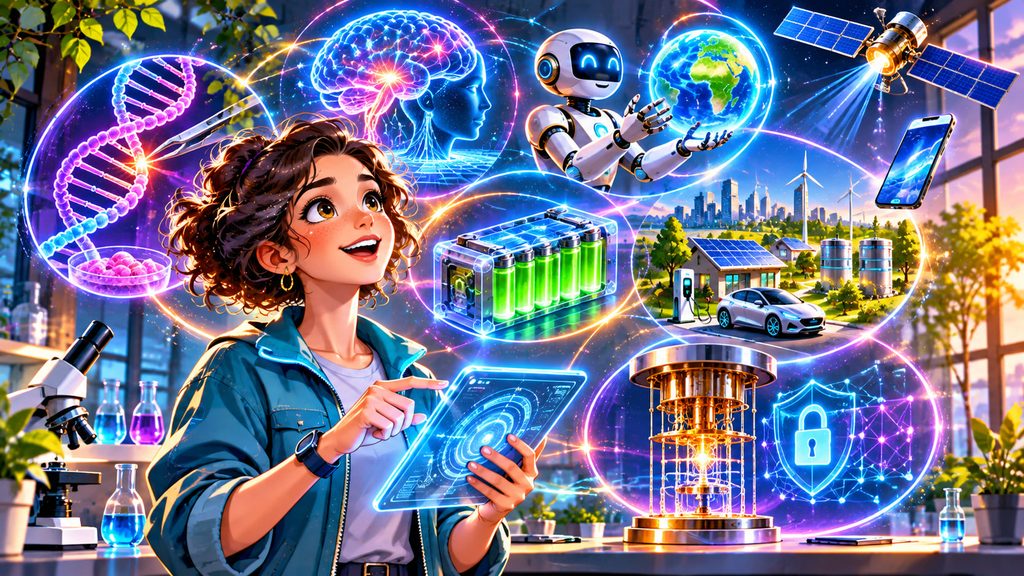
Imagine your phone organizing a trip, a robot learning a new task, or a satellite delivering a message beyond cellular coverage. These ideas are no longer science fiction. In 2027, which will become everyday tools?
The biggest technology trends of 2027 may be less about spectacular inventions and more about making powerful systems reliable, affordable, and accessible. From artificial intelligence to energy storage and biotechnology, several advances are entering a particularly important stage.
1. AI Agents That Actually Complete Tasks
A conventional chatbot answers questions; an AI agent can use software tools to carry out multi-step assignments. An agent might compare travel options, prepare an itinerary, or organize a spreadsheet while requesting approval before sensitive actions. Connections to calendars and databases make such workflows increasingly practical.
But agents can misunderstand instructions, mishandle permissions, or compound errors. Technology analyst Gene Alvarez of Gartner has emphasized the need to govern autonomous systems rather than focus only on their capabilities. In 2027, watch whether agents can complete complicated work with clear oversight and verifiable results.
2. Robots That Understand the Physical World
Robotics is gaining from advances in computer vision and world models, AI systems designed to predict how environments change following an action. A robot that anticipates what might happen when it lifts a box can plan more effectively than one following rigid instructions. Warehouses, factories, and laboratories are natural testing grounds.
The International Federation of Robotics reported that about five million industrial robots were operating worldwide in 2025. The next challenge involves greater adaptability, not simply installing more arms on assembly lines. General-purpose household robots remain far more difficult because homes contain unpredictable objects, pets, and people.
3. Voice AI That Handles Real Conversations
Voice assistants are moving beyond simple commands toward speech reasoning models that process spoken language and respond in context. Applications include accessibility, translation, and complex customer service. Systems increasingly combine speech recognition, reasoning, and natural-sounding responses.
Progress will be measured by how well they handle interruptions, accents, background noise, and sensitive information. A fluent voice is not proof of accurate advice. Privacy controls and the ability to transfer difficult cases to a human will matter as much as realism.
4. Software Created With AI Coding Assistants
AI coding systems can already write functions, explain unfamiliar programs, and suggest repairs. Coding agents can work across files, run tests, and coordinate changes. This could help small teams build useful software more quickly.
But generating code is not the same as producing secure, maintainable software. Teams still need testing, access controls, and human review of important changes. In 2027, the significant advance may be better systems for checking what AI-generated software actually does.
5. Powerful AI Running Directly on Devices
On-device AI performs selected calculations on phones, laptops, vehicles, or other equipment instead of sending every request to a distant data center. This can reduce delays, support offline features, and limit data transmission. Specialized chips are making increasingly capable local models possible.
The trade-off is constrained memory, battery life, and computing power. Smaller models may be efficient without matching the capabilities of much larger cloud systems. Watch for hybrid designs that decide intelligently which tasks belong on the device and which require the cloud.
6. Cybersecurity for a Quantum Future
Quantum computers are still developing, but protecting information against future attacks has become a practical task. Post-quantum cryptography uses mathematical techniques intended to resist attacks from powerful quantum computers. In 2024, the U.S. National Institute of Standards and Technology finalized its first major standards, followed by further transition guidance in October 2026.
Organizations cannot upgrade every system overnight. Software, hardware, certificates, and long-lived records must be examined carefully. A major 2027 story will be the gradual migration of ordinary digital infrastructure, not a sudden quantum machine breaking the internet.
7. Batteries Beyond Conventional Lithium-Ion
Sodium-ion batteries replace lithium with sodium in a different battery chemistry. Sodium is abundant, and certain designs perform well in cold conditions, making them interesting for lower-cost vehicles and stationary energy storage. However, their lower energy density can limit driving range.
Meanwhile, solid-state batteries aim to replace conventional liquid electrolytes with solid materials. They could improve safety or energy density, but manufacturing remains challenging. Toyota has targeted 2027–2028 for commercialization efforts; that is a development goal, not evidence that mass-market breakthroughs are guaranteed.
8. Smarter Electricity Grids and Energy Storage
Electric vehicles, heat pumps, and AI data centers are increasing pressure on electricity networks. The International Energy Agency estimated data centers consumed approximately 485 terawatt-hours in 2025, with demand potentially nearly doubling by 2030. Matching electricity supply with demand is becoming a major engineering challenge.
Grid flexibility uses technologies such as batteries, demand-response systems, and improved forecasting to balance power networks. Better storage can absorb surplus solar energy and release it after sunset. These less visible innovations could prove as important as new power plants.
9. Gene Editing Becomes More Precise
CRISPR gene editing allows researchers to make targeted changes to DNA. Some treatments already use edited cells to address inherited disease, while experimental approaches attempt to edit cells directly inside the body. In October 2026, researchers reported the first known use of prime editing directly in a person as part of a clinical trial.
The technique enables precise changes without traditional CRISPR’s typical double-strand cutting. Clinical success, however, requires careful evidence of safety, durability, and benefits. Expect meaningful trial results and improved delivery methods, not universal cures in a single year.
10. Satellite Connections for Ordinary Phones
Direct-to-device connectivity allows compatible mobile phones to communicate with satellites when terrestrial networks are unavailable. Early services already support certain messaging and data features through participating operators. This could be especially useful during emergencies or in remote areas.
Coverage, bandwidth, handset compatibility, and local regulations remain important constraints. Satellite links cannot yet match dense urban networks. The development to watch in 2027 is broader usable coverage and a growing range of supported services.
What Will Separate Real Breakthroughs From Hype?
The most useful test is whether a technology works safely outside a demonstration. Look for independently measured performance, transparent costs, practical availability, and clear limits. Scientific milestones matter; commercial promises are not achievements.
In 2027, the most useful technologies may be those that quietly solve real problems rather than those making the loudest predictions. Which development would you most like to experience first: a dependable AI assistant, more capable robots, better batteries, or treatments based on precision gene editing? Share your thoughts in the comments.
Interesting Facts
- Roughly five million industrial robots were operating worldwide in 2025.
- The first major U.S. post-quantum cryptographic standards were finalized in 2024.
- Some sodium-ion batteries retain strong performance at exceptionally low temperatures.
- Global data-center electricity use was approximately 485 terawatt-hours in 2025.
- Researchers reported an initial human use of in-body prime editing in October 2026.
- Satellite-to-phone services can operate without a nearby conventional cellular tower.
Glossary
- AI Agent — Software that uses an AI model and tools to pursue tasks across multiple steps.
- World Models — Computational models that predict how environments may evolve.
- Speech Reasoning Models — AI systems that process spoken input and interpret conversational context.
- Coding Agents — AI-based systems that can modify, test, and manage software development tasks.
- On-Device AI — Artificial intelligence processing performed locally on a user’s hardware.
- Post-Quantum Cryptography — Encryption and signature techniques designed to resist quantum-computing attacks.
- Sodium-Ion Batteries — Rechargeable batteries that use sodium ions to move charge.
- Solid-State Batteries — Batteries that use a solid electrolyte rather than a conventional liquid one.
- Grid Flexibility — The ability of a power system to adjust supply and demand while remaining stable.
- CRISPR Gene Editing — Techniques that use CRISPR-based molecular tools to modify DNA.
- Prime Editing — A gene-editing approach designed to make specific DNA changes using a specialized editing system.
- Direct-to-Device Connectivity — Communication between ordinary compatible devices and satellites.