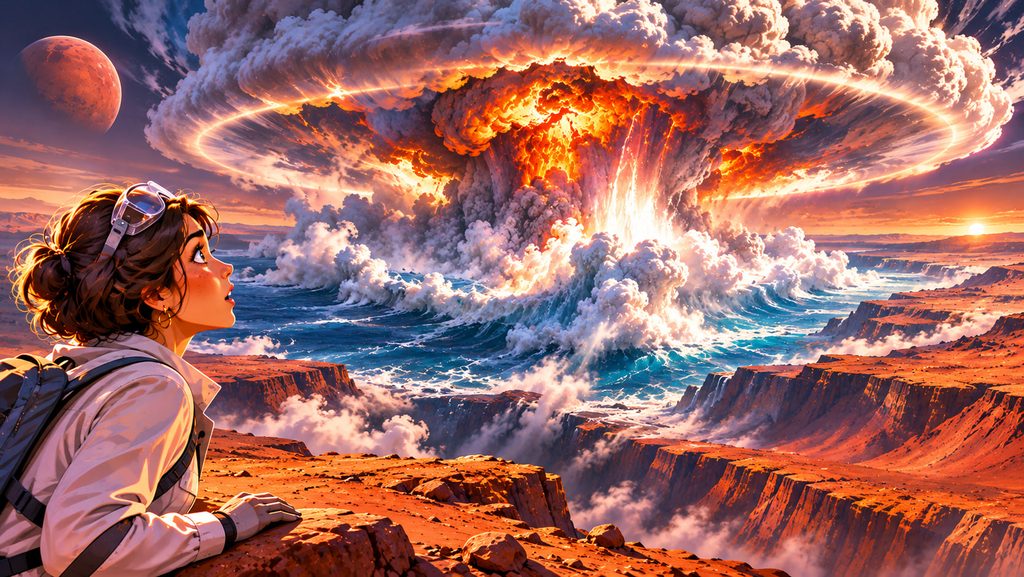
Imagine standing on Mars billions of years ago. Instead of rusty dunes, a river might cross a plain toward a lake. Rain or snowmelt may have fed the river beneath volcanic mountains. Today, most of that landscape is a desert hostile to stable surface water.
What happened to the Red Planet? Orbiters and rovers reveal environments very different from today’s. But the transformation was probably not a single spectacular catastrophe. Mars lost the conditions for widespread surface water through prolonged atmospheric and climatic changes.
What Was Mars Like Four Billion Years Ago?
Mars and Earth formed from ancient solar-system material but evolved differently. Much ancient terrain dates to the Noachian period, roughly 4.1–3.7 billion years ago. Valleys, minerals, and sediments show that rivers and lakes existed intermittently. Its atmosphere was probably thicker, permitting surface liquid water.
Yet scientists do not picture every region as a permanently warm paradise. Climate models struggle to keep Mars warm under the younger, dimmer Sun. Some envision cold periods interrupted by warmth from volcanic gases or orbital changes. The geological evidence establishes that water flowed; exactly how often and for how long remains an active question.
The Riverbeds That Survived for Billions of Years
Orbital images reveal branching valleys resembling Earth’s drainage systems. Channels cut through highlands, suggesting flowing water. Other sediments record flooding, lakes, and drying. These forms are difficult to explain entirely through wind or lava.
Perseverance explores Jezero Crater, where a river fed a lake around 3.5 billion years ago. Its delta preserves changes in water flow through layered sediments. In 2026, radar revealed older buried structures consistent with another river delta. Some regions experienced several watery chapters.
Did Mars Have a Vast Northern Ocean?
Mars’s northern lowlands contrast sharply with its southern highlands. This contrast inspired the hypothesis of a northern ocean. Possible shorelines, sediments, and Zhurong rover observations support the idea. If real, it involved water moving across enormous distances.
Yet shorelines, timing, and ocean extent remain disputed. Some features may have formed through different geological processes. Rivers and lakes are established; an enormous ocean remains a possibility. The distinction matters when imagining the planet’s appearance.
How Did Mars Lose Its Protective Atmosphere?
Today’s carbon dioxide atmosphere has less than one percent of Earth’s surface pressure. Its thinness limits warming and destabilizes exposed liquid water. Mars lost atmospheric gases across immense timescales. Ultraviolet light, impacts, chemistry, and the solar wind contributed.
NASA’s MAVEN spacecraft studied gas escaping from the upper atmosphere. Its observations linked charged particles from the Sun to atmospheric erosion, and in 2025 researchers reported direct observations of sputtering, a process in which energetic particles knock atmospheric atoms into space. MAVEN principal investigator Bruce Jakosky has emphasized how gradual gas loss transforms climate. Slow losses can ultimately produce enormous environmental change.
Why Did the Planet Lose Its Magnetic Shield?
A global magnetic field can help deflect many charged particles carried by the solar wind. Magnetized ancient crust suggests a former core dynamo: movement of conducting material deep inside. The dynamo ceased, leaving Mars without a global magnetic shield. Local magnetism remains in the crust.
The shutdown’s timing remains uncertain. Its disappearance probably increased atmospheric vulnerability, but it cannot be blamed for the entire transformation. Mars’s size, geological activity, and atmospheric chemistry also mattered. A lost magnetic field was an important part of the story, not a single switch that instantly killed a thriving world.
Where Did All the Martian Water Go?
Not all water escaped into space. Some hydrogen was lost after sunlight broke water molecules apart, while oxygen participated in chemical reactions or escaped through atmospheric processes. Some became trapped through mineral hydration or survived as polar and underground ice. These reservoirs explain why a dry surface need not mean zero water.
Scientists measure ordinary hydrogen against deuterium, its heavier isotope. Preferential escape of light hydrogen leaves clues to past water loss. Calculating the original quantity still requires assumptions. Mars’s missing water is therefore a puzzle with several destinations rather than one simple answer.
Did Mars Experience a Sudden Global Disaster?
Impacts and eruptions disrupted young Mars. Volcanoes released gases; impacts changed temperatures and moved water. Declining pressure eventually made rivers and lakes harder to sustain. Geological evidence points toward repeated environmental transitions rather than a single identifiable day when Mars became a desert.
A 2024 analysis proposed multiple climate shifts, with water returning after dry periods. This picture is more complicated than an abrupt collapse, but also more revealing. Mars may have alternated between hospitable and harsh conditions before its current aridity. Even now, Mars experiences weather, seasons, and shifting ice.
Could Ancient Mars Have Supported Life?
Water, energy, and essential chemistry made some ancient settings promising. Curiosity found ancient lake sediments and potentially microbe-friendly conditions in Gale Crater. A 2025 study identified wave ripples suggesting wind once stirred ice-free lakes. Such discoveries reveal possible habitats.
Perseverance examined Jezero rocks containing possible biosignatures. Nonliving chemistry can create similar features; Martian life remains unconfirmed. Habitability means that conditions could support life, not that life definitely appeared. Carefully testing those differences is one reason ancient lake sediments are so valuable.
Why Mars’s Past Matters for Earth’s Future
Ancient Mars shows how strongly a planet’s surface depends on its atmosphere, internal activity, and interactions with its star. Earth and Mars began with some comparable ingredients but followed dramatically different paths. That contrast informs studies of distant planets. A world that once had water is not necessarily a world that can preserve it indefinitely.
Rovers and orbiters reconstruct this history from rocks, gases, and buried layers. Mars was neither Earth’s twin nor always a desert. The most fascinating possibility is that Mars’s landscape changed while environments suitable for microbial life still existed. If you could explore one scene from ancient Mars, would you choose a flowing river, a crater lake, or the possible northern ocean? Share your thoughts in the comments.
P.S. I saw a film, created by volunteers, which claimed that not so long ago, Mars was inhabited—until certain cyclical processes triggered a global catastrophe, transforming what was once a planet similar to our own into a lifeless one. They also warned that, unless we change our attitude toward nature and each other, a similar event could occur around 2036 in the vicinity of the Mariana Trench…
Interesting Facts
- Around 3.5 billion years ago, a river transported sediments into the lake that once filled Jezero Crater.
- Some Martian valleys branch like river systems on Earth, preserving evidence of ancient water erosion.
- Mars’s present surface atmospheric pressure is typically less than one percent of Earth’s.
- Ancient rocks retain traces of an early global magnetic field even though Mars lacks one today.
- MAVEN recorded evidence of the solar wind removing atmospheric gases, including direct evidence of sputtering reported in 2025.
- Scientists have identified minerals that formed through contact with water, including clays and carbonates.
- No spacecraft has confirmed that life ever existed on Mars.
Glossary
- Noachian Period — An early chapter of Martian geological history associated with many ancient valleys and heavily cratered terrains.
- Solar Wind — A stream of charged particles flowing outward from the Sun.
- Sputtering — Atmospheric erosion in which energetic particles transfer momentum and eject atoms into space.
- Magnetic Field — A physical field that influences the motion of charged particles.
- Core Dynamo — A mechanism by which moving electrically conducting material inside a planet generates a magnetic field.
- Hydration — The incorporation of water or water-derived components into minerals.
- Deuterium — A heavier isotope of hydrogen containing one neutron in its nucleus.
- Biosignatures — Chemical, structural, or other features that may indicate past or present life but require careful confirmation.