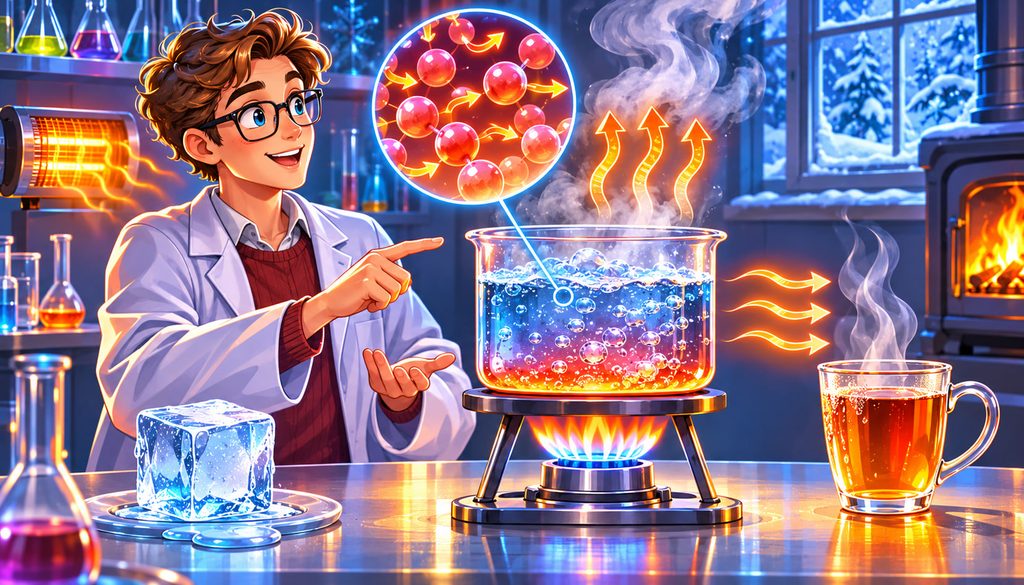
A metal spoon becomes hot in a bowl of soup, sunlight warms your face, and an ice cube slowly melts in a glass of water. These familiar events seem completely different, yet they share the same physical principle. Energy is moving from one place to another because of a temperature difference. This invisible process is called heat, and it plays a fundamental role in almost everything happening around us.
Heat explains how we cook food, regulate body temperature, generate electricity, and cool powerful computers. However, the scientific meaning of heat is surprisingly different from its everyday use. Heat is not a mysterious substance stored inside objects; it is energy transferred because of a temperature difference. Understanding this distinction opens the door to some of the most fascinating principles of modern physics.
What Is Heat in Physics?
In physics, heat is energy transferred between a system and its surroundings as a result of a temperature difference. A hot cup of coffee transfers energy to the cooler air around it, gradually losing temperature. The transferred energy is measured in joules, the same units used for mechanical work and electrical energy. Once energy has entered an object, it becomes part of that object’s internal energy rather than remaining a separate substance called heat.
This distinction helps explain why heat and temperature are not interchangeable terms. Temperature determines the direction of spontaneous heat transfer between systems, while internal energy depends on the material’s microscopic state and amount of matter. A swimming pool of warm water can possess much more internal energy than a tiny cup of boiling water. Higher temperature does not necessarily mean greater total internal energy.
What Happens to Atoms and Molecules When Something Gets Hot?
Everything around us consists of particles that are constantly moving or interacting. In gases, molecules travel freely and collide with one another, while atoms in solids vibrate around their positions. When an object receives energy through heating, the microscopic motion and interactions of its particles can change. In many circumstances, this increases its temperature, although phase changes provide important exceptions.
The famous physicist Richard Feynman emphasized how the behavior of enormous numbers of atoms helps explain familiar physical phenomena. A thermometer cannot follow every individual particle, but it measures a macroscopic property arising from their collective behavior. Temperature is closely connected to the statistical distribution of microscopic energy. This connection between the invisible atomic world and everyday experience is one of the foundations of thermodynamics.
Why Does Heat Naturally Flow from Hot to Cold?
Place a warm mug on a cold table and energy begins passing into the cooler surface. The mug gradually cools while the surrounding material warms, until they approach thermal equilibrium. At equilibrium, microscopic energy exchanges continue, but there is no net heat flow between the objects. The temperature difference that originally drove the transfer has disappeared.
This tendency is explained by the second law of thermodynamics, which describes the natural direction of energy dispersal. Heat does not spontaneously transfer from a colder object to a hotter one without some additional change or external energy input. Refrigerators appear to reverse this behavior, but they accomplish it by consuming electrical energy. The direction of natural heat flow is one of the fundamental rules governing physical processes.
Conduction: Why Metal Feels Colder Than Wood
Conduction is heat transfer through matter or between objects in direct contact, without large-scale movement of the material itself. When a metal spoon rests in hot soup, energy travels along the spoon toward the handle. Metals conduct heat efficiently because their electrons and atomic vibrations help transport energy. Wood and plastic generally conduct heat much less effectively, making them suitable for kitchen utensil handles.
An interesting consequence appears when you touch a metal chair and a wooden chair in the same room. Even if both have identical temperatures, the metal often feels considerably colder. This happens because it removes energy from your skin more rapidly, stimulating temperature-sensitive nerves. Our sense of warmth depends partly on the rate of heat transfer, not simply on an object’s actual temperature.
Convection: How Warm Air and Water Move Heat
Convection transfers thermal energy through the movement of liquids and gases. When water is heated in a pot, warmer regions often become less dense and rise, while cooler regions descend. This circulation helps distribute energy throughout the liquid and contributes to the movement of heat in oceans and the atmosphere. Similar processes help warm rooms equipped with radiators.
Convection can occur naturally through buoyancy or be forced by fans and pumps. A computer cooling fan, for example, moves heated air away from electronic components and replaces it with cooler air. Without sufficient airflow, a layer of warm air can accumulate around the components and reduce cooling effectiveness. This principle is essential in everything from household appliances to industrial cooling systems.
Thermal Radiation: How the Sun Heats Earth
Unlike conduction and convection, thermal radiation does not require matter to carry energy between locations. Objects emit electromagnetic radiation, and this energy can travel through empty space. The Sun warms Earth across approximately 150 million kilometers of space, where there is no continuous atmosphere connecting the two. Radiant energy from a fireplace can also warm your skin without direct physical contact.
Every object with a temperature above absolute zero emits thermal radiation, although most everyday objects radiate mainly in wavelengths invisible to human eyes. As an object becomes hotter, the total radiation it emits generally increases. Extremely hot objects may begin to glow red, orange, or white as their visible emissions become stronger. This relationship helps scientists estimate temperatures in applications ranging from thermal cameras to astronomy.
Why Does Water Take So Much Energy to Heat?
Different substances require different amounts of energy to experience the same temperature change. This property is called specific heat capacity. Near room temperature, heating one kilogram of liquid water by one degree Celsius requires approximately 4,180 joules. Many metals require substantially less energy for the same increase.
Water’s relatively high specific heat capacity has enormous consequences for Earth’s climate. Oceans absorb vast quantities of energy without undergoing rapid temperature changes, helping moderate temperatures in coastal regions. They can also release accumulated energy gradually as their surroundings cool. The same characteristic makes water valuable in central heating, engine cooling, and industrial temperature-control systems.
Why Can Ice Melt Without Getting Warmer?
One of the most surprising properties of heat transfer appears during changes of physical state. When ice melts at normal atmospheric pressure, its temperature remains approximately 0°C while ice and water coexist. The incoming energy changes the structure of the material rather than immediately increasing its temperature. This energy involved in a phase transition is known as latent heat.
Boiling provides an even more dramatic example. At normal atmospheric pressure, converting one kilogram of water at 100°C into steam at the same temperature requires approximately 2.26 million joules. That is why steam can cause particularly serious burns when it condenses on skin and releases substantial energy. An object can absorb or release energy through heating without changing temperature during a phase transition.
How Scientists Discovered the True Nature of Heat
For centuries, some scientists believed heat was an invisible fluid that moved between objects. During the nineteenth century, experiments challenged that explanation and established a relationship between heat and mechanical work. British physicist James Prescott Joule famously used falling weights to rotate paddles in water and measured the resulting temperature increase. His investigations demonstrated how mechanical work could produce changes in internal energy.
These discoveries helped establish the first law of thermodynamics, which expresses conservation of energy for thermodynamic systems. Internal energy can change through both heat transfer and work done on or by a system. Compressing a gas, for example, may raise its temperature even when no heat enters from the surroundings. The international unit of energy, the joule, honors Joule’s scientific contributions.
How Heat Powers Modern Technology and Keeps Us Alive
Modern heating and cooling systems make extensive use of these physical principles. A heat pump uses external work to transfer energy from a colder environment to a warmer one. Refrigerators use related technology to remove energy from their interiors, while residential heat pumps can extract energy from outdoor air even during cold weather. They do not create energy from nothing; they move it between locations.
The human body is another sophisticated system that constantly manages energy. Metabolism releases energy from food, while conduction, convection, radiation, and evaporation help maintain a suitable body temperature. Sweating cools the skin because evaporating water requires energy, some of which comes from the body. The next time you touch a cold window, stand in sunlight, or feel a breeze after exercising, which form of heat transfer will you notice first? Share your observations in the comments.
Interesting Facts
- Heat is measured in joules, just like mechanical work and electrical energy.
- Metal and wood at exactly the same temperature can feel dramatically different to the touch.
- The Sun transfers energy to Earth through radiation traveling across the vacuum of space.
- One kilogram of water requires approximately 4,180 joules to warm by 1°C near room temperature.
- Vaporizing one kilogram of water at its normal boiling point requires about 2.26 million joules.
- Ice can continuously absorb energy while remaining at approximately 0°C during melting.
- A refrigerator uses electrical energy to move heat from its colder interior into warmer surroundings.
Glossary
- Internal Energy — Energy associated with the microscopic motion and interactions of particles within a system.
- Temperature — A physical property determining the direction of spontaneous heat transfer between systems.
- Thermodynamics — The branch of physics studying energy, heat, work, temperature, and their relationships.
- Thermal Equilibrium — A condition in which systems in thermal contact exchange no net heat.
- Second Law of Thermodynamics — A fundamental principle describing the natural direction of energy transfer and the limits of thermal processes.
- Conduction — Heat transfer through contact or within matter without bulk movement of the material.
- Convection — Energy transfer involving the movement of liquids or gases.
- Thermal Radiation — Energy emitted and transferred through electromagnetic waves.
- Specific Heat Capacity — The energy required to raise the temperature of one kilogram of a substance by one kelvin.
- Latent Heat — Energy absorbed or released during a phase transition without a temperature change.
- First Law of Thermodynamics — The principle of conservation of energy applied to heat, work, and internal energy.
- Heat Pump — A device that uses work to transfer thermal energy from a cooler region to a warmer one.