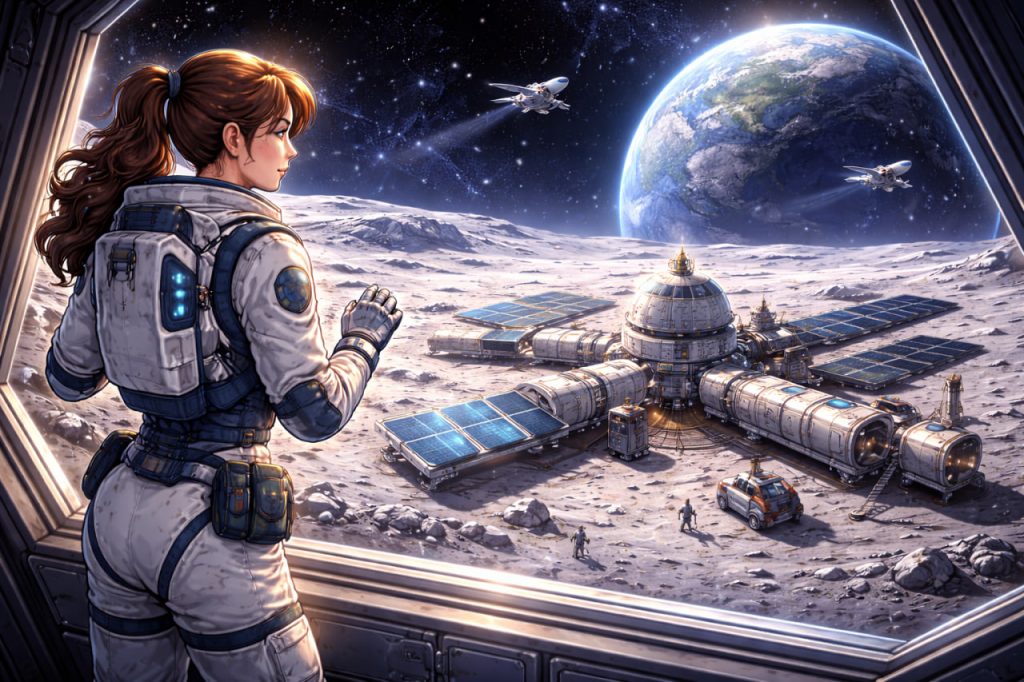
A space station orbiting the Moon represents one of the most important steps in expanding human presence beyond low Earth orbit. Unlike Earth-orbiting stations, a lunar station would serve as a gateway for deep-space missions, scientific research, and long-term exploration. Positioned in lunar orbit, it could support missions to the Moon’s surface and act as a staging point for journeys to Mars. Building such a station is technically complex but considered achievable with modern space engineering. As global interest in lunar exploration grows, a lunar space station is increasingly viewed as a strategic infrastructure project rather than a distant concept. Understanding its purpose and construction challenges reveals how humanity may extend its reach deeper into space.
Why a Lunar Space Station Is Necessary
A lunar station would function as a logistics hub, enabling spacecraft to refuel, dock, and transfer crew. Missions to the Moon’s surface would become more efficient, as supplies and astronauts could travel in stages rather than directly from Earth. It would also provide a platform for testing life-support systems, radiation shielding, and deep-space technologies. Aerospace strategist Dr. Elena Ruiz explains:
“A lunar station bridges the gap between Earth orbit and deep space.
It allows gradual expansion rather than risky long-distance leaps.”
By operating farther from Earth’s magnetic protection, the station would also help researchers study space radiation and long-duration human adaptation.
Scientific and Exploration Benefits
The Moon offers unique scientific opportunities, including geological studies of ancient lunar rocks and observations of deep space free from Earth’s atmospheric interference. A station in lunar orbit could coordinate robotic missions and sample-return operations. It would also support construction of future lunar bases by storing equipment and facilitating communication. From a research perspective, a lunar station would serve as a testbed for technologies needed for Mars exploration.
How It Could Be Built
Construction would likely occur in phases. Initial modules would be launched separately and assembled in lunar orbit using automated docking systems. Modular design allows gradual expansion, reducing the need for a single large launch. Key components would include habitation modules, power systems, communication arrays, and docking ports. Solar panels would provide primary energy, supplemented by battery storage. Some mission planners propose using materials transported from Earth, while future phases might incorporate lunar-derived resources to reduce launch costs.
Orbital Position and Stability
Choosing the correct orbit is essential. One proposed location is a near-rectilinear halo orbit (NRHO), which provides stable positioning with minimal fuel requirements for correction. This orbit allows regular access to both the lunar surface and Earth. It also ensures consistent communication coverage. Engineers must carefully calculate gravitational influences from both Earth and the Moon to maintain long-term stability.
Engineering and Safety Challenges
Operating beyond low Earth orbit introduces new risks. Increased radiation exposure, micrometeoroid impacts, and communication delays must be addressed. Shielding systems, autonomous repair technologies, and reliable life-support infrastructure are critical. Resupply missions would take longer and require precise planning. Every system must be highly reliable due to limited immediate support from Earth.
Future Outlook
A lunar space station represents a stepping stone toward sustainable space exploration. It enables gradual expansion, reduces mission risk, and strengthens international cooperation. As technology advances and costs decrease, such infrastructure may become central to humanity’s long-term presence beyond Earth. Rather than a standalone project, a lunar station would form part of a broader architecture for deep-space exploration.
Interesting Facts
- A lunar station would operate far beyond Earth’s protective magnetosphere.
- Modular construction allows gradual expansion over time.
- Near-rectilinear halo orbit provides long-term orbital stability.
- The Moon’s surface may provide future construction resources.
- A lunar station could serve as a staging point for Mars missions.
Glossary
- Lunar Orbit — the path a spacecraft follows around the Moon.
- Logistics Hub — a central point for supply transfer and coordination.
- NRHO (Near-Rectilinear Halo Orbit) — a stable orbital path around the Moon.
- Modular Design — construction using separate units assembled together.
- Deep-Space Exploration — missions beyond low Earth orbit.