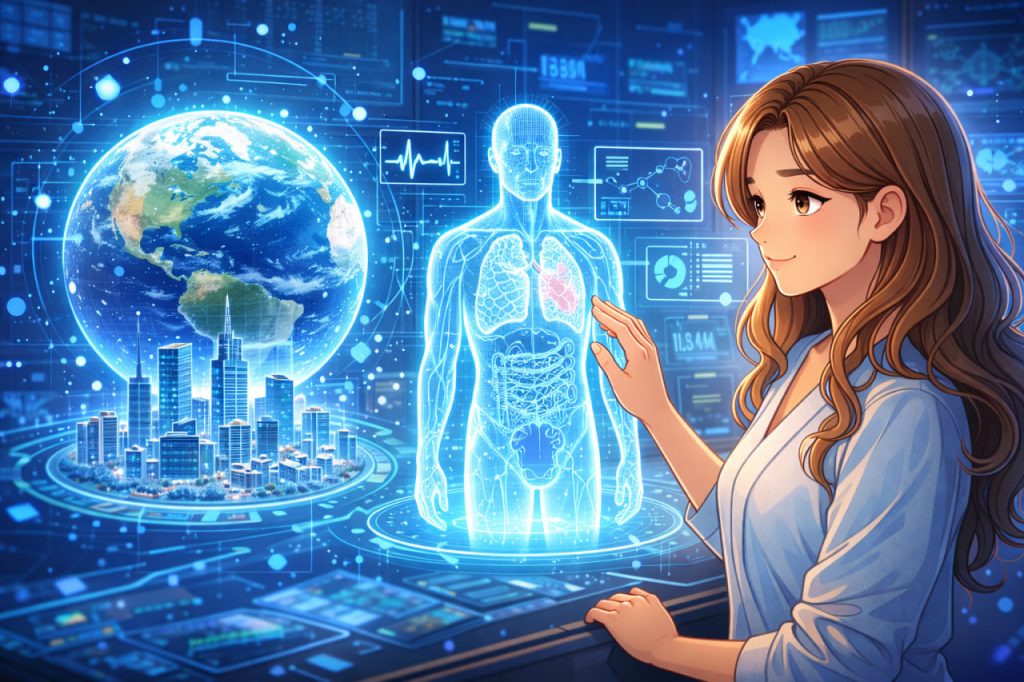
The concept of a digital twin refers to a highly detailed virtual model that mirrors a real-world object, system, or living organism. Originally developed for industrial engineering, digital twin technology is now expanding into urban planning, healthcare, environmental science, and even planetary research. By combining real-time data, sensors, simulations, and advanced analytics, digital twins allow researchers and professionals to test scenarios without physically altering the original system. This capability improves decision-making, reduces risk, and increases efficiency across many sectors. Whether modeling an entire smart city, a patient’s cardiovascular system, or global climate patterns, digital twins represent a powerful bridge between physical reality and computational insight. As technology evolves, these virtual replicas are becoming increasingly precise and dynamic.
What Is a Digital Twin?
A digital twin is more than a static 3D model. It is a continuously updated virtual system that reflects real-time conditions through data integration. Sensors collect information from physical environments, feeding it into computational models that simulate performance, stress, or potential outcomes. According to systems engineer Dr. Martin Keller:
“A digital twin is a living simulation.
It evolves with its physical counterpart,
allowing us to predict and optimize before acting.”
This predictive capacity distinguishes digital twins from traditional modeling tools. They do not simply represent reality—they interact with it through continuous feedback loops.
Digital Twins of Cities
Smart cities increasingly use digital twin technology to simulate traffic flow, energy consumption, infrastructure wear, and emergency response scenarios. Urban planners can test how new transportation systems might affect congestion or how climate events could impact flood zones. These models integrate geographic data, building information, and population movement patterns. By simulating extreme weather or energy demand spikes, city administrators can improve resilience planning. Digital twins of cities also support sustainability goals by optimizing energy grids and reducing waste. This approach reduces trial-and-error experimentation in real urban environments.
Medical Digital Twins
In healthcare, digital twins are being developed to model individual patients. By integrating imaging data, genetic information, and physiological measurements, doctors can simulate treatment responses before applying them. For example, a digital twin of a heart may help predict how it would respond to surgery or medication adjustments. Biomedical researcher Dr. Elena Rossi explains:
“Personalized digital models allow us to explore treatment pathways
in a virtual space,
reducing uncertainty and improving patient safety.”
While still evolving, this technology has potential applications in precision medicine, chronic disease management, and surgical planning.
Planetary and Climate Digital Twins
Digital twin technology is also used to simulate entire ecosystems and even planetary systems. Climate scientists develop high-resolution Earth models that integrate atmospheric, oceanic, and land-surface data. These simulations help predict extreme weather patterns, sea-level changes, and long-term climate shifts. By adjusting variables in virtual space, researchers can test the outcomes of different environmental policies or emission scenarios. Planetary digital twins may also support space exploration missions by modeling surface conditions on Mars or other celestial bodies.
Challenges and Ethical Considerations
Despite their promise, digital twins require enormous computational power, accurate data collection, and strong cybersecurity protections. Data privacy is particularly important in medical applications, where sensitive personal information must be safeguarded. Additionally, overreliance on simulations without proper validation can lead to inaccurate conclusions. Transparency in model design and data sources is essential to ensure responsible use. As digital twin technology expands, ethical frameworks and regulatory standards will play a crucial role in guiding development.
Interesting Facts
- Digital twins were first widely adopted in aerospace engineering to simulate spacecraft performance.
- Some cities use digital twins to monitor real-time traffic and pollution levels.
- Medical digital twins may support personalized treatment planning in the future.
- Climate digital twins integrate data from satellites, ocean buoys, and weather stations.
- High-resolution digital twins require significant computational and cloud resources.
Glossary
- Digital Twin — a dynamic virtual replica of a physical system updated through real-time data.
- Simulation Model — a computational representation used to test scenarios and predict outcomes.
- Smart City — an urban area that uses digital technology to improve infrastructure and services.
- Precision Medicine — a healthcare approach tailored to an individual’s biological characteristics.
- Feedback Loop — a system where outputs are continuously used as inputs to refine performance.