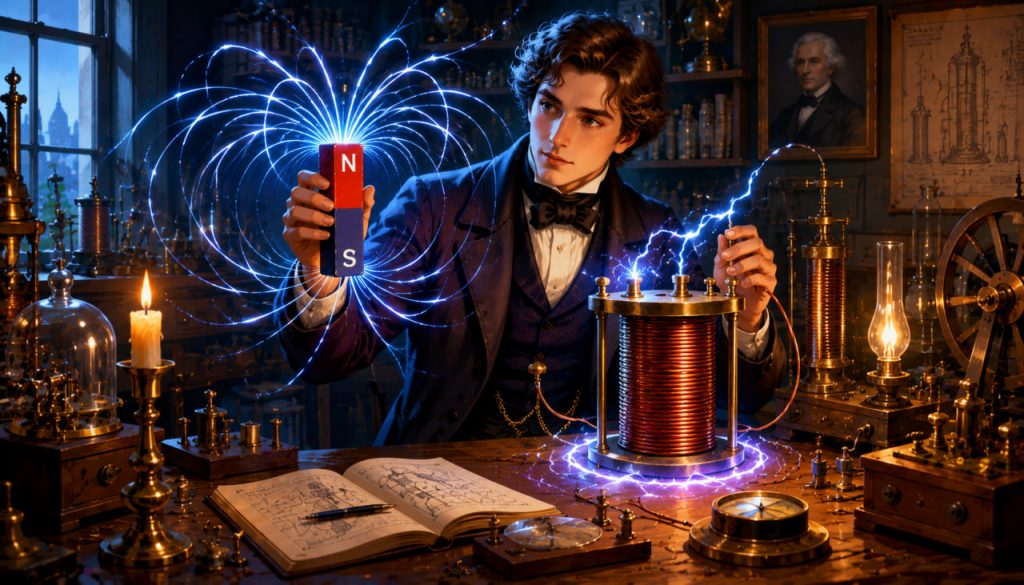
Few scientists have influenced modern civilization as profoundly as Michael Faraday. Although he received little formal education and began life in poverty, Faraday became one of the greatest experimental scientists in history. His discoveries laid the foundations of modern electricity, electromagnetism, and electrical engineering.
Today, almost every electrical device—from power stations and electric motors to smartphones and computers—relies on principles that Faraday helped uncover. His work transformed humanity’s understanding of nature and helped make the technological world we know possible.
Faraday’s life is also an inspiring story of curiosity, perseverance, and scientific creativity.
Humble Beginnings
Michael Faraday was born on September 22, 1791, in Newington Butts, near London, England.
His family was poor, and opportunities for education were limited.
As a young boy, Faraday received only a basic schooling.
At the age of fourteen, he became an apprentice to a bookbinder.
At first glance, this job seemed unrelated to science.
However, it changed his life.
While binding books, Faraday spent countless hours reading them.
Many of these books discussed:
- Physics
- Chemistry
- Electricity
- Natural philosophy
His passion for learning grew rapidly.
The Lecture That Changed Everything
Faraday became fascinated by science and saved money to attend lectures by the famous chemist Humphry Davy at the Royal Institution.
Faraday carefully took notes during the lectures and later sent them to Davy.
Impressed by the young man’s dedication, Davy offered him a position as an assistant.
This opportunity opened the door to a scientific career.
Faraday had no university degree, yet he gained access to one of the leading scientific institutions of the era.
Early Work in Chemistry
Faraday initially focused on chemistry.
Among his achievements were investigations of:
- Gases
- Chemical compounds
- Electrochemistry
He helped discover benzene, an important organic compound still widely used in chemistry today.
His experiments also improved understanding of how electricity and chemical reactions are connected.
These studies eventually led to some of his most important breakthroughs.
The Birth of Electromagnetic Induction
Faraday’s most famous discovery came in 1831.
Scientists already knew that electricity could create magnetism.
Faraday asked an important question:
Could magnetism create electricity?
Through a series of ingenious experiments, he demonstrated that changing magnetic fields can generate electric currents.
This phenomenon became known as electromagnetic induction.
The discovery was revolutionary.
It forms the basis of nearly all modern electrical power generation.
The Principle Behind Modern Power Plants
Every major electrical generator works using Faraday’s principle.
Whether electricity comes from:
- Hydroelectric dams
- Wind turbines
- Nuclear power stations
- Coal plants
- Gas turbines
the basic mechanism remains remarkably similar.
Moving magnets relative to conductors generates electricity.
Faraday’s discovery continues to power the modern world nearly two centuries later.
The Invention of the First Electric Motor Concepts
Faraday also made major contributions to electric motors.
In 1821, he demonstrated a simple device that converted electrical energy into continuous motion.
This experiment represented one of the earliest electric motors.
Although primitive by modern standards, it established principles later used in:
- Industrial motors
- Electric vehicles
- Household appliances
- Robotics
Modern electric transportation owes much to Faraday’s pioneering work.
A Master of Experimental Science
Faraday possessed an extraordinary talent for designing experiments.
Unlike many scientists of his era, he relied heavily on direct observation rather than advanced mathematics.
His experiments were known for being:
- Elegant
- Precise
- Creative
- Easy to understand
Many of his demonstrations are still used in science education today.
The Concept of Fields
One of Faraday’s most important intellectual contributions involved the idea of fields.
Before Faraday, many scientists viewed forces as acting directly across empty space.
Faraday proposed that electric and magnetic effects exist throughout space in the form of invisible fields.
This idea initially seemed unusual.
Later, physicist James Clerk Maxwell transformed Faraday’s concepts into mathematical equations that became the foundation of classical electromagnetism.
Today, field theory is central to modern physics.
Faraday’s Famous Candle Lectures
Faraday was not only a brilliant researcher but also an exceptional science communicator.
His lecture series known as The Chemical History of a Candle became legendary.
Using a simple candle, he explained:
- Combustion
- Chemistry
- Physics
- Heat transfer
These lectures demonstrated his belief that complex scientific ideas could be made understandable to everyone.
They remain celebrated examples of science education.
Personal Character and Legacy
Faraday was widely respected for his integrity and humility.
Despite his fame, he declined several honors and political positions.
He preferred focusing on scientific research and public education.
His influence extended far beyond his own discoveries.
Many scientists regard him as one of the greatest experimental physicists in history.
Expert Perspective
Physicist Albert Einstein kept portraits of only three scientists in his office:
- Isaac Newton
- James Clerk Maxwell
- Michael Faraday
Einstein deeply admired Faraday’s contributions and considered his work fundamental to the development of modern physics.
This admiration from one of history’s greatest scientists highlights Faraday’s extraordinary impact.
Why Michael Faraday Still Matters
Modern civilization depends heavily on electricity.
Power grids, communication systems, transportation, medical equipment, and countless technologies operate using principles Faraday discovered.
His work demonstrates that groundbreaking science does not always require advanced education or privileged circumstances.
Curiosity, persistence, and creativity can change the world.
More than 150 years after his death, Michael Faraday remains one of the most influential scientists who ever lived.
Interesting Facts
- Faraday received very little formal education.
- He began his career as a bookbinder’s apprentice.
- He discovered electromagnetic induction in 1831.
- The unit of electrical capacitance, the farad, is named in his honor.
- Faraday helped discover benzene.
- His work laid the foundation for modern electric generators and motors.
Glossary
- Electromagnetic Induction — The generation of electricity by changing magnetic fields.
- Electric Current — The flow of electric charge through a conductor.
- Generator — A machine that converts mechanical energy into electrical energy.
- Electric Motor — A device that converts electrical energy into motion.
- Magnetic Field — A region around a magnet where magnetic forces can be detected.
- Capacitance — The ability of a system to store electrical charge.