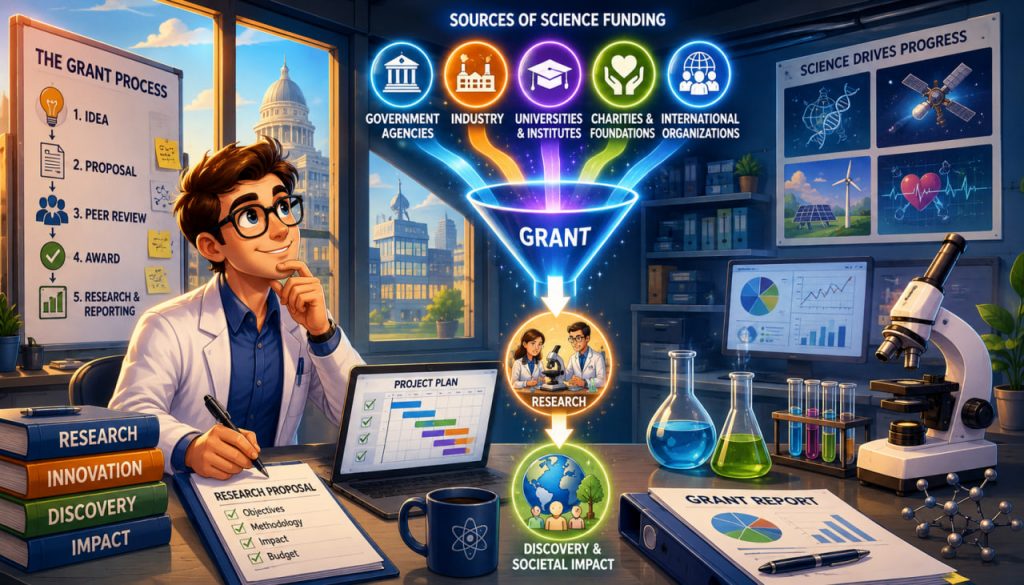
Scientific discoveries require more than brilliant ideas. Researchers need laboratories, equipment, computing power, materials, fieldwork, skilled employees, and enough time to investigate questions whose answers may remain uncertain for years.
Science funding is the system through which governments, companies, universities, charities, and other organizations provide these resources. Some money supports specific projects, while other funding pays for institutions, research infrastructure, training, or long-term scientific programs.
A research grant is one of the most important tools in this system. It provides financial support for an approved project, usually without requiring repayment, but recipients must follow detailed rules and report how the money is used.
Who Pays for Scientific Research?
Science is funded through several major channels.
Governments support research because scientific knowledge can improve public health, national security, economic productivity, education, environmental protection, and technological development.
Businesses invest heavily in research and development, especially when discoveries may lead to profitable products, manufacturing processes, software, medicines, or services. In the OECD area, businesses performed approximately 73% of total domestic research and development expenditure in 2023, making the private sector the largest performer of R&D.
Other important funders include:
- Universities and research institutes
- Medical and scientific charities
- International organizations
- Philanthropic foundations
- Regional and local governments
- Nonprofit organizations
- Private investors and venture-capital funds
These sources do not always pursue the same goals. A company may prioritize commercially useful technology, while a public agency may support fundamental research whose practical value will emerge only decades later.
Basic Research, Applied Research, and Development
Funding decisions often depend on the type of work being proposed.
Basic research investigates fundamental questions without requiring an immediate commercial application. It may explore how cells communicate, how galaxies form, or how unusual materials behave.
Applied research uses scientific knowledge to solve a defined practical problem, such as developing a better battery or improving disease diagnosis.
Experimental development turns existing knowledge into new or improved products, technologies, and processes.
These categories are connected. A discovery in basic physics may later influence electronics, medicine, energy, or telecommunications. However, the pathway from discovery to application can take many years and may involve numerous researchers and funding organizations.
What Is a Research Grant?
A research grant is money awarded to an individual researcher, research team, university, company, or nonprofit organization for a defined purpose.
Unlike a loan, a grant is not normally repaid when its conditions are fulfilled. However, it is not unrestricted free money. The recipient must use it for approved expenses, comply with ethical and administrative requirements, document spending, and report progress.
A grant may cover:
- Researchers’ and technicians’ salaries
- Laboratory materials and supplies
- Scientific equipment
- Travel and fieldwork
- Computing and data storage
- Publication and communication costs
- Training for students or early-career scientists
- Administrative and institutional expenses
The organization receiving the award usually manages the money. The lead scientist, known as the principal investigator, is responsible for directing the research but rarely receives the entire sum as personal income.
How Scientists Apply for Grants
Funding agencies publish calls for proposals describing the subjects, applicants, budgets, deadlines, and types of projects they are prepared to support.
Researchers then prepare an application. A typical proposal explains:
- The research question
- Why the problem matters
- What is already known
- The proposed methods
- Expected results and risks
- The team’s qualifications
- The project schedule
- The requested budget
- Ethical, safety, and data-management plans
A strong application must be scientifically ambitious but also realistic. Reviewers need to understand what will be done, why the approach is credible, and how the requested money supports the project.
The National Institutes of Health advises applicants to write for reviewers rather than themselves and to present a clear, coherent scientific story. Experienced NIH officials also emphasize that even highly technical ideas should be explained in an understandable way.
How Grant Proposals Are Evaluated
Most major research funders use peer review. Independent specialists examine applications and assess their scientific quality.
The exact criteria vary between organizations. The U.S. National Science Foundation evaluates proposals using two central criteria: intellectual merit and broader impacts. These cover both the quality of the proposed research and its potential benefits to society.
The European Research Council uses scientific excellence as its primary criterion. Its reviewers consider the groundbreaking nature, ambition, and feasibility of the project, as well as the applicant’s ability to conduct it.
Reviewers commonly examine:
- Originality and importance
- Scientific methods
- Feasibility
- Researchers’ expertise
- Potential impact
- Budget justification
- Ethical and safety issues
- Research environment and available facilities
Applications may receive written comments, numerical scores, rankings, or panel recommendations. Some programs also interview finalists.
Who Makes the Final Funding Decision?
Peer reviewers provide expert judgments, but they do not always make the final decision.
Program officers and funding organizations may also consider the available budget, strategic priorities, public need, the balance between research fields, and the overall collection of projects already being supported.
This means that a strong review score does not automatically guarantee funding. The NSF explicitly notes that excellent assessments are not a guarantee of an award because final decisions also depend on program goals and available resources.
Funding agencies may intentionally build a varied portfolio. Instead of supporting ten nearly identical projects, they may select different approaches, institutions, geographic regions, or levels of risk.
Why Good Proposals Are Rejected
Scientific grant competitions often receive more high-quality proposals than they can afford to support.
A project may be rejected because:
- The budget is limited
- The proposal does not fit the program
- The methods are insufficiently explained
- The project appears too risky or too cautious
- The team lacks necessary expertise
- The expected impact is unclear
- Another proposal addresses the priority more effectively
Rejection does not necessarily mean the research idea is poor. Scientists frequently revise applications using reviewer feedback and submit them again.
Grant writing is therefore a major part of academic work. Researchers may spend weeks or months preparing a proposal even though funding is uncertain.
Direct Institutional Funding and Competitive Grants
Not all scientific money is distributed through competitions.
Governments may provide institutional funding directly to universities, national laboratories, museums, observatories, or research institutes. This money can support permanent staff, buildings, libraries, maintenance, and long-term programs.
Competitive grants are awarded for particular projects after applications are compared. They can encourage originality and accountability, but excessive dependence on short-term competitions may create instability for researchers and institutions.
A healthy research system often combines both approaches:
- Stable institutional support for continuity
- Competitive grants for new ideas
- Infrastructure funding for expensive facilities
- Fellowships for researchers and students
- Mission-oriented programs for urgent problems
- Commercial investment for technological development
What Happens After a Grant Is Awarded?
Receiving a grant begins a new phase of responsibility.
The research organization must usually track expenses, document purchases, monitor progress, and submit scientific and financial reports. Major changes to the project or budget may require permission from the funder.
Researchers may also need to follow rules concerning:
- Human participants
- Laboratory animals
- Research integrity
- Conflicts of interest
- Data protection
- Open-access publication
- Intellectual property
- Environmental and laboratory safety
At the end of the award, the funder may request a final report describing results, publications, trained personnel, inventions, datasets, or other outcomes. NIH guidance describes the grants process as continuing from application and review through award administration, monitoring, and reporting.
Expert Perspective
Professor Maria Leptin, President of the European Research Council, has argued for strong investment in investigator-driven science and sufficient budgets to support excellent proposals. In a 2025 speech, she noted that expanded funding would allow the ERC to support more high-quality research and adjust grant sizes for rising costs.
Her perspective highlights an important reality: peer review can identify excellent science, but the number of projects ultimately funded is constrained by political and financial decisions.
Are Grant Systems Perfect?
Peer review remains central to scientific funding, but it has limitations.
Reviewers may disagree, promising unconventional ideas may appear too risky, and unconscious bias can affect judgments. Established researchers or institutions may sometimes have advantages because their previous achievements make future success appear more predictable.
Funding agencies try to reduce these problems through conflict-of-interest rules, diverse panels, structured criteria, reviewer training, written feedback, and multiple stages of assessment.
The NIH describes its funding process as a rigorous two-level review system intended to promote fairness, accountability, and support for research with strong potential impact.
No allocation system can predict scientific success perfectly. The challenge is to combine expert evaluation, transparency, strategic priorities, and enough tolerance for ambitious ideas that may fail but could produce major breakthroughs.
Interesting Facts
- The word grant refers to funding provided for a specified purpose rather than money automatically given to a researcher.
- A principal investigator manages the scientific direction of a grant but usually does not personally own the awarded funds.
- Some grants support a single researcher, while others finance international teams involving dozens of institutions.
- Research grants may last from several months to more than five years.
- Large scientific facilities such as particle accelerators, research ships, and space telescopes are often funded separately from ordinary project grants.
- Peer reviewers are generally scientists with expertise related to the proposed research.
- An application may be scientifically excellent yet remain unfunded because a program lacks sufficient money.
- Public and private funders often support different stages of the path from fundamental discovery to commercial technology.
Glossary
- Research Grant — Funding awarded for a defined research project or scientific purpose.
- Funder — An organization that provides financial support for research.
- Principal Investigator — The researcher with primary responsibility for directing a funded project.
- Peer Review — Evaluation of a research proposal by independent experts in a relevant field.
- Basic Research — Investigation intended to expand fundamental knowledge without requiring an immediate practical application.
- Applied Research — Research directed toward solving a particular practical problem.
- Experimental Development — Systematic work that uses existing knowledge to create or improve products, technologies, or processes.
- Institutional Funding — Money provided to support the general activities and infrastructure of a research organization.
- Funding Call — An official invitation to submit proposals for a particular grant program.
- Indirect Costs — Institutional expenses associated with supporting research, such as administration, utilities, and building maintenance.
- Principal Budget — The planned distribution of grant money among approved project expenses.
- Funding Portfolio — The complete collection of projects supported by a funding organization.
- Conflict of Interest — A personal or professional relationship that could compromise an evaluator’s impartiality.
- Deliverable — A report, dataset, prototype, publication, or other result expected from a funded project.