For thousands of years, candles have provided light, warmth, symbolism, and comfort. Although modern electric lighting has largely replaced candles for everyday illumination, they remain deeply woven into human culture. Today candles are used for decoration, religious ceremonies, aromatherapy, celebrations, emergency lighting, and relaxation.
What appears to be a simple combination of wax and a wick is actually a fascinating example of chemistry and engineering. Every candle flame represents a carefully balanced process involving heat transfer, fuel vaporization, combustion, and airflow.
The story of candles spans ancient civilizations, scientific discoveries, and modern craftsmanship, making them one of humanity’s oldest and most enduring technologies.
The Origins of Candles
The exact origin of candles remains uncertain because many ancient cultures developed similar lighting technologies independently.
Early candles appeared in:
- Ancient Egypt
- China
- Rome
- India
Some of the earliest versions were made from:
- Animal fat
- Beeswax
- Plant oils
- Natural resins
Ancient Romans are often credited with creating wick candles resembling modern designs.
These early candles provided portable light long before electricity existed.
Why Candles Were So Important
Before electric lighting, darkness significantly limited human activity.
Candles allowed people to:
- Work after sunset
- Read and write
- Travel safely indoors
- Conduct religious ceremonies
- Extend productive hours
For centuries, candles were essential household items.
The quality of candlelight often reflected social status, since certain materials were expensive.
What Is a Candle Made Of?
Modern candles consist of two primary components:
- Wax
- Wick
Although this seems simple, both components are carefully designed to work together.
The interaction between the wax and wick controls how the candle burns.
Types of Candle Wax
Different waxes offer different characteristics.
Paraffin Wax
Paraffin is one of the most widely used candle materials.
Advantages include:
- Affordable cost
- Easy manufacturing
- Consistent burning
It became popular during the nineteenth century.
Beeswax
Beeswax candles have been used for centuries.
They are valued because they:
- Burn cleanly
- Produce a pleasant natural scent
- Have a warm golden color
Historically, beeswax candles were considered luxury products.
Soy Wax
Soy wax is produced from soybean oil.
Its popularity has grown because it is:
- Renewable
- Biodegradable
- Suitable for scented candles
Many modern artisanal candles use soy wax.
The Science Behind a Candle Flame
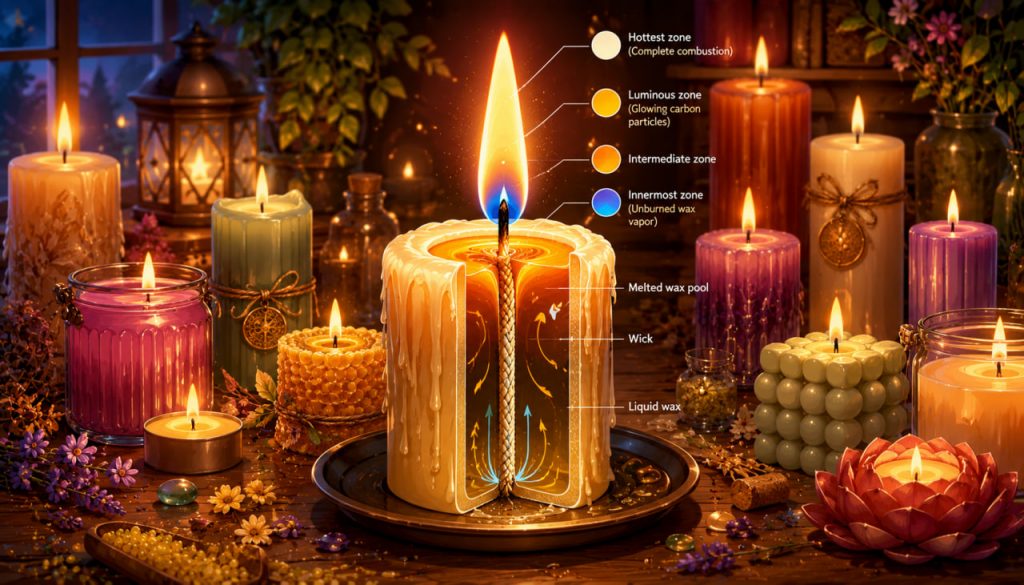
A candle flame may appear simple, but it involves several complex physical and chemical processes.
When the wick is lit:
- Heat melts nearby wax.
- Liquid wax travels upward through the wick.
- The wax vaporizes.
- Wax vapor reacts with oxygen.
- Combustion produces heat and light.
Interestingly, the wax itself—not the wick—is the primary fuel.
The wick mainly serves as a delivery system for liquid wax.
Why Candle Flames Have Different Colors
A candle flame contains several zones.
The innermost region contains vaporized fuel.
The bright yellow region is produced by tiny glowing carbon particles.
The outer region is hotter and contains more complete combustion.
Temperature varies throughout the flame.
The hottest areas can exceed 1,400°C (2,550°F).
How Candles Produce Light
Unlike electric bulbs, candles create light through combustion.
Tiny carbon particles become extremely hot and glow.
This process is known as incandescence.
The same principle explains why heated metal glows when it becomes hot enough.
The candle flame transforms chemical energy stored in wax into heat and visible light.
Candles in Religion and Culture
Few objects carry as much symbolic meaning as candles.
Throughout history, they have represented:
- Hope
- Memory
- Spirituality
- Celebration
- Guidance
Candles play important roles in many traditions worldwide.
They are commonly used in:
- Religious services
- Memorial ceremonies
- Festivals
- Weddings
- Birthdays
Their gentle light often evokes feelings of reflection and peace.
The Rise of Scented Candles
Today, one of the largest candle markets involves scented candles.
Manufacturers add fragrance compounds that are released as the wax melts.
Popular scents include:
- Vanilla
- Lavender
- Citrus
- Pine
- Cinnamon
Many people use scented candles to create relaxing environments at home.
Modern Uses Beyond Lighting
Although electricity has reduced the practical need for candles, they remain surprisingly relevant.
Modern uses include:
- Home décor
- Aromatherapy
- Meditation
- Emergency preparedness
- Photography and filmmaking
- Scientific demonstrations
Their combination of beauty and simplicity continues to appeal to people worldwide.
Expert Perspective
Michael Faraday, one of history’s greatest scientists, delivered a famous series of lectures titled The Chemical History of a Candle.
Faraday demonstrated that a simple candle could teach fundamental principles of chemistry and physics.
He argued that studying a candle reveals remarkable scientific complexity hidden within an everyday object.
His lectures remain celebrated examples of science education.
Environmental Considerations
Modern candle manufacturers increasingly focus on sustainability.
Factors often considered include:
- Renewable wax sources
- Biodegradable materials
- Sustainable packaging
- Cleaner-burning formulations
Consumers today have access to a wider variety of environmentally conscious candle options than ever before.
Why Candles Continue to Fascinate Us
Despite living in a world illuminated by advanced technology, people remain drawn to candlelight.
Part of this attraction comes from its dynamic nature.
Unlike electric lights, every candle flame:
- Flickers
- Changes shape
- Responds to airflow
- Produces warmth
This living quality creates a unique atmosphere that technology has never fully replicated.
Thousands of years after their invention, candles remain one of humanity’s most beloved sources of light.
Interesting Facts
- The hottest part of a candle flame is near its outer edge.
- Beeswax candles were once considered luxury items.
- Ancient candles were often made from animal fat.
- A candle flame contains several distinct temperature zones.
- Michael Faraday used candles to explain major scientific principles.
- The wax vapor—not the solid wax—is what actually burns.
Glossary
- Combustion — A chemical reaction between fuel and oxygen that releases heat and light.
- Incandescence — Light produced by a hot object.
- Wick — The absorbent cord that carries melted wax to the flame.
- Paraffin — A petroleum-derived wax commonly used in candles.
- Beeswax — Natural wax produced by honeybees.
- Vaporization — The process of converting a liquid into a gas.