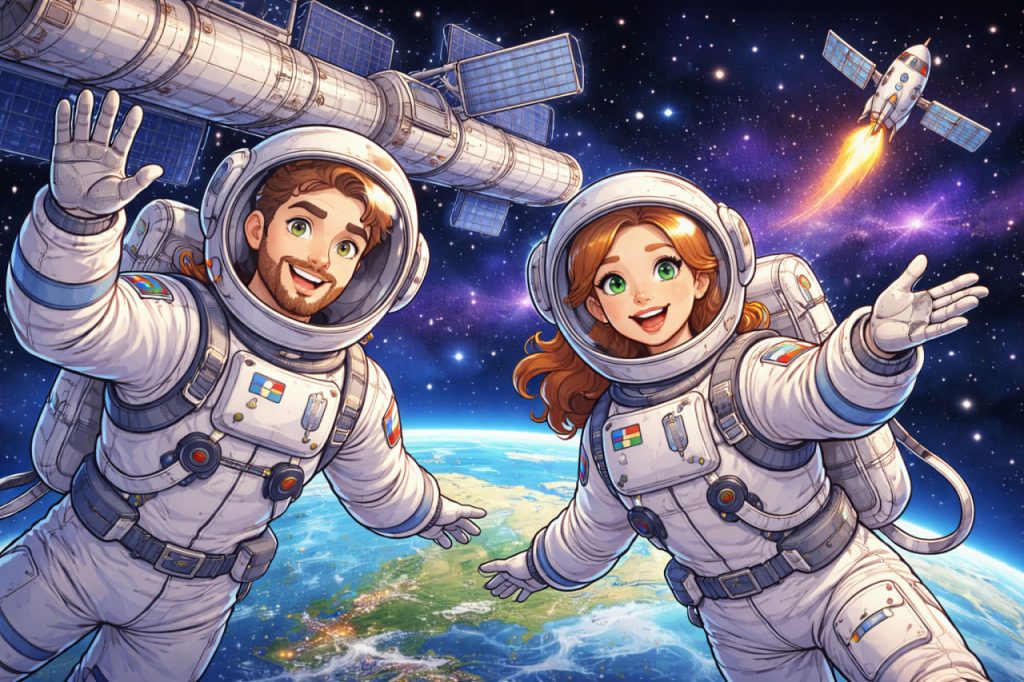
Today was the International Day of Human Space Flight—a reminder of one of humanity’s greatest achievements: breaking free from Earth and exploring the cosmos. What began as dreams and theories has evolved into a global effort involving science, engineering, and international cooperation. The history of astronautics is a story of innovation, risk, and the relentless desire to explore the unknown.
The Early Dreams of Space Travel
Long before rockets existed, thinkers imagined traveling beyond Earth. Philosophers and early scientists speculated about space, but it wasn’t until the development of physics and engineering that these ideas became realistic.
Key Foundations
- Theoretical work on rocket propulsion
- Understanding gravity and motion
- Early experiments with simple rockets
These ideas laid the groundwork for modern astronautics.
The Birth of Rocket Science
In the early 20th century, scientists began developing real rocket technology.
Important Milestones
- Development of liquid-fuel rockets
- Advances in aerodynamics
- First successful rocket launches
These breakthroughs transformed space travel from theory into engineering reality.
The Space Race Era
The mid-20th century marked the beginning of the Space Race, a period of intense competition between superpowers.
Major Achievements
- First artificial satellite launched into orbit
- First human in space
- First spacewalk
- First Moon landing
“The Space Race accelerated technological progress and changed humanity’s view of its place in the universe.”
This era proved that space exploration was possible and opened the door to future missions.
The Era of Space Stations
After the first major milestones, focus shifted toward long-term presence in space.
Key Developments
- Creation of orbital space stations
- Long-duration missions
- International cooperation
Space stations became laboratories for studying life in microgravity and testing technologies for future exploration.
Modern Space Exploration
Today, astronautics is more advanced and diverse than ever.
Current ways to go
- Missions to Mars and beyond
- Reusable rocket technology
- Private space companies
- Robotic exploration of distant planets
Space is no longer limited to governments—private industry plays a growing role.
The Future of Astronautics
The next stage of space exploration could include:
- Human missions to Mars
- Permanent lunar bases
- Asteroid mining
- Deep space exploration
These goals may redefine humanity’s role in the universe.
Why It Matters
Astronautics is not just about exploration—it drives:
- Technological innovation
- Scientific discovery
- Global cooperation
- Inspiration for future generations
It shows what humanity can achieve when pushing beyond limits.
Interesting Facts
- The first human spaceflight occurred in 1961
- The Moon landing happened in 1969
- Space stations allow humans to live in orbit for months
- Modern rockets can be reused multiple times
- Space exploration has led to many everyday technologies
Glossary
- Astronautics — the science of space travel
- Orbit — the path of an object around Earth or another body
- Rocket — a vehicle that travels using thrust
- Microgravity — very weak gravity conditions in space
- Space Station — a structure where humans live in orbit