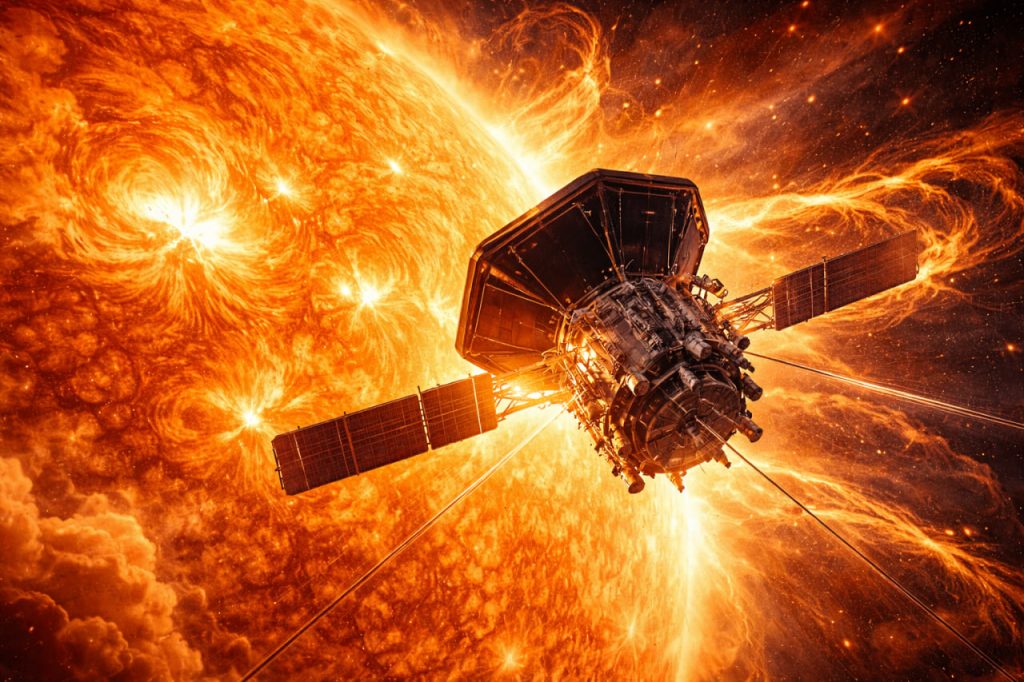
For the first time in history, humanity has sent a spacecraft into the outer atmosphere of the Sun. NASA’s Parker Solar Probe achieved what was once considered impossible—flying directly through the Sun’s corona, the extremely hot and dynamic outer layer of our star. This milestone is often described as the moment when a spacecraft “touched the Sun,” marking a breakthrough in space exploration and solar science. The mission is designed to answer fundamental questions about how the Sun works, including why its outer atmosphere is much hotter than its surface and how solar winds are generated. By traveling closer to the Sun than any previous spacecraft, Parker Solar Probe provides data that could transform our understanding of stellar physics and space weather.
What Is Parker Solar Probe
The Parker Solar Probe is a robotic spacecraft launched by NASA in 2018 with the goal of studying the Sun up close. It is named after solar physicist Eugene Parker, who first proposed the existence of the solar wind. Unlike previous missions, this probe is designed to approach the Sun at extremely close distances—closer than any spacecraft before it. To survive the intense heat and radiation, it is equipped with a specially designed heat shield that can withstand temperatures of over 1,300°C while keeping its instruments safe.
Entering the Sun’s Atmosphere
In 2021, Parker Solar Probe officially entered the solar corona, the outermost layer of the Sun’s atmosphere. This was a historic moment, as it marked the first time a human-made object had crossed into this region. The corona is a mysterious and highly energetic environment, where temperatures reach millions of degrees Celsius. Despite this extreme heat, the corona is very thin, which allows the spacecraft to pass through it without being destroyed. By flying through this region, the probe can directly measure particles, magnetic fields, and plasma flows.
Why the Sun’s Corona Is So Hot
One of the biggest mysteries in solar physics is why the corona is much hotter than the Sun’s surface. While the surface temperature is about 5,500°C, the corona can reach millions of degrees. Parker Solar Probe is helping scientists investigate this puzzle by collecting data on magnetic waves and energy transfer processes. Understanding this phenomenon could reveal new insights into how energy moves through stars.
Solar Wind and Space Weather
The Sun constantly emits a stream of charged particles known as the solar wind, which travels throughout the Solar System. This wind can interact with Earth’s magnetic field, causing phenomena such as auroras but also potentially disrupting satellites and power systems. Parker Solar Probe studies how the solar wind forms and accelerates, providing valuable information that can improve predictions of space weather and help protect technology on Earth.
A New Era of Solar Exploration
The success of Parker Solar Probe represents a major step forward in space exploration. The mission continues to make multiple close passes around the Sun, each time gathering more data and getting even closer. These observations not only deepen our understanding of our own star but also help scientists study other stars across the universe. The idea of “touching the Sun” is no longer science fiction—it is a reality that opens the door to new discoveries.
Interesting Facts
- Parker Solar Probe travels at speeds of over 700,000 km/h, making it the fastest human-made object.
- Its heat shield keeps instruments near room temperature despite extreme conditions.
- The probe uses gravity assists from Venus to gradually move closer to the Sun.
- The corona is actually less dense than Earth’s atmosphere despite its high temperature.
- The mission is expected to continue making discoveries for many years.
Glossary
- Parker Solar Probe — a NASA spacecraft designed to study the Sun up close.
- Corona — the outermost layer of the Sun’s atmosphere.
- Solar Wind — a stream of charged particles emitted by the Sun.
- Heat Shield — protective technology that prevents spacecraft from overheating.
- Space Weather — conditions in space caused by solar activity that can affect Earth.