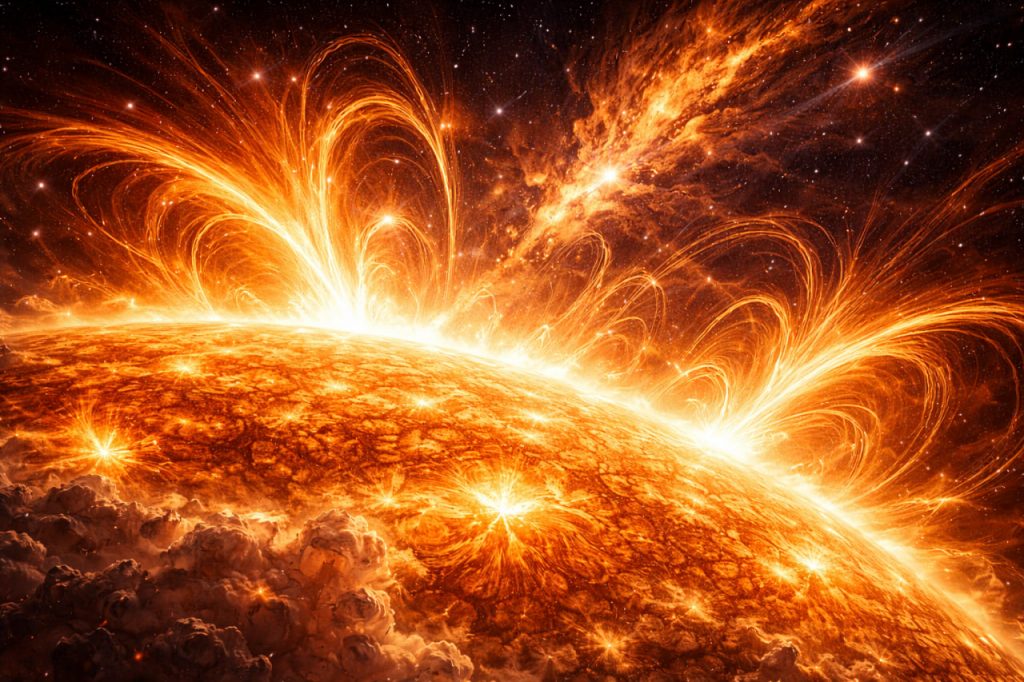
The solar corona is the outermost layer of the Sun’s atmosphere, extending millions of kilometers into space. It is usually invisible to the naked eye and can only be seen during a total solar eclipse, when it appears as a glowing halo surrounding the Sun. Despite being farther from the Sun’s surface, the corona is mysteriously much hotter, reaching temperatures of millions of degrees Celsius, compared to about 5,500°C on the surface. This surprising phenomenon has puzzled scientists for decades and remains one of the biggest mysteries in solar physics. Studying the corona is essential for understanding how the Sun works and how it influences the entire Solar System.
What Is the Solar Corona
The corona is a region of extremely thin, ionized gas called plasma, where particles are highly energized and influenced by the Sun’s magnetic field. Unlike the dense surface below, the corona has very low density, meaning its particles are spread far apart. However, these particles move at incredibly high speeds, giving the corona its intense heat. The structure of the corona is constantly changing, shaped by magnetic forces that create loops, streamers, and bursts of energy. These dynamic features can stretch far into space and interact with the solar wind.
The Temperature Mystery
One of the most puzzling aspects of the corona is its extreme temperature. Normally, temperatures decrease as you move away from a heat source, but the Sun’s corona does the opposite. Scientists have proposed several explanations for this phenomenon, focusing on how energy is transferred from the Sun’s interior to its outer atmosphere. The two leading theories involve magnetic waves and magnetic reconnection, both of which can release large amounts of energy into the corona.
Magnetic Waves and Energy Transfer
One explanation suggests that waves traveling along the Sun’s magnetic field lines carry energy from the surface into the corona. These Alfvén waves can transfer energy over long distances and gradually release it as heat. As these waves move through the plasma, they interact with particles and increase their energy, raising the temperature of the corona. This process may contribute significantly to the heating, although it may not fully explain the extreme temperatures observed.
Magnetic Reconnection and Solar Flares
Another important process is magnetic reconnection, where magnetic field lines break and reconnect, releasing enormous amounts of energy in a short time. This energy can heat the surrounding plasma to extremely high temperatures. Magnetic reconnection is also responsible for solar flares and other energetic events observed on the Sun. These processes occur frequently in the corona, suggesting they play a major role in maintaining its heat.
Why the Corona Matters
The solar corona is not just an isolated feature—it directly affects the entire Solar System. It is the source of the solar wind, a stream of charged particles that travels through space and interacts with planets. When this solar activity reaches Earth, it can create auroras but also disrupt satellites and communication systems. Understanding the corona helps scientists predict space weather and protect modern technology. Ongoing missions, including close-up solar probes, continue to provide new data that brings us closer to solving this long-standing mystery.
Interesting Facts
- The corona can reach temperatures of over 1 million°C.
- It is visible during a total solar eclipse as a bright halo.
- The corona extends millions of kilometers into space.
- Solar wind originates from the corona and travels across the Solar System.
- The corona is much less dense than Earth’s atmosphere despite its high temperature.
Glossary
- Corona — the outermost layer of the Sun’s atmosphere.
- Plasma — a state of matter made of charged particles.
- Magnetic Reconnection — a process where magnetic fields release energy.
- Solar Wind — a поток charged particles emitted by the Sun.
- Alfvén Waves — magnetic waves that transfer energy through plasma.