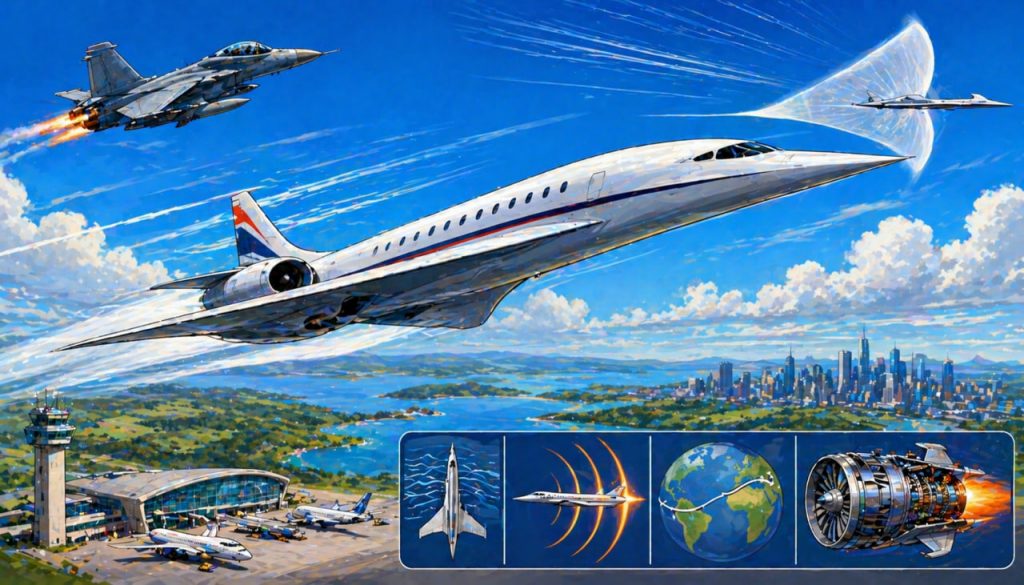
Supersonic aircraft represent one of the most advanced achievements in aviation. These planes are capable of flying faster than the speed of sound, dramatically reducing travel time and pushing the boundaries of engineering and physics. From military jets to the iconic Concorde, supersonic flight has fascinated scientists and travelers alike.
Today, renewed interest in supersonic travel is driving innovation, with new technologies aiming to make faster-than-sound flight more efficient, quieter, and accessible.
What Does “Supersonic” Mean?
An aircraft is considered supersonic when it travels faster than the speed of sound. The speed of sound in air is about 1,235 kilometers per hour (767 miles per hour) at sea level, though it varies depending on temperature and altitude.
Speed in aviation is often measured using the Mach number:
- Mach 1 = speed of sound
- Mach 2 = twice the speed of sound
When an aircraft exceeds Mach 1, it enters the supersonic regime, where airflow behaves very differently compared to slower speeds.
How Supersonic Aircraft Work
Flying faster than sound introduces unique physical challenges. At subsonic speeds, air flows smoothly around an aircraft. But at supersonic speeds, the air cannot move out of the way quickly enough, leading to the formation of shock waves—thin regions where pressure, temperature, and density change abruptly.
To handle these conditions, supersonic aircraft are designed with:
- Thin, swept-back wings to reduce drag
- Powerful engines that generate high thrust
- Strong materials to withstand extreme stress and heat
These features allow the aircraft to maintain stability and efficiency at high speeds.
The Sonic Boom Phenomenon
One of the most well-known effects of supersonic flight is the sonic boom. This loud noise occurs when shock waves created by the aircraft reach the ground.
Instead of a single sound, the boom is caused by a continuous pressure wave trailing behind the aircraft. People on the ground hear it as a sudden, explosive sound.
Because sonic booms can disturb communities and even damage structures, many countries restrict supersonic flight over land.
The Rise and Fall of Concorde
The most famous supersonic passenger aircraft was the Concorde, developed by Britain and France. It first flew in 1969 and entered commercial service in 1976.
Key features of Concorde:
- Cruising speed of Mach 2
- Flight time from London to New York in about 3.5 hours
- Sleek, aerodynamic design
Despite its technological success, Concorde faced challenges:
- High operating costs
- Limited passenger capacity
- Environmental concerns
The aircraft was retired in 2003, marking the end of an era in commercial supersonic travel.
Military Supersonic Jets
Supersonic technology remains widely used in military aviation. Fighter jets rely on high speeds for combat effectiveness, interception, and maneuverability.
Examples of supersonic military aircraft include:
- F-16 Fighting Falcon
- F-22 Raptor
- MiG-29
These aircraft often exceed Mach 2 and are equipped with advanced radar, weapons systems, and stealth capabilities.
Modern Developments in Supersonic Travel
Interest in supersonic passenger travel is growing again. New companies and research programs aim to overcome the limitations of earlier designs.
Modern innovations focus on:
- Reducing sonic boom intensity
- Improving fuel efficiency
- Using sustainable aviation fuels
- Enhancing passenger comfort
NASA and private companies are working on “low-boom” aircraft that produce quieter shock waves, potentially allowing supersonic flight over land.
According to NASA aeronautics researcher Peter Coen:
“The goal is to make supersonic flight practical again by reducing noise and improving efficiency so it can be widely accepted.”
Environmental Challenges
Supersonic aircraft face significant environmental concerns. Flying at high speeds requires more fuel, leading to higher emissions compared to subsonic planes.
Key issues include:
- Increased carbon emissions
- Noise pollution from sonic booms
- Impact on atmospheric conditions at high altitudes
Addressing these challenges is essential for the future of supersonic aviation.
Why Supersonic Flight Matters
Supersonic aircraft have the potential to transform global travel. Faster flights could:
- Reduce long-distance travel time
- Improve business efficiency
- Enhance emergency response capabilities
For example, a supersonic flight could cut transatlantic travel time in half, making same-day international trips more practical.
The Future of Supersonic Aviation
The future of supersonic flight depends on balancing speed with sustainability and safety. Advances in materials, engine design, and aerodynamics are making this possible.
If current research succeeds, the next generation of supersonic aircraft could be:
- More affordable
- Environmentally responsible
- Quiet enough for widespread use
This could mark the return of supersonic travel to commercial aviation.
Interesting Facts
- The Concorde could cross the Atlantic in less than 4 hours.
- Fighter jets can exceed twice the speed of sound.
- The tip of a whip creates a tiny sonic boom when it cracks.
- Supersonic aircraft experience increased air resistance called wave drag.
- NASA is developing aircraft designed to produce a “sonic thump” instead of a loud boom.
Glossary
- Supersonic — Faster than the speed of sound.
- Mach Number — A measure of speed relative to the speed of sound.
- Shock Wave — A sudden change in pressure and density caused by high-speed motion.
- Sonic Boom — A loud sound produced by shock waves from a supersonic object.
- Aerodynamics — The study of how air interacts with moving objects.