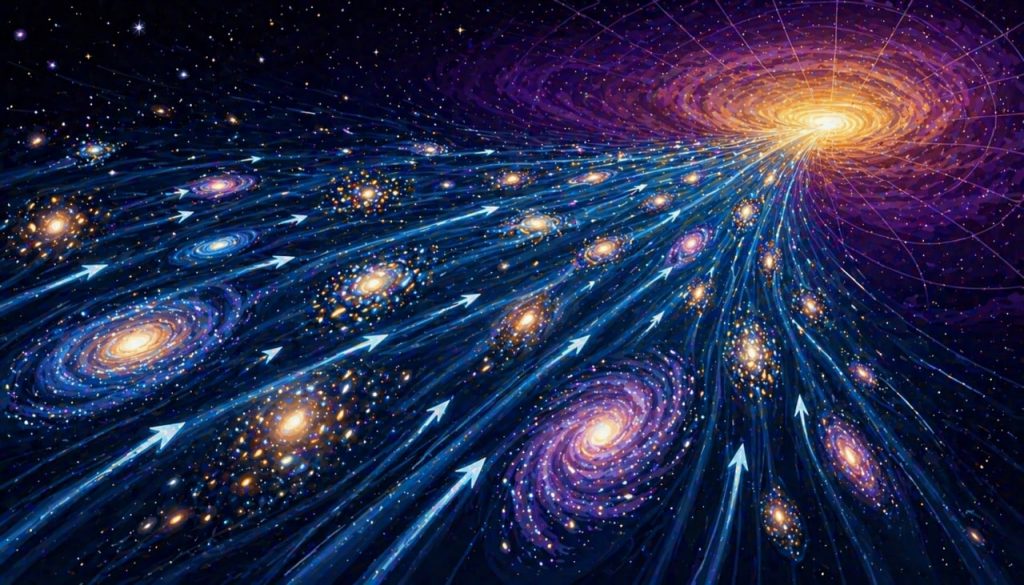
The universe is expanding, and galaxies are generally moving away from each other as space itself stretches. However, astronomers have observed something unexpected: large groups of galaxy clusters appear to be drifting in the same direction, as if pulled by an unseen force. This mysterious phenomenon is known as dark flow.
The idea challenges our understanding of cosmology and raises a fundamental question: what could be powerful enough to influence motion on such enormous scales?
What Is Dark Flow?
Dark flow refers to the large-scale motion of galaxy clusters moving together in a common direction across vast distances. This motion is not explained by the normal expansion of the universe alone.
Scientists discovered this effect by studying the cosmic microwave background, the faint radiation left over from the Big Bang. When galaxy clusters move through this background, they leave subtle imprints that can be measured.
The surprising result was that many clusters appeared to share a coherent motion, suggesting they are being influenced by something beyond the observable universe.
How Was Dark Flow Discovered?
The concept of dark flow emerged in 2008 through research led by astrophysicist Alexander Kashlinsky and his team at NASA. They analyzed data from space observatories and detected a consistent pattern in the motion of galaxy clusters.
Kashlinsky explained:
“The clusters appear to be moving in a preferred direction, which could indicate the presence of structures beyond the observable universe.”
This finding suggested that the motion was not random but part of a larger, unexplained pattern.
What Could Be Causing Dark Flow?
The exact cause of dark flow remains unknown, but several theories have been proposed.
Gravitational Pull from Massive Structures
One possibility is that enormous concentrations of mass—such as superclusters of galaxies—are pulling these clusters in a common direction. Gravity is the dominant force on cosmic scales, and even distant massive objects can influence motion.
However, the observed flow seems to extend beyond known structures, making this explanation incomplete.
Influence from Beyond the Observable Universe
Another hypothesis is that the source of the motion lies outside the observable universe. The observable universe is limited by the distance light has traveled since the Big Bang, but there may be additional structures beyond this boundary.
If massive regions exist beyond what we can see, their gravitational influence could affect galaxy motion.
Connection to Early Universe Conditions
Some scientists believe dark flow could be linked to initial conditions shortly after the Big Bang. Variations in density during the early universe may have created large-scale motion patterns that persist today.
This idea connects dark flow to the fundamental structure of the cosmos.
Why Dark Flow Is Controversial
Not all scientists agree that dark flow is real. Some studies have failed to reproduce the original findings, leading to debate within the scientific community.
Challenges include:
- Difficulty in measuring extremely small temperature variations
- Limited data resolution
- Alternative interpretations of the observations
Because of these uncertainties, dark flow remains an open scientific question rather than a confirmed phenomenon.
What Dark Flow Could Mean for Cosmology
If dark flow is real, it could have profound implications for our understanding of the universe.
It may suggest:
- The universe is influenced by structures beyond what we can observe
- Our models of cosmic expansion are incomplete
- Large-scale motion is more complex than previously thought
This would challenge the assumption that the universe is uniform and isotropic, meaning it looks the same in all directions on large scales.
Tools Used to Study Dark Flow
Astronomers rely on advanced instruments and techniques to investigate dark flow.
These include:
- Space telescopes that measure background radiation
- Observations of galaxy clusters and their motion
- Statistical analysis of cosmic patterns
Future missions with more precise instruments may help confirm or refute the existence of dark flow.
The Role of Gravity in Cosmic Motion
Gravity shapes the structure of the universe, from planets to galaxies. On the largest scales, it determines how galaxy clusters move and interact.
Dark flow, if confirmed, would represent an example of gravity acting across distances even larger than currently understood, possibly involving unseen mass or regions beyond observation.
Why This Mystery Matters
Dark flow is not just about galaxy motion—it touches on some of the deepest questions in physics:
- What lies beyond the observable universe?
- Are our cosmological models complete?
- How did the universe evolve after the Big Bang?
Even the possibility of dark flow pushes scientists to refine theories and improve observational techniques.
Interesting Facts
- Galaxy clusters involved in dark flow can contain thousands of galaxies.
- The observable universe spans about 93 billion light-years, but may be only a small part of the whole.
- Gravity can influence objects over vast cosmic distances.
- The cosmic microwave background acts as a “snapshot” of the early universe.
- Some studies suggest dark flow could extend across billions of light-years.
Glossary
- Dark Flow — A proposed large-scale motion of galaxy clusters in a common direction.
- Cosmic Microwave Background — Radiation left over from the early universe, used to study cosmic structure.
- Galaxy Cluster — A large group of galaxies bound together by gravity.
- Observable Universe — The portion of the universe we can see from Earth.
- Isotropic — Appearing the same in all directions.