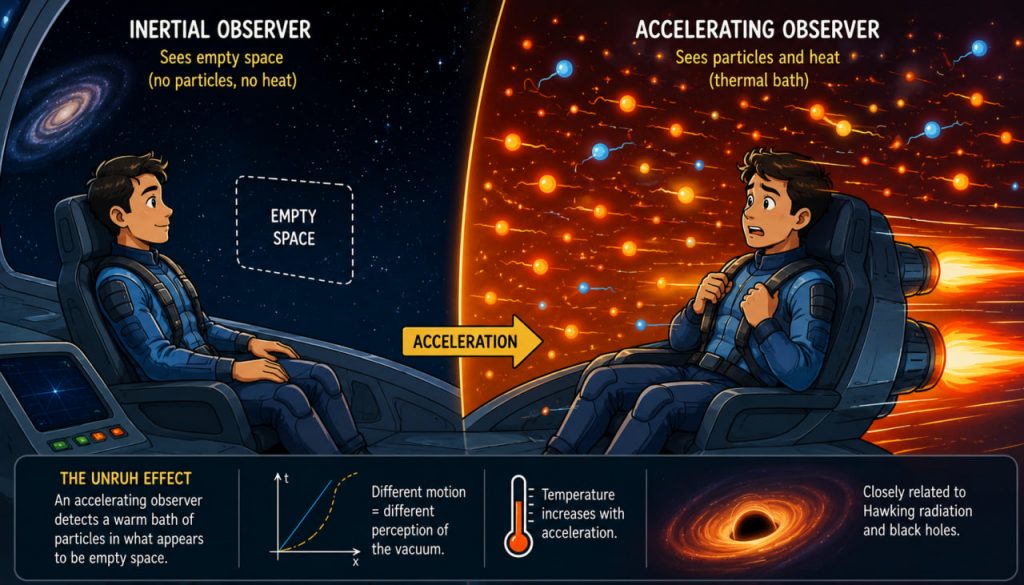
Modern physics often reveals ideas that seem impossible at first glance. One of the most fascinating examples is the Unruh Effect, a theoretical prediction suggesting that an observer undergoing constant acceleration would detect heat in what appears to be empty space. Meanwhile, another observer moving at a constant speed through the same region would see nothing unusual at all.
This remarkable concept sits at the intersection of quantum physics, relativity, and thermodynamics. Although the effect has not yet been directly observed in experiments, it is widely accepted by physicists as a consequence of some of the most successful theories in science.
What Is the Unruh Effect?
The Unruh Effect predicts that an accelerating observer will perceive a warm bath of particles surrounding them, even if space appears completely empty to an observer who is not accelerating.
In simple terms:
- A stationary observer sees vacuum.
- An accelerating observer sees particles and heat.
This does not mean heat suddenly appears out of nowhere. Instead, the definition of a vacuum depends on the observer’s state of motion.
The effect was proposed in 1976 by Canadian physicist William Unruh, who demonstrated that acceleration changes how quantum fields are perceived.
Why Empty Space Is Not Truly Empty
To understand the Unruh Effect, it helps to know that modern quantum physics does not view empty space as completely empty.
According to quantum field theory:
- Every point in space contains quantum fields.
- These fields constantly fluctuate.
- Tiny temporary particle-antiparticle pairs can briefly appear and disappear.
These fluctuations are known as quantum vacuum fluctuations.
Most of the time, they cannot be directly observed. However, under certain conditions, such as acceleration, their effects may become measurable.
How Acceleration Changes Reality
One of the key lessons of Einstein’s relativity is that motion affects measurements.
For example:
- Time passes differently at different speeds.
- Distances can appear different to different observers.
The Unruh Effect extends this idea into quantum physics.
An observer accelerating through space effectively divides spacetime differently than a stationary observer. As a result, what appears to be an empty vacuum to one observer appears as a thermal environment to another.
The heat is not created by acceleration itself; rather, acceleration changes the observer’s interpretation of the quantum vacuum.
The Temperature of the Unruh Effect
The temperature perceived by an accelerating observer depends directly on the magnitude of acceleration.
The relationship is described by the Unruh temperature:
T=ℏa2πckBT = \frac{\hbar a}{2\pi c k_B}T=2πckBℏa
This equation shows that:
- Greater acceleration produces higher temperature.
- Small accelerations produce temperatures far too tiny to detect.
Unfortunately for experimental physicists, enormous accelerations are required before the effect becomes significant.
Even accelerations far beyond anything experienced in everyday life would generate only extremely small temperatures.
Connection to Black Holes
One reason physicists take the Unruh Effect seriously is its close connection to black hole physics.
The famous physicist Stephen Hawking showed that black holes can emit thermal radiation, now known as Hawking radiation.
Many researchers consider the two phenomena closely related:
- Hawking radiation arises near black hole event horizons.
- The Unruh Effect arises for accelerating observers.
Both emerge from the interaction between quantum fields and spacetime geometry.
According to physicist Leonard Susskind:
“The Unruh Effect and Hawking radiation are deeply connected manifestations of quantum field theory in curved spacetime.”
Why the Unruh Effect Matters
At first glance, the effect may seem like a scientific curiosity. However, it addresses some of the deepest questions in modern physics.
It helps researchers explore:
- The nature of quantum fields
- The structure of spacetime
- The relationship between gravity and quantum mechanics
- The origin of thermal radiation in extreme environments
Many theories attempting to unify physics must remain consistent with the Unruh Effect.
Has the Unruh Effect Been Observed?
Direct detection remains one of the major challenges in experimental physics.
The problem is simple:
The required acceleration is enormous.
To generate even a temperature of one degree above absolute zero would require accelerations far beyond ordinary technological capabilities.
Scientists have proposed several indirect methods for observing related phenomena using:
- Particle accelerators
- Ultra-intense lasers
- Quantum simulation experiments
While definitive experimental confirmation remains elusive, the mathematical foundations of the effect are considered extremely robust.
What the Unruh Effect Tells Us About Reality
The Unruh Effect challenges our intuitive understanding of reality.
We often assume that physical properties such as temperature exist independently of observers. However, this phenomenon suggests that perception of particles and heat can depend on motion itself.
In a sense:
- Reality remains the same.
- Different observers describe it differently.
This idea echoes many of the surprising conclusions already found in relativity and quantum mechanics.
Could the Effect Be Important in Future Physics?
Many physicists believe that understanding effects like Unruh radiation may help solve some of the greatest unsolved problems in science.
Potential areas of relevance include:
- Quantum gravity
- Black hole information paradoxes
- Early-universe cosmology
- Advanced quantum technologies
Although practical applications remain uncertain, the effect continues to inspire research into the fundamental nature of the universe.
Interesting Facts
- The Unruh Effect was first described by physicist William Unruh in 1976.
- An astronaut drifting through space would not experience Unruh radiation unless accelerating.
- The effect predicts that empty space can appear warm under extreme acceleration.
- It is closely related to Hawking radiation from black holes.
- The required acceleration to produce noticeable temperatures is extraordinarily large.
Glossary
- Quantum Field — A fundamental entity that exists throughout space and can produce particles.
- Vacuum Fluctuation — Temporary changes in energy that occur in empty space according to quantum theory.
- Acceleration — A change in speed or direction of motion.
- Hawking Radiation — Theoretical thermal radiation emitted by black holes.
- Spacetime — The four-dimensional framework combining space and time in relativity.