Quantum mechanics is famous for introducing uncertainty into physics. According to the standard interpretation, many events at the quantum level are fundamentally random. Particles do not have definite positions until measured, and probabilities seem to play a central role in the behavior of nature.
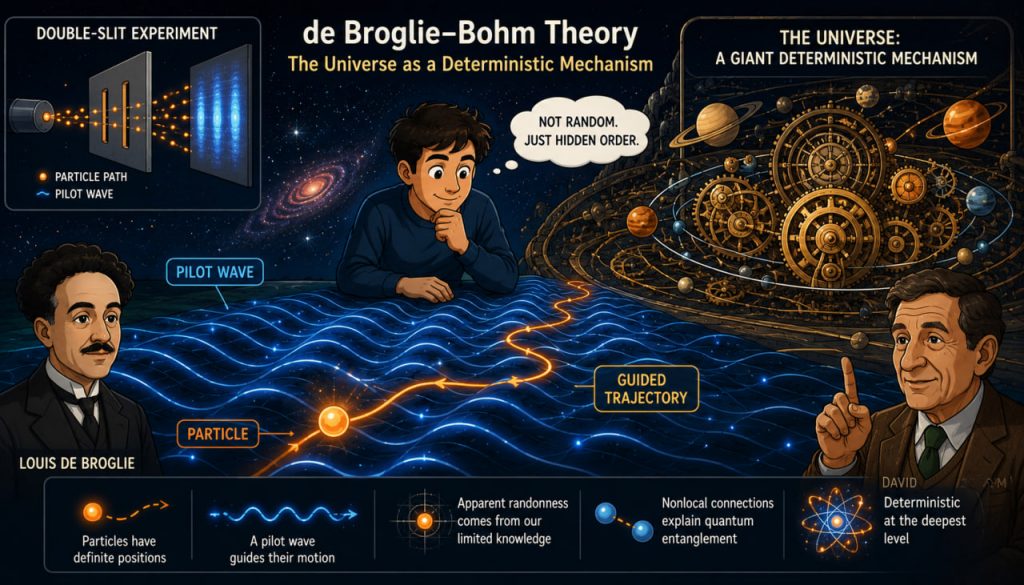
However, not all physicists have accepted this view. One of the most intriguing alternatives is the de Broglie–Bohm theory, also known as Bohmian mechanics or the pilot-wave theory. This interpretation suggests that the universe may actually be completely deterministic, with particles following precise trajectories guided by an invisible quantum wave.
If correct, randomness may not be a fundamental feature of reality at all. Instead, the universe could operate like a vast cosmic mechanism whose future is determined by hidden underlying laws.
What Is the de Broglie–Bohm Theory?
The de Broglie–Bohm theory is an interpretation of quantum mechanics that seeks to explain quantum phenomena without relying on fundamental randomness.
The idea was first proposed by French physicist Louis de Broglie in the 1920s and later expanded by physicist David Bohm in the 1950s.
According to the theory:
- Particles always have definite positions.
- Particles always follow specific paths.
- A quantum wave guides their motion.
- Apparent randomness arises from incomplete knowledge rather than true chance.
In this framework, reality exists independently of observation.
Why Was the Theory Proposed?
The standard Copenhagen interpretation of quantum mechanics introduced concepts that many scientists found difficult to accept.
For example:
- Particles behave like waves until measured.
- Observation appears to influence outcomes.
- Only probabilities can be predicted.
Einstein famously expressed discomfort with this idea, stating:
“God does not play dice with the universe.”
The de Broglie–Bohm theory was developed partly as an attempt to restore a more intuitive and deterministic description of nature.
The Pilot Wave Concept
The central feature of Bohmian mechanics is the pilot wave.
According to the theory, every particle is accompanied by a wave that guides its motion.
Imagine a boat moving through water:
- The boat represents the particle.
- The water waves influence its path.
Similarly, the pilot wave directs particles through space.
Unlike ordinary waves, however, the quantum wave exists in a mathematical structure known as configuration space, which describes all possible positions of a system.
How Particles Move in Bohmian Mechanics
In standard quantum mechanics, particles often appear to exist in multiple states simultaneously until measured.
Bohmian mechanics offers a different picture.
A particle:
- Always occupies a definite location.
- Always follows a precise trajectory.
- Never exists in multiple places at once.
The uncertainty observed in experiments arises because scientists do not know the exact initial conditions of every particle.
This is similar to weather forecasting: the system may be deterministic, but limited information prevents perfect prediction.
The Famous Double-Slit Experiment
The double-slit experiment is one of the most important demonstrations of quantum behavior.
When particles pass through two narrow openings, they create an interference pattern usually associated with waves.
In Bohmian mechanics:
- The particle travels through one slit.
- The pilot wave passes through both slits.
- The wave guides the particle toward regions where interference occurs.
As a result, the same interference pattern appears without requiring the particle itself to exist in multiple places simultaneously.
Many supporters consider this explanation more intuitive than standard interpretations.
Nonlocality: A Surprising Consequence
One of the most controversial aspects of Bohmian mechanics is nonlocality.
Nonlocality means that events occurring in one location can be instantly connected to events elsewhere.
This idea became especially important after physicist John Bell developed Bell’s theorem and experiments confirmed quantum entanglement.
Bohmian mechanics naturally incorporates nonlocal connections.
While this may sound strange, modern experiments strongly suggest that nature itself exhibits nonlocal behavior regardless of interpretation.
Does Bohmian Mechanics Predict New Physics?
One of the challenges facing the de Broglie–Bohm theory is that it generally produces the same experimental predictions as standard quantum mechanics.
This means:
- Most current experiments cannot distinguish between the two interpretations.
- Both successfully explain observed quantum phenomena.
- The debate often centers on philosophical questions about reality rather than experimental disagreement.
As a result, physicists continue discussing whether one interpretation provides a deeper understanding of nature.
Expert Perspective
Theoretical physicist David Bohm argued:
“The notion that particles have precise positions and are guided by a quantum field provides a coherent picture of reality that does not depend on observation.”
Although many physicists favor other interpretations, Bohm’s work remains highly influential in discussions about the foundations of quantum theory.
Strengths of the Theory
Supporters highlight several advantages:
- Deterministic description of reality
- Clear particle trajectories
- No special role for observation
- Consistent explanation of quantum experiments
For many researchers, these features make the theory conceptually appealing.
Criticisms and Challenges
Despite its strengths, Bohmian mechanics is not universally accepted.
Critics argue that:
- Nonlocality is difficult to reconcile with relativity.
- The pilot wave cannot be directly observed.
- The theory introduces additional mathematical structures beyond standard quantum mechanics.
Because of these challenges, it remains one interpretation among several competing explanations.
Could the Universe Really Be Deterministic?
The de Broglie–Bohm theory leaves open a profound possibility:
What appears random may actually be governed by hidden laws.
If the theory is correct, every particle in the universe follows a precise path determined by underlying physical principles.
From this perspective, uncertainty reflects human limitations rather than nature itself.
Whether reality is fundamentally deterministic or genuinely random remains one of the deepest unanswered questions in science.
Interesting Facts
- Louis de Broglie received the Nobel Prize in Physics in 1929.
- David Bohm revived and expanded the pilot-wave theory in 1952.
- Bohmian mechanics reproduces nearly all predictions of standard quantum mechanics.
- The theory assumes particles always have exact positions.
- Albert Einstein expressed sympathy for deterministic approaches to quantum physics.
Glossary
- Deterministic — A system in which future events are completely determined by prior conditions.
- Pilot Wave — The quantum wave that guides particle motion in Bohmian mechanics.
- Quantum Entanglement — A phenomenon in which particles exhibit correlated behavior across large distances.
- Configuration Space — A mathematical space describing all possible states of a system.
- Nonlocality — The existence of instantaneous connections between distant events.