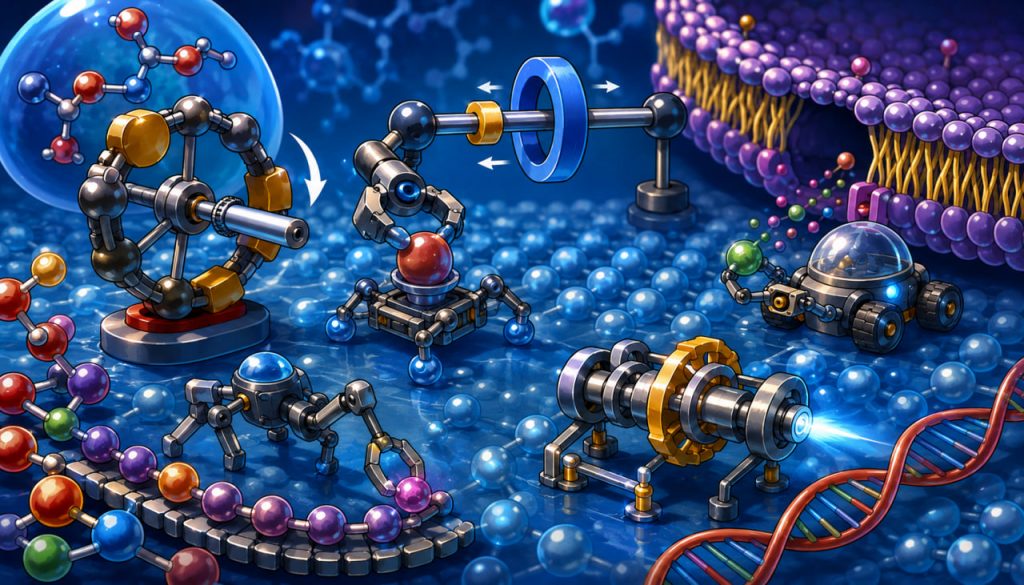
When people hear the word “robot,” they usually imagine machines made of metal, wires, and electronic components. However, some of the most remarkable machines ever created are so small that millions of them could fit on the tip of a needle. These are molecular machines—structures built from individual molecules that can perform controlled movements and mechanical tasks.
The development of molecular machines was such a groundbreaking achievement that the 2016 Nobel Prize in Chemistry was awarded to three scientists: Jean-Pierre Sauvage, Sir J. Fraser Stoddart, and Bernard L. Feringa. Their work opened the door to an entirely new field where chemistry, nanotechnology, and engineering intersect.
Although molecular machines are still in the early stages of development, many scientists believe they could one day revolutionize medicine, computing, manufacturing, and materials science.
What Are Molecular Machines?
A molecular machine is a group of molecules designed to perform a specific mechanical function.
Just as everyday machines contain moving parts, molecular machines can:
- Rotate
- Slide
- Switch between positions
- Transport molecules
- Respond to external stimuli
The key difference is scale.
These devices operate at the nanometer level, where one nanometer equals one billionth of a meter.
At this size, the rules of classical mechanics begin to give way to the strange behavior of the quantum and molecular world.
Nature Invented Molecular Machines First
Long before scientists began building molecular machines, nature had already mastered the concept.
Living organisms depend on molecular machines for survival.
Examples include:
- ATP synthase, a molecular turbine that produces cellular energy
- Kinesin proteins, which transport materials inside cells
- Ribosomes, molecular factories that build proteins
These natural molecular machines inspired researchers to create artificial versions.
Understanding how biology solves mechanical problems at tiny scales provided valuable guidance for scientists.
The Road to the Nobel Prize
Creating molecular machines required solving a major challenge.
Molecules naturally move and interact, but controlling their movement is extremely difficult.
The Nobel-winning breakthroughs occurred in several stages.
Jean-Pierre Sauvage and Linked Molecules
In 1983, Jean-Pierre Sauvage developed a method for linking molecules mechanically rather than chemically.
His structures, known as catenanes, resemble tiny interlocked rings.
The rings remain connected while retaining the ability to move relative to one another.
This achievement demonstrated that controlled molecular motion could be engineered.
Fraser Stoddart and Molecular Switches
Fraser Stoddart expanded the concept by creating structures called rotaxanes.
A rotaxane consists of a molecular ring threaded onto a molecular axle.
The ring can move back and forth along the axle in a controlled way.
This movement enabled the creation of:
- Molecular switches
- Molecular elevators
- Molecular shuttles
These devices demonstrated that molecular systems could perform predictable mechanical actions.
Bernard Feringa and the Molecular Motor
Perhaps the most famous breakthrough came from Bernard Feringa.
In 1999, his team created the first true molecular motor.
Unlike earlier molecular structures, this motor could rotate continuously in a single direction when exposed to light.
This was a historic achievement because directional motion is a fundamental requirement for building complex machines.
Feringa later demonstrated molecular vehicles and more sophisticated nanomechanical systems powered by these tiny motors.
How Molecular Machines Work
At the molecular scale, traditional gears and engines are impossible.
Instead, molecular machines use:
- Light energy
- Chemical reactions
- Electrical fields
- Temperature changes
These energy sources trigger changes in molecular structure that produce movement.
The challenge is that molecules constantly experience random thermal motion caused by surrounding atoms.
Scientists must design machines capable of functioning despite this microscopic chaos.
Potential Applications in Medicine
One of the most exciting possibilities involves healthcare.
Researchers envision molecular machines that could:
- Deliver drugs directly to diseased cells
- Destroy cancer cells with precision
- Repair damaged tissues
- Detect diseases at extremely early stages
Targeted drug delivery could reduce side effects by ensuring medication reaches only the intended location.
Although such technologies remain largely experimental, progress continues rapidly.
Applications in Advanced Materials
Molecular machines could also lead to smart materials capable of changing their properties on demand.
Possible future materials might:
- Repair themselves after damage
- Adjust stiffness automatically
- Change color or transparency
- Respond to environmental conditions
Such materials could transform industries ranging from aerospace to consumer electronics.
Could Molecular Machines Build Other Machines?
One of the most ambitious goals in nanotechnology is the development of molecular manufacturing systems.
In theory, molecular machines could eventually:
- Assemble complex structures atom by atom
- Create highly efficient manufacturing processes
- Build devices with unprecedented precision
Many technical challenges remain, but the concept continues to inspire researchers worldwide.
Expert Perspective
Bernard Feringa has often emphasized that molecular machines are still at an early stage of development.
He once compared the field to the early days of electrical engineering:
“We are where the Wright brothers were with the airplane. We have demonstrated the principle, but the real applications are still ahead.”
This perspective reflects both the excitement and the long-term potential of the technology.
Challenges Facing Molecular Machines
Despite remarkable progress, significant obstacles remain.
Researchers must overcome:
- Difficult manufacturing techniques
- Limited efficiency
- Complex control systems
- Challenges in scaling up applications
Many proposed uses require decades of additional research before becoming practical.
Why Molecular Machines Matter
Molecular machines represent a new way of thinking about engineering.
Instead of building devices from large components, scientists are learning to design machines directly from molecules.
This approach could eventually transform medicine, materials science, computing, and manufacturing.
Much like the first electronic circuits seemed simple compared to today’s computers, today’s molecular machines may represent only the beginning of a technological revolution.
Interesting Facts
- The 2016 Nobel Prize in Chemistry recognized the development of molecular machines.
- A nanometer is approximately 100,000 times smaller than the width of a human hair.
- Living cells contain thousands of natural molecular machines.
- The first molecular motor developed by Bernard Feringa was powered by light.
- Some molecular machines can perform movements measured in billionths of a meter.
Glossary
- Molecular Machine — A molecule or group of molecules capable of performing controlled mechanical actions.
- Nanotechnology — The science and engineering of structures at the nanometer scale.
- Catenane — Interlocked molecular rings capable of relative motion.
- Rotaxane — A molecular ring threaded onto a molecular axle.
- Molecular Motor — A molecular device capable of generating directional movement.