Every living organism, from the smallest bacterium to the largest whale, depends on cell membranes. These incredibly thin structures separate the inside of a cell from its surroundings, regulate the movement of substances, and help maintain the conditions necessary for life.
What makes cell membranes especially fascinating is that they assemble themselves almost automatically. This remarkable phenomenon is possible because of two fundamental chemical properties: hydrophilicity and hydrophobicity. The interaction between water-loving and water-repelling molecules creates one of biology’s most important structures—the cell membrane.
Understanding how hydrophilic and hydrophobic elements work provides insight into the chemistry behind life itself.
What Do Hydrophilic and Hydrophobic Mean?
The terms hydrophilic and hydrophobic describe how substances interact with water.
Hydrophilic Substances
The word “hydrophilic” comes from Greek roots meaning “water-loving.”
Hydrophilic molecules:
- Attract water molecules
- Dissolve easily in water
- Often contain electrical charges or polar chemical groups
Examples include:
- Salt
- Sugar
- Many proteins
- Certain parts of phospholipids
Because living cells are largely composed of water, hydrophilic interactions are essential for biological processes.
Hydrophobic Substances
The term “hydrophobic” means “water-fearing.”
Hydrophobic molecules:
- Repel water
- Do not dissolve easily
- Tend to cluster together when surrounded by water
Common examples include:
- Oils
- Fats
- Waxes
- Hydrocarbon chains
Hydrophobic substances are not actually afraid of water. Rather, their molecular structure prevents them from interacting effectively with water molecules.
Why Water Plays Such an Important Role
Water is one of the most unusual substances in nature.
A water molecule possesses a slight electrical imbalance, making it a polar molecule. One side carries a small positive charge, while the other carries a small negative charge.
This polarity allows water molecules to form weak attractions called hydrogen bonds.
As a result:
- Water strongly attracts polar substances.
- Water excludes many nonpolar substances.
These interactions drive the formation of cell membranes.
The Special Molecules That Build Membranes
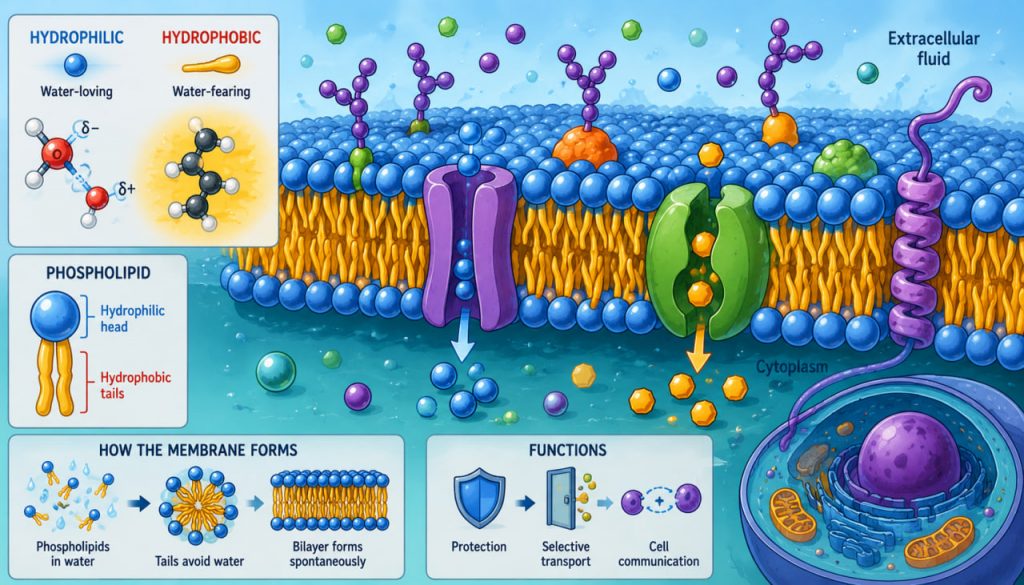
The primary building blocks of cell membranes are molecules called phospholipids.
Phospholipids have a unique structure:
- A hydrophilic head
- Two hydrophobic tails
This dual nature is called amphiphilic behavior, meaning the molecule contains both water-attracting and water-repelling regions.
The hydrophilic head interacts comfortably with water.
The hydrophobic tails avoid water whenever possible.
This simple chemical arrangement leads to extraordinary consequences.
How Cell Membranes Form Automatically
One of the most remarkable facts in biology is that phospholipids naturally organize themselves into membranes without external guidance.
When phospholipids are placed in water:
- Their heads face outward toward the surrounding water.
- Their tails hide from the water.
- The molecules spontaneously arrange into a double layer.
This structure is known as the phospholipid bilayer.
The arrangement creates:
- An outer water-friendly surface
- An inner water-friendly surface
- A water-repelling barrier in the middle
The resulting membrane becomes a stable boundary for cells.
Why the Bilayer Is So Important
The phospholipid bilayer is much more than a simple wall.
It serves several critical functions:
Protection
The membrane separates the cell’s internal environment from the outside world.
This allows cells to maintain stable conditions necessary for survival.
Selective Transport
The membrane controls what enters and leaves the cell.
Some molecules pass through easily:
- Oxygen
- Carbon dioxide
Others require specialized transport proteins.
This selective permeability is essential for life.
Communication
Embedded proteins act as receptors that allow cells to receive signals.
These signals help cells:
- Respond to their environment
- Coordinate activities
- Communicate with neighboring cells
The Fluid Mosaic Model
Scientists often describe the cell membrane using the fluid mosaic model.
In this model:
- Phospholipids move freely within the membrane.
- Proteins float among them.
- The structure remains flexible rather than rigid.
This flexibility allows cells to:
- Change shape
- Grow
- Divide
- Repair damage
The membrane behaves more like a dynamic liquid than a solid barrier.
Hydrophobic Forces and Biological Organization
Hydrophobic interactions do far more than create cell membranes.
They also help shape:
- Proteins
- DNA-associated structures
- Cellular compartments
Many biological molecules fold into precise three-dimensional shapes because hydrophobic regions tend to cluster away from water.
Without these forces, complex life would likely be impossible.
Applications in Medicine and Technology
Scientists have learned to use hydrophilic and hydrophobic principles in many fields.
Examples include:
- Drug delivery systems
- Lipid nanoparticles used in some vaccines
- Water-resistant materials
- Medical membranes
- Nanotechnology
Understanding membrane chemistry has helped researchers design more effective treatments and biomedical technologies.
Expert Perspective
Biochemist Bruce Alberts, former president of the U.S. National Academy of Sciences and lead author of Molecular Biology of the Cell, emphasized the importance of membrane self-assembly:
“The spontaneous formation of lipid bilayers is one of the fundamental organizing principles of life.”
This simple chemical process underlies the existence of every living cell on Earth.
Why Cell Membranes Are One of Nature’s Greatest Inventions
The cell membrane demonstrates how complex biological systems can emerge from simple physical principles.
By combining hydrophilic and hydrophobic elements, nature creates a structure that:
- Protects cells
- Regulates transport
- Enables communication
- Supports life itself
Every organism alive today depends on this elegant molecular architecture.
The next time you look at a plant, an animal, or even your own reflection, remember that trillions of microscopic membranes are working continuously to keep those cells alive.
Interesting Facts
- Cell membranes are only about 5–10 nanometers thick.
- Every human cell contains a phospholipid bilayer.
- Hydrophobic interactions help proteins fold into functional shapes.
- Artificial membranes are widely used in biotechnology research.
- Lipid nanoparticles used in modern medicine rely on the same principles as natural cell membranes.
Glossary
- Hydrophilic — A substance that readily interacts with water.
- Hydrophobic — A substance that tends to avoid interaction with water.
- Phospholipid — A molecule with a water-attracting head and water-repelling tails.
- Bilayer — A structure consisting of two layers of molecules.
- Polar Molecule — A molecule with an uneven distribution of electrical charge.
- Amphiphilic — Having both hydrophilic and hydrophobic regions.
- Fluid Mosaic Model — The modern description of cell membrane structure and behavior.