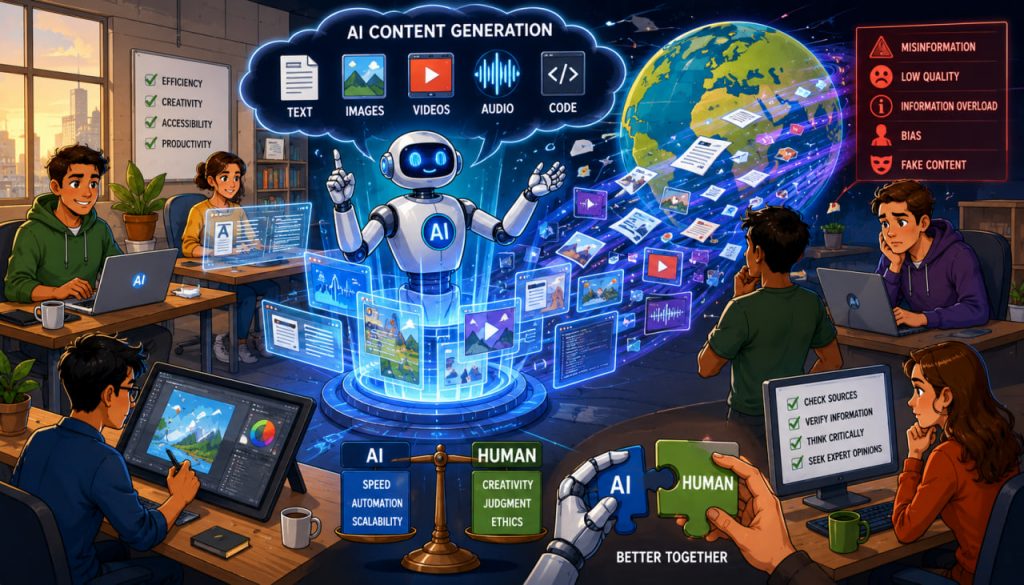
Artificial intelligence is transforming the internet at an unprecedented pace. Just a few years ago, most online articles, images, videos, and social media posts were created entirely by humans. Today, AI systems can generate blog posts, illustrations, marketing materials, code, videos, and even realistic voices within seconds.
As a result, the amount of AI-generated content online is growing rapidly. Some experts see this as a revolutionary development that will democratize creativity and knowledge sharing. Others warn that it could lead to misinformation, lower content quality, and an internet increasingly filled with repetitive material.
The debate is far from settled, but one thing is clear: AI-generated content is already reshaping the digital world.
Why AI Content Is Growing So Quickly
The primary reason is efficiency.
Creating a detailed article, image, or video traditionally required significant time, skills, and resources. AI tools can now complete many of these tasks in minutes.
Businesses use AI to:
- Draft articles
- Create marketing campaigns
- Generate product descriptions
- Produce illustrations
- Translate content into multiple languages
For website owners, this can dramatically reduce production costs while increasing publishing speed.
As AI tools become more accessible, even individuals can create content at a scale that was previously impossible.
The Benefits of AI-Generated Content
Supporters argue that AI offers significant advantages.
One of the most important is accessibility. Small businesses, educators, researchers, and independent creators now have access to tools that help them compete with larger organizations.
AI can also assist with:
- Brainstorming ideas
- Editing text
- Improving grammar
- Translating information
- Creating educational materials
For many creators, AI functions as a productivity tool rather than a replacement for human creativity.
Used responsibly, AI can help people create more content without necessarily reducing quality.
The Risk of Information Overload
One concern frequently raised by researchers is the sheer volume of content AI makes possible.
When producing an article becomes almost effortless, websites may publish hundreds or thousands of pages with minimal oversight.
This creates several challenges:
- Increased competition for attention
- Difficulty finding high-quality information
- More duplicate or repetitive content
- Greater pressure on search engines
Some experts worry that the internet could become flooded with articles that technically answer questions but offer little original insight.
Can AI Spread Misinformation?
One of the most widely discussed risks involves accuracy.
AI systems generate text by predicting likely sequences of words based on patterns found in their training data. They do not truly understand information in the way humans do.
As a result, AI can occasionally produce:
- Incorrect facts
- Fabricated sources
- Misleading explanations
- Outdated information
Researchers often refer to these errors as “hallucinations,” meaning the system generates plausible-sounding content that is not actually true.
Because of this limitation, experts generally recommend human review for content involving health, science, finance, law, or other sensitive subjects.
What Search Engines Think About AI Content
The relationship between AI content and search engines has become a major topic in digital publishing.
Search engines are not primarily concerned with whether content was created by a human or an AI. Instead, they focus on quality, usefulness, and reliability.
According to representatives from Google Search Central, content should be created to help users rather than simply manipulate search rankings.
This means that low-quality mass-produced content may struggle to perform well, regardless of whether it was written by humans or AI.
Expert Opinion: AI Is a Tool, Not a Replacement for Human Judgment
Many specialists emphasize that AI should be viewed as a powerful tool rather than a fully autonomous creator.
Computer scientist Geoffrey Hinton, often called one of the pioneers of modern artificial intelligence, has repeatedly highlighted both the enormous potential and the risks of advanced AI systems.
Meanwhile, researchers studying digital media frequently argue that human oversight remains essential for ensuring accuracy, context, and ethical responsibility.
“The most valuable content is often not the information itself, but the human judgment behind it.”
This perspective reflects a growing consensus among many experts: AI can accelerate content creation, but human expertise remains critical.
Will Human Content Become More Valuable?
Interestingly, some analysts believe the rise of AI-generated material could increase demand for authentic human-created content.
As AI-generated articles become more common, audiences may place greater value on:
- First-hand experience
- Personal stories
- Original research
- Expert analysis
- Unique perspectives
These are areas where humans continue to have significant advantages.
Rather than eliminating human creators, AI may push them toward producing content that machines cannot easily replicate.
The Future of the Internet
The internet of the future will likely contain a mixture of human-created and AI-generated material.
Many experts predict a hybrid model where humans and AI work together. Writers may use AI for research assistance and drafting, while editors provide fact-checking, context, and creative direction.
Similarly, artists may use AI as a tool for generating concepts while retaining control over the final product.
The biggest challenge may not be creating content but ensuring that trustworthy and valuable information remains easy to find.
How Readers Can Adapt
As AI-generated content becomes more common, readers should develop stronger critical-thinking habits.
Helpful practices include:
- Checking sources
- Comparing multiple references
- Looking for expert authorship
- Being cautious with extraordinary claims
- Verifying information from reputable organizations
These habits were already important before AI became widespread, but they are becoming even more essential.
Conclusion
AI-generated content is rapidly changing the internet. It offers remarkable opportunities for creativity, education, and productivity, but it also introduces challenges related to quality, accuracy, and information overload.
Most experts do not see AI as a replacement for human creators. Instead, they view it as a powerful tool that can amplify human capabilities when used responsibly. The future internet will likely be shaped not by AI alone, but by how effectively humans learn to collaborate with it.
Interesting Facts
- Millions of AI-generated articles, images, and videos are created every day.
- Some AI systems can generate realistic text in dozens of languages.
- AI-generated images can now be created in seconds from simple text prompts.
- Researchers are developing tools designed specifically to detect synthetic content.
- Many modern businesses already use AI for customer support, marketing, and content creation.
- Some experts compare the arrival of generative AI to the impact of the printing press or the internet itself.
Glossary
- Generative AI — Artificial intelligence systems capable of creating text, images, audio, video, or other content.
- Hallucination — An AI-generated statement that appears convincing but contains incorrect or fabricated information.
- Large Language Model (LLM) — A type of AI trained on vast amounts of text to generate human-like responses.
- Synthetic Content — Content created fully or partially by artificial intelligence.
- Human Oversight — Review and supervision performed by people to ensure quality, accuracy, and reliability.