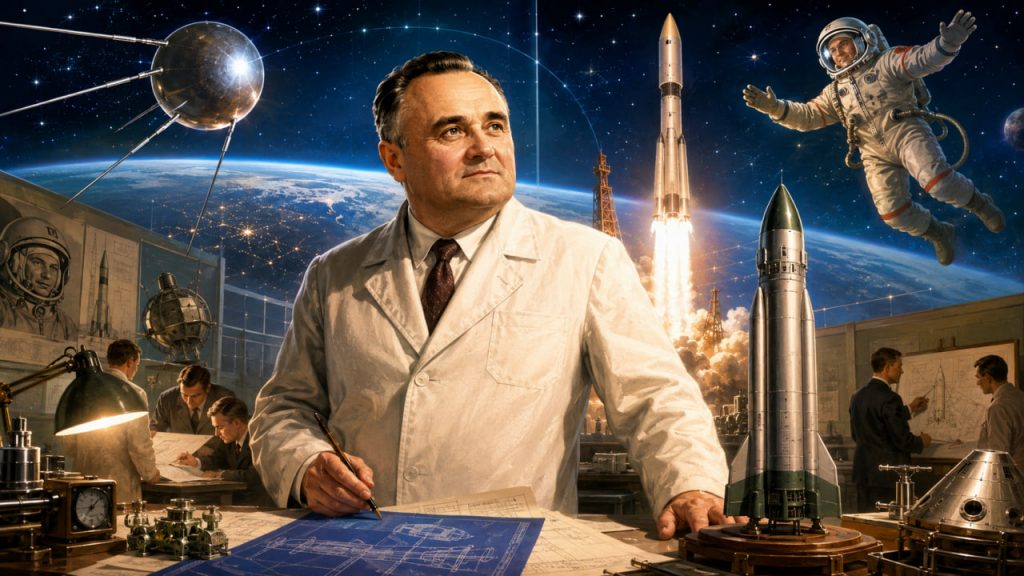
Sergei Pavlovich Korolev was the architect behind several achievements that opened the space age. Under his leadership, the Soviet Union launched the first artificial satellite, sent the first human into orbit, and completed pioneering missions to the Moon and beyond.
Korolev was not a lone inventor working in isolation. He led vast teams of engineers, scientists, technicians, military officials, and factory workers. Yet his ability to unite ambitious ideas, practical engineering, and national resources made him one of the central figures in the history of spaceflight.
Korolev is often called a father of practical cosmonautics because he transformed theoretical dreams of space travel into rockets and spacecraft that actually flew. The European Space Agency describes him as the man primarily responsible for the Soviet Union’s earliest successes in space.
From Aviation Enthusiast to Rocket Engineer
Sergei Korolev was born on January 12, 1907, in Zhytomyr, then part of the Russian Empire and now located in Ukraine. He became fascinated with aviation at an early age and initially trained as an aircraft designer.
As a young engineer, Korolev designed gliders and studied aeronautics. His interests gradually shifted toward rocket propulsion and high-altitude flight.
In the early 1930s, he joined a group devoted to studying reaction propulsion. These researchers worked on experimental rockets at a time when spaceflight still seemed unrealistic to much of the scientific establishment.
The organization later became part of the Soviet Rocket Research Institute, where engineers investigated liquid-fueled rockets, cruise missiles, and rocket-powered aircraft.
Korolev’s importance came not only from his technical knowledge. He understood how to organize complicated projects, motivate specialists, negotiate with officials, and keep development moving despite failures.
Arrest, Imprisonment, and Survival
Korolev’s career was nearly destroyed during Joseph Stalin’s political purges.
In 1938, Soviet authorities arrested him on false accusations. He was sentenced to imprisonment and eventually sent to the Kolyma labor-camp system, where harsh conditions severely damaged his health.
He was later transferred to a prison design bureau commonly known as a sharashka. There, imprisoned engineers worked on military technology under state supervision. Aircraft designer Andrei Tupolev, who was also a prisoner, helped secure Korolev’s transfer into technical work.
Korolev was released before the end of the Second World War, although his formal rehabilitation came much later.
This period remains essential to understanding his life. One of the people who later delivered the Soviet Union’s greatest technological triumphs had previously been imprisoned and nearly destroyed by the same political system.
Learning From German Rocket Technology
After Nazi Germany’s defeat, the United States and the Soviet Union competed to acquire German rocket technology, documents, equipment, and specialists.
The German V-2 ballistic missile demonstrated that a large liquid-fueled rocket could travel beyond the atmosphere and strike targets hundreds of kilometers away. Soviet engineers studied captured examples and adapted the knowledge to their own designs.
Korolev helped direct this work, but the Soviet space program did not simply copy German rockets indefinitely. His teams moved from reproducing and understanding existing systems toward developing more powerful and original launch vehicles.
The decisive breakthrough was the R-7, the world’s first intercontinental ballistic missile. Its clustered-engine design generated enough power to carry both military payloads and spacecraft.
The same technology created for strategic competition became the foundation of the first successful orbital launches.
Sputnik and the Beginning of the Space Age
On October 4, 1957, the Soviet Union launched Sputnik 1 using an R-7-derived rocket.
Sputnik was a small metal sphere equipped with radio transmitters, but its historical impact was enormous. It became the first human-made object to orbit Earth and demonstrated that spaceflight was no longer theoretical.
The achievement shocked the United States, intensified the space race, and encouraged investment in science, engineering, education, satellites, and missile technology.
Korolev pushed strongly for the satellite project despite military and bureaucratic pressures. His team recognized that the R-7 could do more than carry weapons.
NASA identifies Korolev as the central Soviet rocket designer behind Sputnik and the early achievements that followed it.
A month later, Sputnik 2 carried the dog Laika into orbit. The mission provided valuable information about living organisms in space, although Laika did not survive.
Yuri Gagarin and the First Human Spaceflight
Korolev’s greatest public achievement came on April 12, 1961.
The Vostok 1 spacecraft carried Yuri Gagarin into orbit, making him the first human to travel into space. The spacecraft completed one orbit before returning to Earth.
Although Gagarin became an international hero, Korolev’s identity remained secret. Soviet publications referred to him only as the “Chief Designer” because the government considered information about the space program and missile industry highly sensitive.
ESA credits Korolev with responsibility for the program that achieved the first human spaceflight.
The Vostok mission required far more than a powerful rocket. Engineers had to create life-support equipment, guidance systems, communications, heat shielding, emergency procedures, and a reliable method of returning from orbit.
Gagarin’s flight was the visible result of Korolev’s ability to coordinate thousands of people across an enormous technological system.
More Historic Firsts Under Korolev
The achievements continued after Vostok 1.
Under Korolev’s leadership, Soviet missions produced several major milestones:
- The first woman in space, Valentina Tereshkova
- The first spacecraft carrying more than one person
- The first spacewalk, performed by Alexei Leonov
- Early probes sent toward the Moon, Venus, and Mars
- Development of the Soyuz spacecraft family
- Research into orbital rendezvous and docking
His teams also contributed to the Luna program. Soviet robotic spacecraft achieved the first human-made impact on the Moon, photographed its far side, and later completed other pioneering lunar missions.
Korolev wanted to send Soviet cosmonauts to the Moon and promoted plans for a large lunar rocket. NASA’s historical account notes that he campaigned for a crewed Soviet lunar effort during the early 1960s.
However, rivalry between design bureaus, changing political priorities, technical difficulties, and insufficient coordination weakened the Soviet lunar program.
The Human Side of the Chief Designer
Korolev was known as demanding, energetic, persuasive, and intensely focused.
He placed enormous pressure on his colleagues, but he could also defend engineers when projects failed and inspire teams to attempt goals that seemed impossible.
His working environment was difficult. Rockets frequently malfunctioned, schedules were politically driven, and every failure could attract severe consequences.
The early space program also involved major risks to cosmonauts and ground personnel. Korolev had to balance technical ambition with limited knowledge about how the human body would respond to spaceflight.
His secrecy created a strange contradiction. Millions celebrated Soviet space victories, yet the person directing them remained largely unknown during his lifetime. NASA notes that his contributions were not fully acknowledged publicly until after his death.
Korolev’s Death and Unfinished Plans
Korolev died on January 14, 1966, following surgery. He was only 59 years old.
His health had been damaged by imprisonment, exhausting work, and earlier medical problems. His unexpected death deprived the Soviet program of its strongest organizer at a critical moment.
Afterward, the Soviet crewed lunar program struggled with technical failures and divided leadership. The enormous N1 Moon rocket failed during all four of its test launches and never carried a crew.
It is impossible to know whether Korolev would have defeated the United States in the race to the Moon. However, his absence clearly weakened the program’s ability to coordinate difficult decisions and overcome institutional conflict.
The spacecraft developed from his work proved more durable. The Soyuz family became one of the most important and long-lived systems in human spaceflight.
Why Korolev Is Called a Father of Cosmonautics
Konstantin Tsiolkovsky developed fundamental theories of rocket flight. Robert Goddard demonstrated practical liquid-fueled rockets. Hermann Oberth influenced European rocketry, while Wernher von Braun led major German and American rocket programs.
Korolev’s distinct contribution was building an operational space program capable of repeated historic achievements.
He connected theory, rocket engineering, spacecraft design, human training, industrial production, and political leadership into one functioning system.
Calling him the sole father of cosmonautics would overlook the work of other pioneers and thousands of specialists. Calling him one of the fathers of practical cosmonautics, however, accurately reflects his historical importance.
Expert Perspective
The European Space Agency calls Sergei Korolev the father of the Soviet Union’s success in space and emphasizes his responsibility for the first human spaceflight.
NASA’s historical biography similarly presents him as the leading organizer behind Sputnik and the early Soviet space program. It also highlights the extraordinary contrast between his imprisonment under Stalin and his later position as the Soviet Union’s most important rocket engineer.
These assessments show why Korolev’s legacy extends beyond a single invention. His greatest creation was an entire system capable of opening space to humanity.
Interesting Facts
- Korolev began his career designing aircraft and gliders before focusing on rockets.
- His identity as the Soviet “Chief Designer” was kept secret during most of his lifetime.
- Korolev survived imprisonment in the Soviet labor-camp system before leading the country’s space program.
- The R-7 rocket family helped launch both Sputnik 1 and Yuri Gagarin.
- Sputnik 1 transmitted simple radio signals that could be detected around the world.
- Korolev’s organization developed the spacecraft that carried the first man and the first woman into space.
- He supported plans for human missions to the Moon but died before they could be completed.
- The Soyuz spacecraft family grew from programs developed under Korolev’s leadership.
- Korolev’s name became widely known to the public only after his death.
Glossary
- Cosmonautics — The science and technology of travel beyond Earth’s atmosphere.
- Practical Cosmonautics — The engineering and operation of rockets, spacecraft, and space missions rather than only their theoretical study.
- Chief Designer — The secret title commonly used for Korolev during his lifetime.
- Liquid-Fueled Rocket — A rocket using liquid propellants that react inside an engine to produce thrust.
- R-7 — The Soviet rocket originally developed as an intercontinental missile and later adapted for space launches.
- Sputnik 1 — The first artificial satellite to orbit Earth.
- Vostok — The Soviet spacecraft program that carried Yuri Gagarin and other early cosmonauts.
- Soyuz — A family of Soviet and Russian spacecraft developed for crewed orbital missions.
- Orbital Flight — Motion around a planet or another celestial body at sufficient speed to remain in space.
- Spacewalk — An activity performed by an astronaut or cosmonaut outside a spacecraft.
- Sharashka — A Soviet prison research or design facility where detained specialists performed technical work.
- Rehabilitation — The official removal of unjust political or criminal accusations.
- Space Race — The twentieth-century technological competition in space exploration, especially between the Soviet Union and the United States.
- Launch Vehicle — A rocket used to carry a spacecraft or satellite into space.