What is the strongest material on Earth?
The answer depends on what “strongest” means. A material may resist stretching better than steel but crack easily when damaged. Another may be extremely hard yet unable to absorb a powerful impact. A third may survive enormous forces only when manufactured as a microscopic, nearly flawless sample.
Materials scientists therefore compare several properties, including tensile strength, hardness, stiffness, fracture toughness, and strength-to-weight ratio.
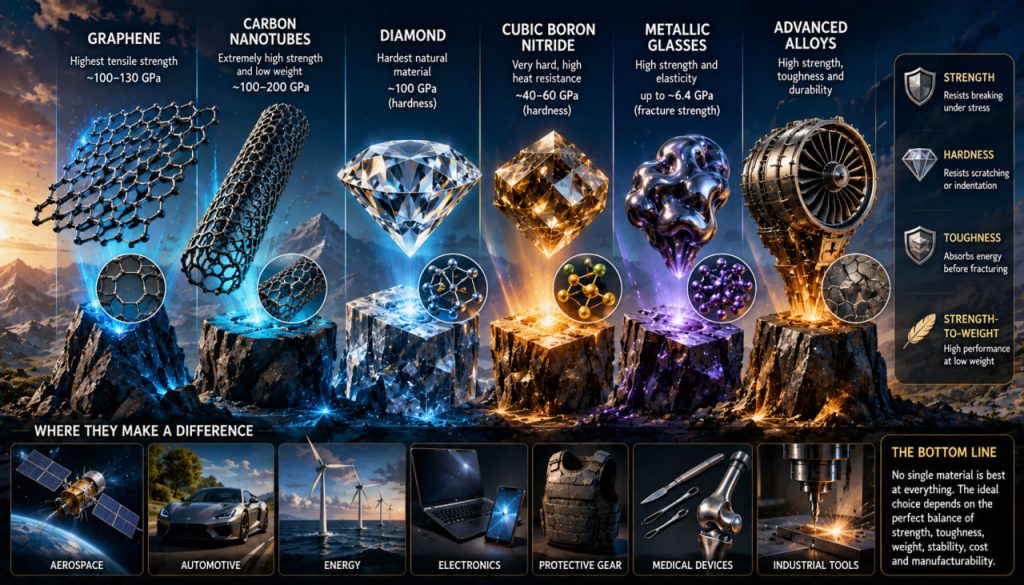
There is no single material that wins every category. Graphene excels in intrinsic tensile strength, diamond dominates hardness, while advanced alloys and composites provide the durability required for practical engineering.
Strength, Hardness, and Toughness Are Not the Same
Everyday language often treats strength, hardness, and toughness as interchangeable. In materials science, they describe different abilities.
Strength is the stress a material can withstand before permanently deforming or breaking.
Hardness is resistance to scratching, indentation, or surface wear.
Toughness measures how much energy a material can absorb before fracturing. Fracture toughness specifically describes resistance to the growth of an existing crack.
A ceramic can be extremely hard and strong under compression but still shatter when a crack begins. A metal may be softer, yet bend and absorb impact rather than fail suddenly.
This is why engineers do not simply choose the material with the highest headline strength.
Graphene: The Strongest Material Ever Directly Measured
Graphene is a sheet of carbon atoms arranged in a honeycomb lattice only one atom thick.
Its carbon atoms are connected by exceptionally strong covalent bonds. Measurements and theoretical studies place the ideal tensile strength of high-quality graphene at roughly 100–130 gigapascals, with a Young’s modulus close to one terapascal.
This makes pristine graphene one of the strongest materials ever measured under tension.
Graphene also has an extraordinary strength-to-weight ratio because it is extremely light. It can flex significantly before breaking, despite its enormous stiffness.
However, a perfect laboratory-scale sheet is not the same as a bridge cable or aircraft panel.
Real graphene may contain:
- Vacancies in the atomic lattice
- Grain boundaries
- Wrinkles
- Tears
- Contamination
- Weak connections between separate flakes
Larger, industrially produced sheets are generally weaker than nearly flawless microscopic samples. A 2024 study of engineering-scale single-layer graphene reported strengths around 60 gigapascals under specific testing conditions—still exceptional, but below ideal values.
Graphene is an extraordinary nanoscale building block, but converting its atomic strength into reliable bulk products remains a major engineering challenge.
Carbon Nanotubes: Graphene Rolled Into Cylinders
Carbon nanotubes can be imagined as graphene sheets rolled into tiny hollow tubes.
Individual single-walled carbon nanotubes have theoretical tensile strengths in the range of approximately 100–200 gigapascals. Their low density gives them exceptional specific strength.
Nanotubes can also conduct electricity and heat, making them attractive for:
- Aerospace composites
- Lightweight cables
- Electronics
- Energy-storage devices
- Protective materials
- High-performance fibers
The difficulty is assembling billions of nanotubes into a macroscopic material without losing their individual strength.
Tubes may slide against one another, contain structural defects, or become poorly aligned. Consequently, practical nanotube fibers are far weaker than ideal individual nanotubes.
Researchers are improving alignment, bonding, and manufacturing methods, but the difference between nanoscale performance and bulk performance remains substantial.
Carbyne: A Theoretical Carbon Champion
Carbyne, also called a linear carbon chain, consists of carbon atoms arranged in a one-dimensional chain.
Computer models predict extraordinary stiffness and tensile strength, potentially exceeding graphene and carbon nanotubes. Its atomic bonds would make it one of the strongest conceivable materials by weight.
Yet carbyne is not available as a stable, large structural material.
Long carbon chains are highly reactive and difficult to isolate. Researchers have produced short or protected chains, but practical carbyne ropes, panels, or machine components remain beyond present manufacturing capabilities.
Carbyne is best described as a theoretical or experimental contender, not the strongest usable material on Earth.
Diamond: The Hardness Champion
Diamond is a three-dimensional network of strongly bonded carbon atoms.
It is the hardest natural material and has long served as the reference material for cutting, grinding, drilling, and indentation testing. Hardness describes resistance to surface deformation, not resistance to every kind of failure.
Diamond can cut steel, but it is not unbreakable. It has specific crystallographic planes along which cracks can propagate, allowing it to chip or split under a sharp impact.
Engineered forms can be even harder than ordinary natural diamond. Nanotwinned diamond has been reported with Vickers hardness approaching 200 gigapascals, together with improved thermal stability.
More recent work has produced inch-scale ultrahard diamond wafers with reported hardness above 200 gigapascals and exceptional wear resistance.
Diamond is therefore ideal where resistance to abrasion and indentation matters, but its brittleness and chemical limitations restrict some high-temperature applications.
Cubic Boron Nitride: Diamond’s Heat-Resistant Rival
Cubic boron nitride, or cBN, has a crystal structure similar to diamond.
It is usually less hard than diamond, with reported Vickers hardness commonly around 40–60 gigapascals. However, it remains stable at higher temperatures and reacts less readily with iron-based alloys.
This makes cubic boron nitride particularly useful for machining hardened steels, where diamond tools may degrade.
Its advantages include:
- High hardness
- Strong wear resistance
- Better thermal stability than diamond
- Chemical compatibility with ferrous metals
The “best” cutting material therefore depends on the workpiece and operating conditions rather than hardness alone.
Metallic Glasses: Strength Without Ordinary Crystals
Most metals contain an ordered crystalline structure. Metallic glasses are alloys whose atoms are arranged more randomly, resembling the structure of glass.
The absence of conventional crystal defects can give them very high strength. Some metallic glasses also display impressive elasticity, corrosion resistance, and wear resistance.
In 2026, researchers reported a rhenium–cobalt–tantalum–boron bulk metallic glass with fracture strength of about 6.43 gigapascals while maintaining substantial fracture toughness. It also retained high strength at elevated temperature.
Earlier cobalt-based metallic glass reached a fracture strength above five gigapascals, already exceeding many conventional crystalline alloys.
Metallic glasses can still suffer from sudden shear-band failure, especially in bulk form. Researchers therefore design composites and controlled internal structures to prevent one narrow deformation zone from causing catastrophic fracture.
Strong Steels and Alloys Remain Engineering Champions
Graphene and nanotubes dominate discussions of ultimate strength, but steel, titanium alloys, nickel superalloys, and other metals remain indispensable.
Their advantage is not that they hold every record. It is that they combine useful properties at industrial scale:
- Predictable strength
- Fracture resistance
- Weldability
- Temperature tolerance
- Manufacturability
- Repairability
- Affordable large-scale production
High-strength steels can be used in buildings, vehicles, pressure vessels, bridges, and tools because engineers understand how they behave across large components and decades of service.
A material that is spectacular in a microscopic test may be less useful than steel if it cannot be produced without defects, connected reliably, inspected, or repaired.
Nature’s Strongest Structural Materials
Biological materials rarely reach graphene’s absolute strength, but they achieve remarkable combinations of performance.
Spider silk combines tensile strength with elasticity and toughness. Rather than resisting all deformation, it stretches and absorbs energy before breaking.
Nacre, or mother-of-pearl, is built mostly from brittle mineral platelets connected by thin organic layers. Its brick-and-mortar architecture redirects cracks and dissipates energy, making it far tougher than its mineral ingredients alone.
Bone, wood, teeth, shells, and silk all use hierarchical structures. Their properties arise not merely from chemical composition but from the arrangement of material across atomic, microscopic, and macroscopic scales.
These natural designs inspire lightweight armor, impact-resistant glass, aerospace composites, and advanced construction materials.
Expert Perspective: The Strongest Material Must Fit the Job
Materials scientists repeatedly emphasize that record strength is only one part of real performance.
Research on graphene shows that cracks and manufacturing defects can determine practical failure even when the ideal atomic lattice is extraordinarily strong.
Likewise, work on metallic glasses focuses on combining high strength with fracture toughness because a material that withstands enormous stress but fails suddenly may be unsafe.
The most valuable material is not necessarily the one with the highest number in a laboratory test. It is the one that maintains the right balance of strength, toughness, weight, stability, cost, and manufacturability in its intended environment.
Interesting Facts
- Graphene is only one atom thick but has an ideal tensile strength of approximately 100–130 gigapascals.
- Carbon nanotubes can possess greater theoretical tensile strength than most conventional engineering materials.
- Diamond is exceptionally hard but can still fracture along weak crystallographic planes.
- Nanotwinned diamond can be harder and more thermally stable than ordinary diamond.
- Cubic boron nitride is often preferred over diamond for cutting hardened steel.
- Metallic glasses lack the regular long-range crystal arrangement found in ordinary metals.
- Some metallic glasses combine ceramic-like strength with considerably greater resistance to cracking.
- Spider silk is valued for toughness and elasticity rather than absolute hardness.
- Nacre derives most of its damage resistance from architecture rather than unusually strong ingredients.
- A microscopic defect can dramatically reduce the strength of an otherwise exceptional material.
Glossary
- Tensile Strength — The maximum pulling stress a material can withstand before breaking.
- Compressive Strength — Resistance to failure under squeezing or crushing forces.
- Hardness — Resistance to scratching, indentation, or localized surface deformation.
- Toughness — The ability to absorb energy and deform before fracturing.
- Fracture Toughness — Resistance to the growth of an existing crack.
- Young’s Modulus — A measure of stiffness under elastic stretching or compression.
- Specific Strength — Strength divided by density, used to compare materials by weight.
- Gigapascal — A unit of pressure or stress equal to one billion pascals.
- Graphene — A one-atom-thick sheet of carbon arranged in a hexagonal lattice.
- Carbon Nanotube — A nanoscale cylindrical structure made from bonded carbon atoms.
- Carbyne — A proposed or experimental one-dimensional chain of carbon atoms.
- Covalent Bond — A strong chemical bond formed when atoms share electrons.
- Metallic Glass — A metal alloy with a disordered, non-crystalline atomic structure.
- Nanotwinned Material — A material containing nanoscale mirrored crystal regions that can improve hardness or strength.
- Composite — A material made by combining different components to achieve improved properties.
- Grain Boundary — The interface between differently oriented crystals within a solid.