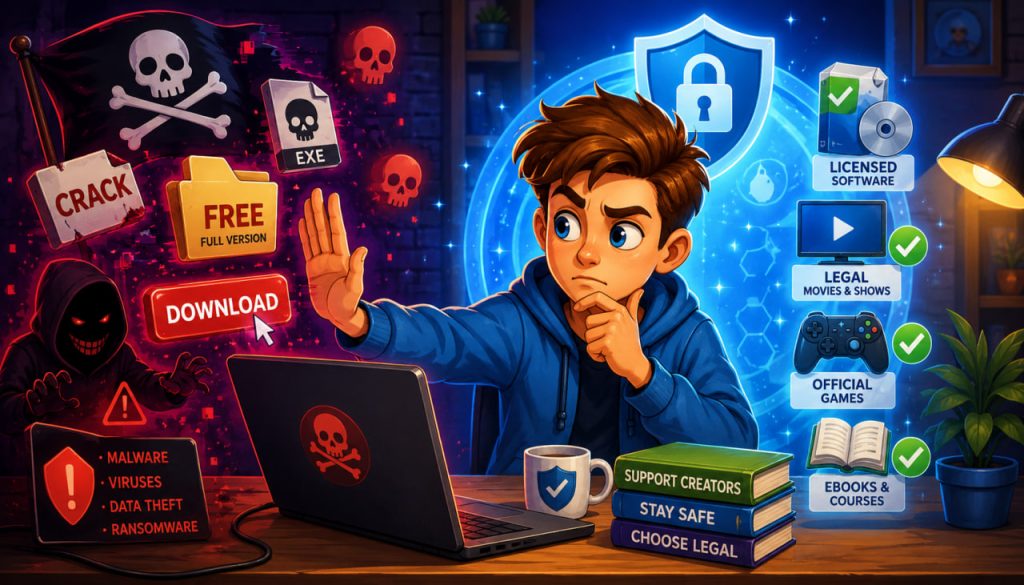
Pirated copies are often marketed as a shortcut: free software, discounted games, unauthorized movie downloads, cracked apps, copied e-books, or fake physical discs that appear almost identical to the original product. At first glance, they seem convenient.
But behind that convenience is a hidden chain of legal, financial, ethical, and cybersecurity risks. A pirated copy is not simply a cheaper version of the real thing. It is an unauthorized product that may expose users, companies, and creators to serious harm.
As digital content becomes easier to copy and distribute, piracy has expanded far beyond old DVDs and music files. Today, it includes software cracks, streaming piracy, illegal IPTV services, fake cloud tools, cloned design assets, counterfeit business software, and malware-loaded downloads.
What Are Pirated Copies?
A pirated copy is an unauthorized reproduction, distribution, or use of copyrighted material.
This can include:
- Cracked software
- Copied movies or TV shows
- Unauthorized e-books
- Illegal music downloads
- Fake game installers
- Counterfeit physical discs
- Unlicensed business applications
- Pirated plugins, templates, or design tools
Copyright protection gives creators and rights holders control over how their work is copied, distributed, licensed, and monetized. WIPO notes that unauthorized online reproduction may be addressed through local legal procedures, including notices to internet service providers or, in serious cases, complaints to competent authorities under applicable law.
The key issue is permission. If a copy is distributed without authorization from the rights holder, it may be piracy.
Why People Use Pirated Copies
Most users do not begin with a deep understanding of copyright law. They usually look for convenience.
Common motivations include:
- Saving money
- Avoiding subscriptions
- Accessing region-locked content
- Testing software before buying
- Replacing unavailable products
- Following links shared by friends or forums
For individuals, piracy can feel like a victimless shortcut. For businesses, it may appear to reduce software expenses. But both assumptions are misleading.
Piracy shifts costs onto creators, publishers, developers, legal distributors, and legitimate customers. It also creates a risky ecosystem where users often cannot verify what they are actually downloading.
The Cybersecurity Risk of Pirated Software
One of the biggest dangers of pirated copies is malware.
Cracked software often requires users to disable security protections, bypass license checks, or run unknown executables. This creates an ideal environment for cybercriminals.
The FBI has warned that pirated software, free games, free movies, free TV content, and torrented files can contain hidden malware that may turn a device into part of a criminal proxy network. The agency also notes that malicious software can remain on a device even after the original app is removed.
This is especially dangerous for businesses.
A single infected machine can lead to:
- Password theft
- Data breaches
- Ransomware attacks
- Financial fraud
- Stolen customer records
- Compromised business email
- Unauthorized network access
The “free” download can become the most expensive file on the computer.
Pirated Copies and Business Risk
For companies, pirated software creates risks that go far beyond one employee’s computer.
Unlicensed tools can break compliance requirements, weaken cybersecurity policies, and expose the organization to audits or legal claims. They may also lack updates, patches, technical support, and compatibility guarantees.
BSA’s Global Software Survey has connected unlicensed software with cybersecurity concerns, stating that organizations can reduce cyberattack risk by assessing their networks and eliminating unlicensed software.
For small businesses, this risk is often underestimated. A designer using a cracked graphics tool, a contractor installing pirated office software, or an employee downloading unauthorized plugins can create exposure for the entire organization.
Software compliance is not just a legal department issue. It is part of cybersecurity hygiene.
The Economic Impact of Piracy
Piracy affects more than individual creators.
It weakens the economic foundation that supports:
- Developers
- Film crews
- Game studios
- Musicians
- Writers
- Designers
- Translators
- Editors
- Customer support teams
- Legal distributors
The OECD and EUIPO reported that counterfeit and pirated goods accounted for up to 2.3% of global trade in 2021, while fake goods represented up to 4.7% of total EU imports.
These numbers show that piracy and counterfeiting are not small underground problems. They are part of a global illicit market that affects innovation, tax revenue, consumer safety, and legitimate businesses.
When piracy becomes normalized, original creators may have fewer resources to produce new work. Smaller studios and independent artists are often hit hardest because they lack the financial cushion of major corporations.
Why Pirated Copies Often Perform Worse
Pirated copies may look functional, but they are frequently unreliable.
Common problems include:
- Missing updates
- Broken features
- Hidden background processes
- Poor performance
- Fake activation tools
- Corrupted files
- No customer support
- Compatibility issues
- Security vulnerabilities
Cracked software can also be modified in ways users cannot see. A program may appear to work while secretly collecting data, injecting ads, mining cryptocurrency, or opening remote access to attackers.
With media files, the risks are different but still real. Pirated movie and game sites often rely on aggressive pop-ups, misleading download buttons, fake players, and deceptive installers.
A legitimate product gives users a trusted supply chain. A pirated copy replaces that trust with uncertainty.
Legal Alternatives Are Better Than Ever
The strongest argument against piracy today is that legal access has become more flexible.
Users now have many legitimate options:
- Free open-source software
- Free trials
- Student discounts
- Freemium tools
- Library e-book services
- Ad-supported streaming
- Used physical media
- Game subscription services
- Creator-supported platforms
- Affordable cloud-based apps
For professional software, open-source alternatives can be especially useful. Tools for writing, design, coding, video editing, office work, and cybersecurity are available legally at no cost.
The goal is not simply to avoid punishment. The goal is to build a safer, more sustainable digital environment.
Expert Perspective
The OECD and EUIPO describe illicit trade in counterfeit and pirated goods as a major challenge for an innovation-driven global economy. Their research highlights that piracy is not only a copyright issue but also a market integrity, enforcement, and consumer-risk problem.
This perspective matters because piracy is often discussed as a personal choice. In reality, it is part of a larger ecosystem involving criminal distribution networks, unsafe downloads, unfair competition, and reduced incentives for legitimate innovation.
When users choose verified sources, they protect both their devices and the creative economy that produces the content they enjoy.
How to Avoid Pirated Copies
A few habits can significantly reduce risk.
Use official websites, verified app stores, trusted retailers, and recognized subscription platforms. Be cautious with files promoted as “cracked,” “pre-activated,” “premium unlocked,” or “free full version.”
Avoid downloads that require disabling antivirus protection. Be suspicious of unusual installers, password-protected archives, and websites filled with fake buttons or forced redirects.
For businesses, the safest approach is software asset management: track installed tools, verify licenses, remove unauthorized apps, and train employees to recognize risky downloads.
The best defense is simple: use legitimate sources and keep software updated.
Interesting Facts
- Piracy is not limited to movies and music; it also affects software, games, fonts, templates, e-books, courses, and plugins.
- Some pirated software installers contain hidden malware before the user even opens the main program.
- Counterfeit physical discs can look professionally packaged while still containing unsafe or unauthorized files.
- Pirated business software can create compliance problems during audits, mergers, insurance reviews, or cybersecurity investigations.
- Open-source software can often replace pirated commercial tools legally and safely.
- Many creators rely on licensing income to fund future updates, new projects, and customer support.
Glossary
- Pirated Copy — An unauthorized copy of copyrighted content, software, media, or another protected work.
- Copyright — A legal right that gives creators control over copying, distribution, adaptation, and public use of their work.
- Cracked Software — Software modified to bypass licensing, activation, or payment systems.
- Malware — Malicious software designed to damage devices, steal information, spy on users, or enable unauthorized access.
- Torrenting — A peer-to-peer file-sharing method that can be used legally or illegally depending on the shared content.
- Counterfeit Goods — Fake products made to imitate genuine items, often without authorization from the brand or rights holder.
- Software License — A legal agreement that defines how software may be installed, used, copied, or shared.
- Software Asset Management — The process of tracking, managing, and verifying software used within an organization.