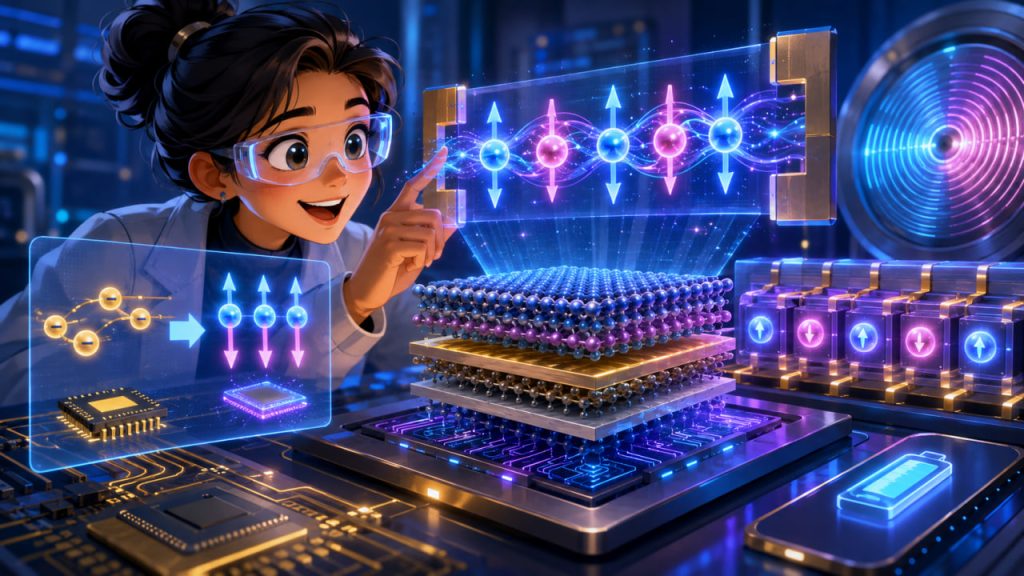
Spintronics is one of the most fascinating fields in modern physics and electronics. Traditional electronics is based mainly on the movement of electric charge. Spintronics goes deeper. It uses another property of the electron: spin.
This may sound abstract, but the idea is powerful. If scientists and engineers can control electron spin as reliably as electric charge, electronic devices could become faster, smaller, more energy-efficient, and more capable.
Spintronics already plays an important role in data storage, magnetic sensors, and memory technology. It is also one of the promising paths toward future computing systems, including low-power processors, advanced memory, and quantum-inspired devices.
What Is Spintronics?
Spintronics, short for spin electronics, is a field that studies how to use the spin of electrons in electronic devices.
An electron has electric charge. That charge allows it to move through wires, create current, and power ordinary electronic circuits.
But an electron also has spin. Spin is a quantum property that makes the electron behave somewhat like a tiny magnet. It can be described as having two basic orientations, often called spin up and spin down.
In normal electronics, engineers mostly care about whether charge is moving or not.
In spintronics, engineers care about the orientation of electron spin.
Traditional electronics asks: where is the charge going? Spintronics asks: which way is the electron’s magnetic state pointing?
Why Electron Spin Matters
Electron spin is valuable because it can store and process information.
In ordinary digital electronics, information is represented by 0s and 1s using electric charge. A transistor switches current on or off.
Spintronics offers another way to represent information. Spin states can act like binary values. For example, spin up may represent one state, and spin down may represent another.
This creates exciting possibilities.
A spin-based system could store information even when power is turned off. It could also reduce heat, because it may require less electric current than conventional charge-based systems.
The main promise of spintronics is better control over information with lower energy loss.
This matters because modern electronics faces a major problem: as devices become smaller and more powerful, heat and energy consumption become harder to manage.
How Spintronics Differs From Traditional Electronics
Traditional electronics depends mainly on moving electrons through semiconductors such as silicon.
This movement creates current. Current allows computers, phones, sensors, and digital systems to operate.
However, moving charge also produces heat. In billions of tiny transistors, this heat becomes a serious limitation.
Spintronics does not completely ignore charge, but it adds spin as a second information channel.
This means a device can use both the charge and magnetic behavior of electrons.
In simple terms:
- Electronics uses charge.
- Magnetics uses magnetic fields.
- Spintronics combines both.
That combination makes spintronics especially useful for memory and storage technologies.
The Role of Magnetism
Spintronics is closely connected to magnetism.
Because electron spin behaves like a tiny magnetic moment, materials with magnetic properties are central to many spintronic devices.
In magnetic materials, many electron spins can align in the same direction. This creates a measurable magnetic state.
By controlling that state, engineers can store information.
For example, one magnetic orientation can represent 0, and the opposite orientation can represent 1.
The ability to read and write magnetic states is the foundation of several important spintronic technologies.
Spintronics turns magnetism into a practical tool for digital information.
Giant Magnetoresistance: A Breakthrough Discovery
One of the most important discoveries in spintronics was giant magnetoresistance, often abbreviated as GMR.
GMR occurs in very thin layers of magnetic and non-magnetic materials. When the magnetic layers are aligned in one way, electrical resistance changes. When they are aligned differently, resistance changes again.
This effect made it possible to build extremely sensitive magnetic read heads for hard disk drives.
That improvement allowed computers to store much more data in smaller spaces.
The discovery of GMR was so important that physicists Albert Fert and Peter Grünberg received the Nobel Prize in Physics in 2007 for their work on it.
This was a major moment for spintronics because it proved that electron spin could be used in real commercial technology.
Spintronic Memory
One of the most promising applications of spintronics is memory.
A well-known example is MRAM, or magnetoresistive random-access memory.
MRAM stores information using magnetic states instead of electric charge stored in capacitors. This gives it several attractive advantages.
MRAM can be:
- Non-volatile
- Fast
- Durable
- Energy-efficient
- Resistant to radiation in some designs
Non-volatile means the memory can keep data even when the power is off.
This is a major advantage over many traditional memory systems, which lose information when electricity stops.
Spintronic memory could help create devices that turn on instantly, waste less power, and store data more reliably.
MRAM is already used in some specialized applications and continues to develop as manufacturing improves.
Spin-Transfer Torque and Spin-Orbit Torque
To use spin in real devices, engineers need ways to control magnetic states.
Two important methods are spin-transfer torque and spin-orbit torque.
Spin-transfer torque works when a spin-polarized current transfers angular momentum to a magnetic layer. This can switch the direction of magnetization.
Spin-orbit torque uses interactions between electron motion and spin inside certain materials to control magnetic states more efficiently.
Both methods are important because they help write information into spintronic memory cells.
The goal is to switch magnetic bits quickly, reliably, and with as little energy as possible.
Why Spintronics Could Reduce Energy Use
Modern computing consumes enormous amounts of electricity.
Data centers, smartphones, artificial intelligence systems, cloud platforms, and billions of connected devices all require memory and processing power.
A large part of energy loss in electronics comes from moving charge and generating heat.
Spintronics may reduce this problem by using magnetic states that can remain stable without constant power.
For example, non-volatile memory does not need electricity to preserve stored data. That means devices could spend less energy maintaining information.
This does not mean spintronics will magically replace all electronics. But it can improve specific parts of computing, especially memory, storage, sensors, and low-power devices.
Spintronics and Quantum Technology
Spin is a quantum property, so spintronics naturally connects with quantum science.
In some advanced research, electron spin is studied as a possible basis for quantum bits, or qubits.
A qubit can represent more complex information than a classical bit because of quantum properties such as superposition and entanglement.
Spin-based quantum systems are still difficult to build and control, but they are a major area of research.
This connection makes spintronics important not only for near-term electronics, but also for future computing ideas.
Spintronics sits at the border between practical electronics and quantum physics.
Expert Perspective
Physicist Albert Fert, one of the pioneers of spintronics, has described the field as a way to exploit not only the charge of electrons but also their spin. This idea changed the direction of electronic technology because it showed that information could be controlled through magnetic quantum properties, not only through electric current.
His work helped transform spintronics from a laboratory concept into a real technological platform.
The key lesson is simple: when scientists learned to control spin, electronics gained a second dimension.
Real-World Applications of Spintronics
Spintronics is already used in several areas.
The most famous application is magnetic data storage. GMR-based read heads helped hard drives become much more powerful.
Spintronic sensors are used to detect magnetic fields with high sensitivity. These sensors can appear in automotive systems, industrial equipment, navigation, robotics, and medical technologies.
MRAM is another growing application. It offers a possible bridge between fast memory and permanent storage.
Spintronics may also support neuromorphic computing, where devices are designed to imitate some features of the brain. Magnetic devices can be used to create energy-efficient artificial synapses and neurons in experimental systems.
Challenges Facing Spintronics
Spintronics is powerful, but it is not simple.
Engineers must control extremely small magnetic structures with great precision. Materials must be stable, reliable, and compatible with existing semiconductor manufacturing.
Major challenges include:
- Reducing switching energy
- Improving device speed
- Increasing memory density
- Managing heat
- Finding better materials
- Scaling production
- Maintaining long-term reliability
There is also the challenge of integration. Spintronic devices must work smoothly with ordinary silicon-based electronics.
The future of spintronics depends not only on physics, but also on manufacturing, cost, and industrial adoption.
The Future of Spintronics
The future of spintronics looks promising because modern technology needs exactly what spintronics can offer: lower power consumption, faster memory, better sensors, and new computing models.
As artificial intelligence, mobile devices, electric vehicles, robotics, and the Internet of Things continue to grow, efficient information processing will become even more important.
Spintronic devices may become key components in next-generation memory, edge computing, secure electronics, and advanced sensors.
The deeper promise is even bigger.
Spintronics shows that the electron is not only a tiny carrier of charge. It is also a quantum object with magnetic identity.
By using spin, scientists are learning how to build electronics that are not just smaller, but smarter.
Interesting Facts
- Spintronics uses electron spin as well as electric charge.
- Electron spin behaves like a tiny magnetic property.
- Giant magnetoresistance helped revolutionize hard disk storage.
- The Nobel Prize in Physics 2007 was awarded for the discovery of GMR.
- MRAM can store data even when power is turned off.
- Spintronic sensors can detect very small magnetic fields.
- Spintronics connects classical electronics with quantum physics.
- Future spintronic devices may help reduce energy use in computing.
- Some spin-based systems are being studied for quantum computing.
- Spintronics could support new forms of brain-inspired computing.
Glossary
- Spintronics — A field of electronics that uses electron spin as well as electric charge.
- Electron Spin — A quantum property of the electron that behaves like a tiny magnetic orientation.
- Charge — The electric property of particles that allows current to flow.
- Magnetic Moment — A property that makes a particle or material respond to magnetic fields.
- Spin Up and Spin Down — Simplified names for two possible spin orientations.
- Giant Magnetoresistance — A change in electrical resistance caused by different magnetic alignments in thin material layers.
- MRAM — Magnetoresistive random-access memory, a type of memory that stores data using magnetic states.
- Non-Volatile Memory — Memory that keeps stored data even when power is off.
- Spin-Transfer Torque — A method of switching magnetization using a spin-polarized current.
- Spin-Orbit Torque — A method of controlling magnetization through interaction between electron spin and motion.
- Quantum Property — A property that belongs to particles at very small scales and follows quantum physics.
- Qubit — A quantum bit used in quantum computing.
- Neuromorphic Computing — Computing inspired by the structure and behavior of the brain.