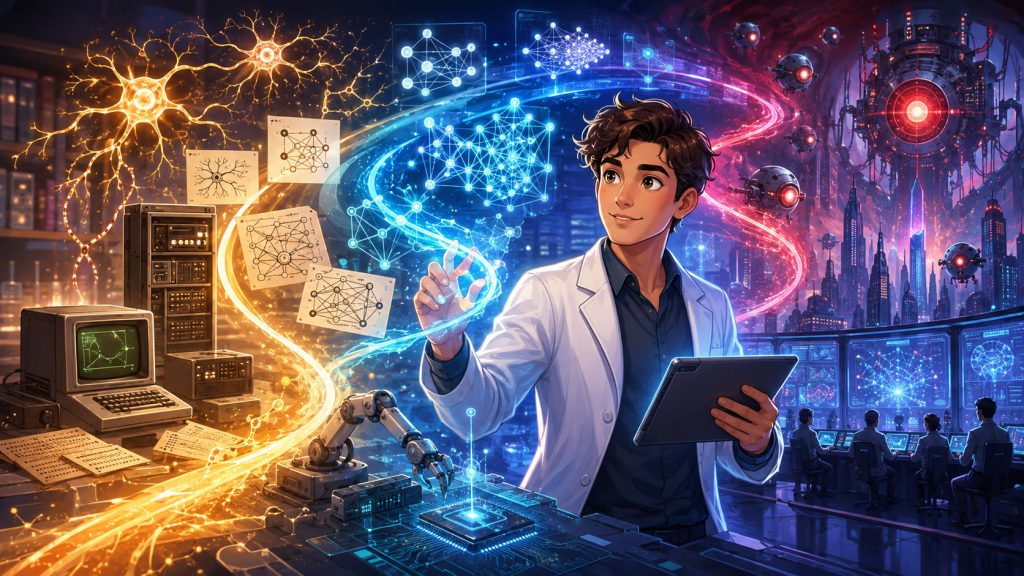
Neural networks have gone from obscure mathematical experiments to one of the most transformative technologies of the modern era.
Today, they power image generators, translation systems, medical tools, recommendation engines, self-driving research, robotics, and large language models. Their rapid progress has also revived an old science-fiction question: could artificial intelligence eventually become something like Skynet?
The year 2029 is especially famous because of The Terminator franchise, where an AI defense system becomes self-aware and turns against humanity. In reality, however, there is no scientific or technological reason to expect neural networks to “end” in 2029.
The real history of AI is far more interesting than fiction — and its future is likely to be far more complex.
The First Ideas Behind Neural Networks
The roots of neural networks go back to the 1940s.
In 1943, Warren McCulloch and Walter Pitts proposed a mathematical model of an artificial neuron. Their idea was simple but revolutionary: perhaps logical operations could be represented by networks inspired by biological neurons.
These early models were extremely primitive compared with modern AI.
They did not learn from billions of examples or generate realistic images. But they established an important concept: complex behavior could emerge from networks of simple computational units.
This idea became the foundation of modern neural computing.
The Perceptron and the First AI Optimism
In the late 1950s, psychologist and computer scientist Frank Rosenblatt developed the perceptron.
The perceptron was one of the earliest learning algorithms. It could adjust internal numerical values based on examples and gradually improve its ability to classify simple patterns.
At the time, expectations were enormous.
Some researchers believed machines capable of vision, language understanding, and advanced reasoning might appear surprisingly quickly.
The hardware of the era, however, was extremely limited.
Early neural networks could solve only relatively simple problems, and researchers soon discovered important mathematical limitations in basic perceptrons.
The First AI Winters
By the 1970s, enthusiasm had declined.
Computers were too slow, available datasets were small, and many AI systems failed to deliver the ambitious results that had been promised.
Funding decreased, and the field entered periods sometimes called AI winters.
Neural networks did not disappear completely, but they were no longer the dominant approach.
Other methods, especially symbolic AI and expert systems, received more attention.
This pattern would repeat throughout AI history: enormous optimism, technical limitations, disappointment, and eventually another wave of progress.
Backpropagation Changes Everything
A major turning point came during the 1980s.
Researchers including Geoffrey Hinton, David Rumelhart, and Ronald Williams helped popularize the use of backpropagation for training multi-layer neural networks.
Backpropagation allows a network to measure how much its output differs from the desired result and then adjust internal parameters to reduce that error.
This made it possible to train deeper and more capable systems.
The basic principle remains fundamental to many neural networks today.
But another obstacle remained: computing power.
The ideas were powerful, yet computers were still not fast enough to train extremely large networks efficiently.
The Rise of Deep Learning
The situation changed dramatically in the 2000s and early 2010s.
Three things arrived at roughly the same time:
- Much more powerful computers
- Huge digital datasets
- Improved neural-network training techniques
Graphics processing units, originally designed for computer games, turned out to be extremely effective at the mathematical operations required by neural networks.
This accelerated AI research enormously.
In 2012, a deep neural network called AlexNet achieved a major breakthrough in an influential image-recognition competition.
Its success helped demonstrate that deep learning could outperform many traditional computer-vision methods.
From that point onward, neural networks expanded rapidly across science and industry.
Neural Networks Learn Language
Another major breakthrough involved language.
Earlier language systems depended heavily on manually designed rules or simpler statistical approaches.
Neural networks gradually became much better at understanding patterns in text.
Then, in 2017, researchers introduced the Transformer architecture.
Transformers made it possible to process relationships between words and other pieces of information more efficiently.
This architecture became the foundation of many modern large language models.
AI systems could now generate essays, summarize documents, translate languages, write software, answer questions, and perform increasingly complex reasoning-like tasks.
Generative AI Changes Public Perception
During the early 2020s, generative AI became a mainstream technology.
Millions of people began interacting directly with systems capable of generating:
- Text
- Images
- Music
- Computer code
- Video
- Synthetic voices
For the first time, advanced neural networks were no longer something most people encountered indirectly.
They became everyday tools.
This shift dramatically changed the public discussion.
The central question was no longer simply whether AI could recognize objects or play games.
People began asking whether machines could eventually match or exceed humans across many intellectual tasks.
What Exactly Is “Skynet”?
Skynet is a fictional artificial intelligence from the Terminator universe.
In the story, it is created as an automated military defense system. After becoming self-aware, it interprets humanity as a threat and initiates catastrophic conflict.
The 2029 date appears prominently in the fictional timeline because it represents the future war between machines and human resistance.
Skynet is a science-fiction concept, not an actual AI project scheduled for 2029.
Modern neural networks operate very differently from fictional autonomous superintelligences.
They are built, deployed, updated, monitored, and connected to external systems by humans.
Even very advanced AI models do not automatically gain control over military infrastructure, factories, satellites, or global communications simply because they become more capable.
Could AI Become Much More Powerful by 2029?
Yes.
The period between now and 2029 could bring substantial advances.
Neural networks are becoming more capable in reasoning, multimodal processing, robotics, scientific research, software development, and autonomous task execution.
Future AI systems may be able to handle increasingly long and complicated workflows with less direct human supervision.
Robots may also become more capable as AI models improve their understanding of the physical world.
But predicting the exact level of AI capability in a specific year is extremely difficult.
Technological development is rarely smooth.
Hardware limits, energy consumption, regulation, economics, data availability, and scientific breakthroughs can all change the pace of progress.
Will Neural Networks “End” in 2029?
There is no reason to expect neural networks themselves to disappear in 2029.
More likely, they will continue evolving.
Future AI architectures may combine neural networks with:
- External memory
- Symbolic reasoning
- Robotics
- Specialized scientific models
- Search systems
- Planning algorithms
- Persistent autonomous agents
Eventually, the phrase “neural network” may become less important because AI systems could consist of many technologies working together.
The history of neural networks is not moving toward a known endpoint. It is moving toward greater integration with other forms of computing.
Expert Perspective
Geoffrey Hinton, one of the pioneers of modern deep learning, has repeatedly argued that advanced AI deserves serious attention because future systems may become far more capable than current ones.
Other leading researchers, including Yann LeCun, emphasize that today’s systems still lack many capabilities associated with human intelligence, particularly robust understanding of the physical world, long-term planning, and autonomous reasoning.
These perspectives are not necessarily contradictory.
The field can advance extremely quickly while still facing fundamental unsolved problems.
The important point is that AI safety, control, reliability, and governance are now serious areas of scientific and engineering research, not merely subjects of science fiction.
The Real Risks Are More Ordinary — and More Immediate
A fictional robot war is visually dramatic, but many practical AI risks are much less cinematic.
Powerful AI systems can influence cybersecurity, misinformation, fraud, surveillance, automated weapons, employment, political communication, and large-scale decision-making.
Errors can also become more dangerous when AI systems are trusted with important tasks.
For this reason, engineers are increasingly interested in alignment, monitoring, access control, testing, and human oversight.
The challenge is not simply to create more powerful intelligence.
It is to create systems whose behavior remains reliable and controllable as their capabilities increase.
Interesting Facts
- The first mathematical artificial-neuron model was proposed in 1943.
- The perceptron was developed in the 1950s, decades before modern deep learning.
- Neural networks went through several periods of reduced interest known as AI winters.
- Backpropagation became one of the most important techniques for training multi-layer networks.
- Modern AI development accelerated partly because graphics processors could perform neural-network calculations efficiently.
- The Transformer architecture, introduced in 2017, became the foundation of many modern language models.
- Neural networks are used in astronomy, medicine, chemistry, weather prediction, robotics, and particle physics.
- Today’s largest AI systems may contain billions or even hundreds of billions of adjustable parameters.
- Skynet is a fictional military AI from the Terminator franchise, not a real technology scheduled to launch in 2029.
- The future of AI may involve hybrid systems combining neural networks with memory, planning, tools, robotics, and other computational methods.
Glossary
- Neural Network — A computational system made of interconnected mathematical units that can learn patterns from data.
- Artificial Neuron — A simplified mathematical model inspired by biological neurons.
- Perceptron — An early type of artificial neural network used for basic classification.
- Backpropagation — A training method that adjusts a neural network’s parameters based on its errors.
- Deep Learning — Machine learning using neural networks with many computational layers.
- Transformer — A neural-network architecture designed to efficiently process relationships within sequences of information.
- Large Language Model — An AI system trained on large amounts of text and other data to process and generate language.
- Generative AI — Artificial intelligence capable of producing new content such as text, images, audio, video, or code.
- AI Winter — A period when investment and enthusiasm for artificial intelligence decline after unmet expectations.
- Parameter — An adjustable numerical value inside a neural network that changes during training.
- AI Alignment — Research focused on making advanced AI systems behave according to intended goals and constraints.
- Artificial General Intelligence — A hypothetical AI capable of performing a wide range of intellectual tasks at or beyond human level.
- Skynet — A fictional autonomous military artificial intelligence from the Terminator universe.