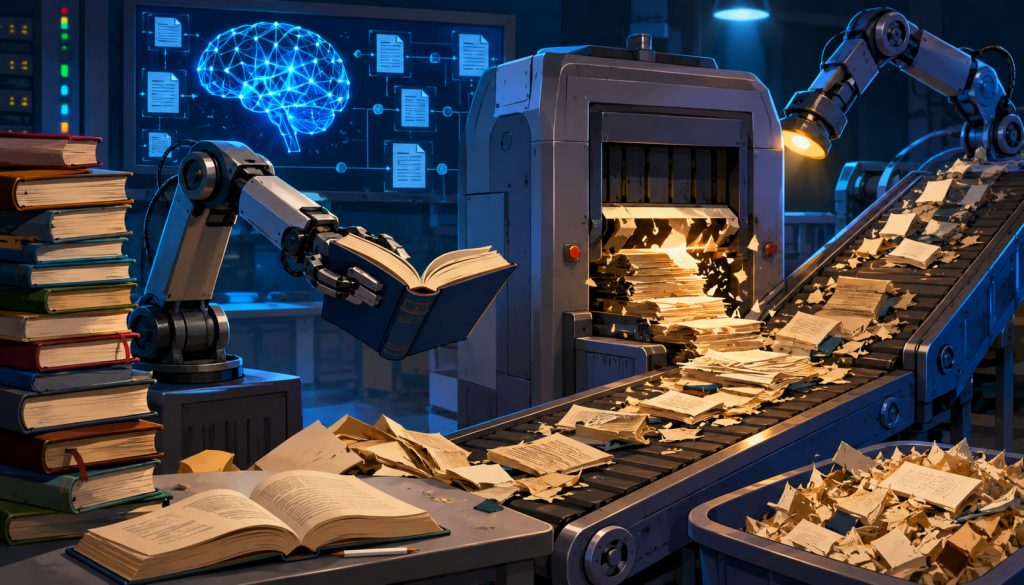
The idea sounds almost absurd: companies building some of the most advanced artificial intelligence systems in history are buying physical books, cutting them apart, scanning them, and sometimes discarding the originals.
Yet this has happened.
The reason is not that AI developers are trying to eliminate literature. In some large-scale digitization projects, physical books are sacrificed because destroying the binding can make high-speed scanning dramatically faster, cheaper, and more accurate.
Books contain something AI developers value enormously: carefully edited human language.
Why Neural Networks Need So Much Text
Modern large language models learn statistical patterns from enormous collections of text.
During training, a model analyzes relationships between words, sentences, concepts, writing styles, and factual information.
The larger and more diverse the training collection, the more linguistic patterns the system can potentially learn.
Internet pages provide vast quantities of text, but online information has limitations.
It may contain:
- Repetitive material
- Spam
- Poorly edited writing
- Automatically generated content
- Short fragments
- Duplicate pages
- Missing historical material
Books are different.
A professionally published book may contain tens of thousands of words that have been written, edited, structured, and reviewed.
For AI training, books are unusually dense sources of coherent human language.
Why Not Simply Download Digital Books?
Many books already exist as e-books, but access is complicated.
Digital editions can be protected by licensing agreements, technological restrictions, copyright rules, or publisher-controlled distribution systems.
Many older books were never officially converted into convenient machine-readable formats.
Libraries may possess physical copies while no clean digital text exists.
For organizations building enormous text collections, purchasing a physical copy can therefore provide a straightforward way to legally acquire the physical object.
The next problem is converting hundreds of pages into digital text.
How a Physical Book Becomes AI Training Data
A normal flatbed scanner is painfully slow for industrial-scale digitization.
Someone would need to open each book, position every page, scan it, turn the page, and repeat the process hundreds of times.
At the scale of millions of books, this becomes enormously expensive.
Industrial digitization can work differently.
The book’s binding is removed, leaving separate pages. Those pages can then be fed rapidly through automatic document scanners.
A machine can process page after page at high speed.
Optical character recognition software then converts the photographed pages into editable digital text.
The destruction of the physical book is therefore often a side effect of optimizing the scanning process.
Why Cut the Spine Off?
Book bindings are designed for reading, not automated scanning.
Pages curve toward the center of an open book, creating shadows, distortions, and hidden text near the spine.
Removing the binding solves several problems at once.
Pages become flat.
They can pass through automatic feeders.
Scanning becomes faster.
Image quality improves.
OCR software can recognize text more reliably.
For a company processing a few books, destroying them would make little sense.
For a project involving hundreds of thousands or millions of volumes, the economics are very different.
Are the Books Literally Thrown Away?
Sometimes a destructively scanned book cannot realistically be returned to normal use.
Once its spine has been removed and its pages separated, restoring it would require rebinding.
If a company purchased inexpensive mass-market copies primarily for digitization, preserving every physical volume may not be considered worthwhile.
This is one reason reports about AI companies “destroying books” attracted so much attention.
There is something culturally uncomfortable about seeing a book treated as temporary raw material.
But technically, the company may value the information contained inside the book rather than the physical object itself.
Why Books Are So Valuable to AI
The quality of training data matters.
A random online comment and a carefully edited history book are both text, but they are very different forms of language.
Books provide long-form structure.
A model encounters arguments developed across chapters, characters maintained across hundreds of pages, technical explanations, historical narratives, specialized vocabulary, and literary styles.
Books also preserve information that may be poorly represented online.
Older science, philosophy, biographies, regional histories, academic writing, and literature can expand the range of language available to a model.
For developers trying to build systems capable of handling sophisticated writing, large book collections are extremely attractive datasets.
The Copyright Problem
Owning a physical book does not automatically mean owning its copyright.
This distinction is central to debates surrounding AI training.
Buying a novel gives someone ownership of that physical copy. It does not normally give them the right to publish unlimited new copies of the novel.
AI training created a new legal question: does converting a purchased book into machine-readable data and using it to train a model count as an ordinary computational use, or does it infringe the author’s rights?
Courts, governments, publishers, authors, and technology companies have been debating where these boundaries should be drawn.
Different stages of the process may raise different questions.
Acquiring a lawful copy, creating a digital archive, training a model, and reproducing passages are not necessarily the same legal act.
Why AI Developers Want Permanent Digital Libraries
Training a major neural network is expensive.
Once companies assemble large datasets, they often want those collections available for future experiments.
A digitized library can be searched instantly.
Researchers can remove duplicates, classify books by subject, analyze language, filter content, and create different training subsets.
Physical books cannot provide that flexibility.
A warehouse containing a million books is primarily a storage problem.
A digital collection containing the same text becomes a computational resource.
This transformation from physical library to machine-readable dataset explains why scanning operations can be strategically important.
Is AI Really “Destroying Books”?
The phrase is technically true in some cases but can also be misleading.
AI companies are not systematically trying to make books disappear from society.
When destructive scanning occurs, companies generally acquire copies because they want to preserve and process the information inside them digitally, not erase it.
In that sense, the physical object can be destroyed while its textual content survives as data.
The deeper debate concerns what happens next.
Authors may see books as creative works with rights attached to them.
AI companies may also see them as information from which statistical patterns can be learned.
Libraries see books as cultural records.
Readers see them as experiences.
The same object therefore has several different kinds of value.
Expert Perspective
Copyright scholars and digital-library specialists frequently distinguish between ownership of a physical copy and ownership of the intellectual property contained within it.
That distinction existed long before modern AI.
Artificial intelligence has made it much more important because machines can analyze an entire library at a scale no human reader could match.
From a technical perspective, digitization allows knowledge to be searched, analyzed, and preserved efficiently.
From the perspective of writers and publishers, the crucial questions concern permission, compensation, control, and how copyrighted works contribute to commercial AI systems.
The controversy is therefore not really about paper. It is about who should control the transformation of human creative work into machine-learning data.
Could Future AI Reduce the Need to Destroy Books?
Probably.
Modern scanning systems are improving rapidly.
High-resolution cameras can photograph open books without removing bindings.
Computer vision can correct curved pages, shadows, perspective distortion, and uneven lighting.
Robotic page-turning systems can automate nondestructive scanning.
Publishers may also increasingly license digital collections directly for AI use.
As more literature becomes available in authorized digital formats, physically cutting books apart may become less attractive.
Ironically, the same advances in artificial intelligence that created demand for enormous book datasets could eventually make nondestructive book digitization much easier.
Interesting Facts
- A typical novel can contain roughly 70,000–120,000 words, making books dense sources of long-form training text.
- Destructive book scanning existed long before the current generative-AI boom.
- Libraries and technology companies have digitized millions of books for search and preservation projects.
- OCR stands for Optical Character Recognition, the technology that converts page images into machine-readable text.
- Removing a book’s binding allows loose pages to pass through high-speed document scanners.
- Modern computer vision can digitally flatten photographs of curved book pages.
- Rare and historically valuable books are generally candidates for careful nondestructive scanning rather than industrial page separation.
- A digital book collection can be searched and analyzed far faster than the same collection stored physically.
- AI systems do not normally store books internally in the same way a hard drive stores individual documents; training changes numerical parameters based on patterns found across enormous datasets.
- Books are particularly useful for language training because they contain long, structured sequences rather than isolated sentences.
Glossary
- Training Data — Information used to adjust the internal parameters of a machine-learning model.
- Large Language Model (LLM) — A neural network trained on large amounts of language data to process and generate text.
- Dataset — An organized collection of information used for analysis or machine learning.
- Digitization — Converting physical or analog information into digital form.
- Destructive Scanning — A digitization method in which a book’s binding is removed so individual pages can be scanned rapidly.
- Nondestructive Scanning — Digitizing a book while keeping the physical volume intact.
- OCR — Optical Character Recognition, software that identifies letters and words inside scanned images.
- Copyright — Legal protection governing certain uses of original creative works.
- Machine-Readable Text — Text stored in a format that computer software can directly process and analyze.
- Model Parameter — A numerical value inside a neural network that is adjusted during training.
- Corpus — A large organized collection of written or spoken language used for research or computational analysis.
- Digital Library — A structured collection of books, documents, or other materials stored electronically.