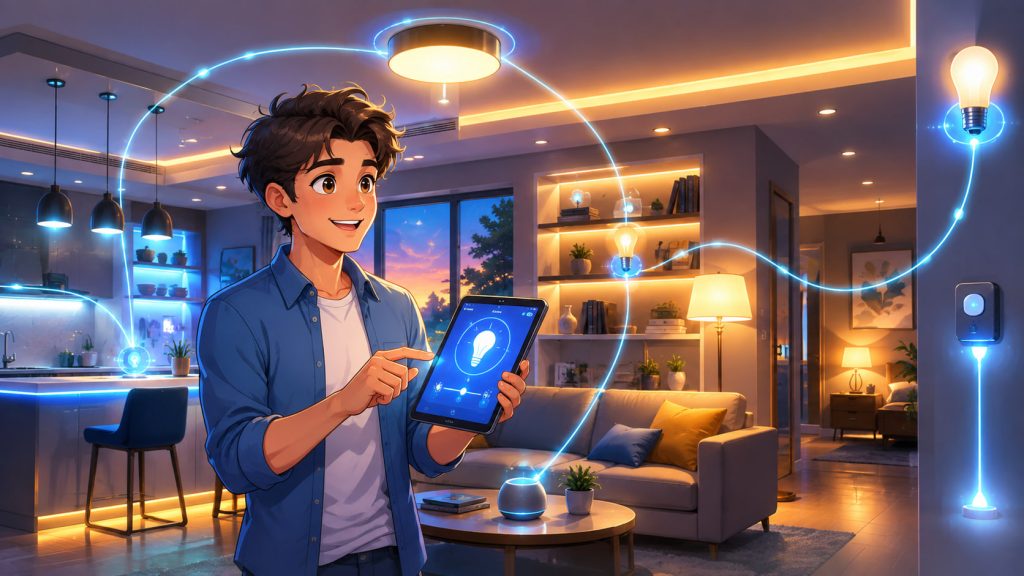
Smart home lighting has evolved far beyond switching lamps on and off with a phone.
Modern systems can automatically adjust brightness, color temperature, schedules, and individual rooms based on time, movement, daylight, and personal preferences. They can also work together with security systems, voice assistants, sensors, blinds, thermostats, and other connected devices.
For many households, smart lighting is one of the easiest and most practical ways to enter the world of home automation.
It can improve comfort, reduce unnecessary energy use, create different moods, and make everyday routines more convenient.
What Is Smart Home Lighting?
Smart lighting refers to lamps, bulbs, switches, dimmers, controllers, and sensors that can be managed digitally.
Instead of relying only on a traditional wall switch, users can control lighting through:
- Smartphone applications
- Voice assistants
- Smart wall switches
- Motion sensors
- Timers and schedules
- Presence sensors
- Automated routines
Some systems operate through Wi-Fi, while others use communication standards such as Zigbee, Bluetooth, Thread, or Matter-compatible platforms.
The main advantage is flexibility.
A single light can be controlled individually, while entire rooms or even the whole house can be managed as one system.
Smart Bulbs vs. Smart Switches
There are two common approaches to smart lighting.
Smart bulbs contain their own wireless electronics. They can often change brightness, color temperature, or full RGB color.
Smart switches replace traditional wall switches and control the electrical circuit itself.
Smart bulbs are usually easier to install because they simply replace existing bulbs.
Smart switches are often more convenient for permanent home systems because people can continue using familiar wall controls.
The best solution often combines both approaches depending on the room and the type of lighting.
Decorative lamps may work well with smart bulbs, while ceiling fixtures may be better controlled through smart switches or dimmers.
Why Automation Is More Important Than Remote Control
Being able to turn off a lamp from a smartphone is useful, but automation is where smart lighting becomes truly valuable.
A well-designed system can react automatically.
For example, lights can turn on when someone enters a hallway after sunset.
Bedroom lights can gradually brighten in the morning.
Outdoor lighting can activate when motion is detected.
The entire house can switch to a lower evening brightness at a chosen time.
The goal of a good smart home is not to make people constantly use an app. It is to make technology disappear into everyday routines.
The best lighting automation works quietly in the background.
Motion and Presence Sensors
Motion sensors have been used for decades, but modern smart homes can make them much more sophisticated.
A traditional motion sensor may simply detect movement.
More advanced presence sensors can identify subtle movements, allowing the system to determine whether someone is still sitting in a room.
This is particularly useful in offices, bathrooms, kitchens, and living rooms.
A poorly configured motion system can become frustrating if lights turn off while someone is sitting still.
Presence detection helps solve this problem.
Smart systems can also combine sensor information with time of day and ambient light levels.
For example, a hallway light does not need to activate during a bright afternoon simply because someone walks past.
Using Natural Daylight More Efficiently
One of the most practical features of smart lighting is daylight-responsive control.
Light sensors can measure how much natural illumination is already available.
If sunlight is sufficient, artificial lights can remain dimmed or switched off.
As daylight decreases, the system can gradually increase interior lighting.
This technique is often called daylight harvesting.
It is widely used in commercial buildings and can also be applied in modern homes.
The result can be both greater comfort and reduced electricity consumption.
Color Temperature Matters
Not all white light looks the same.
Warm white lighting has a yellowish appearance similar to traditional incandescent lamps.
Cooler white lighting appears brighter and more blue.
Color temperature is measured in kelvins.
Lower values usually produce warmer light, while higher values create cooler light.
Smart lighting systems can automatically adjust this throughout the day.
In the morning and daytime, cooler and brighter light can support alertness and visibility.
In the evening, warmer and softer lighting can create a more relaxing atmosphere.
Dynamic lighting allows one fixture to serve several different purposes throughout the day.
Smart Lighting and Sleep
Light strongly influences the human circadian rhythm.
The body uses environmental light as one of the signals that helps regulate sleep and wake cycles.
Bright light during the daytime can support alertness, while excessive bright or blue-rich light late at night may interfere with natural preparation for sleep.
Smart lighting can gradually reduce brightness and shift toward warmer tones in the evening.
In the morning, lights can slowly become brighter before an alarm.
This does not mean smart bulbs can cure sleep problems, but carefully designed lighting can support a healthier daily rhythm.
Expert Perspective
Lighting specialists often emphasize that good lighting design is not simply about installing brighter lamps.
It is about placing the correct amount and quality of light where people actually need it.
Human-centric lighting design considers factors such as brightness, glare, color temperature, daylight exposure, task requirements, and time of day.
The same principle applies to smart homes.
Automation should improve good lighting design rather than compensate for poor fixture placement or excessive brightness.
A well-designed room may combine general lighting, task lighting, and accent lighting rather than depending on one powerful ceiling fixture.
Scenes Make Lighting Much More Useful
One of the most convenient smart-home features is the ability to create lighting scenes.
A scene stores several lighting settings and activates them together.
A “Movie” scene might dim ceiling lights while leaving subtle indirect lighting behind the television.
A “Dinner” scene could create warmer, softer illumination around the dining area.
A “Cleaning” scene might turn every light to maximum brightness.
A “Night” scene could switch off most of the house while leaving low-level hallway lighting active.
Instead of controlling ten individual lamps, users activate one scene.
Smart Lighting Can Improve Home Security
Lighting can also contribute to security.
Outdoor lights can activate when movement is detected around entrances.
Indoor lights can turn on automatically when a security system detects activity.
When residents are traveling, lighting schedules can simulate normal household activity.
More advanced systems can vary the timing slightly instead of switching lights at exactly the same minute every night.
Smart lighting should not replace alarms, locks, or cameras, but it can become part of a broader home-security strategy.
Energy Savings: How Much Can Smart Lighting Help?
LED lighting already uses significantly less electricity than older incandescent technology.
Smart controls can reduce consumption further by ensuring lights operate only when necessary.
The greatest savings usually come from:
- Automatic shutoff
- Occupancy detection
- Dimming
- Daylight-responsive control
- Scheduling
- Efficient LED fixtures
The actual savings depend on household habits.
A home where people already switch lights off carefully may see a smaller difference.
In a larger home where lights are frequently left on, automation can have a much greater effect.
What Happens When the Internet Goes Down?
This is an important question when selecting a system.
Some smart lighting systems depend heavily on cloud servers.
If the internet connection fails, certain app features or remote controls may stop working.
Systems with local control can often continue operating inside the home even without internet access.
Wall switches should also remain functional whenever possible.
A reliable smart home should still function as a normal home when its internet connection disappears.
For permanent installations, local automation is often more dependable than cloud-only control.
Privacy and Cybersecurity
Smart lighting is part of the Internet of Things.
Connected bulbs, switches, hubs, and controllers exchange data over home networks.
Poorly secured devices can potentially create cybersecurity risks.
Users should choose reputable equipment, install firmware updates, use strong passwords, and secure their home network.
Devices that no longer receive security updates may eventually become weaker points in an otherwise well-protected system.
For this reason, long-term software support is becoming an important factor when selecting smart-home products.
Matter and the Future of Smart Lighting
One long-standing problem with smart homes has been compatibility.
A bulb from one manufacturer might not work properly with another company’s platform.
Matter was developed to improve interoperability between connected devices and ecosystems.
Combined with technologies such as Thread, it is intended to make smart-home equipment easier to install and control across different platforms.
The industry is still evolving, but greater compatibility may gradually reduce the need for homeowners to remain locked into a single manufacturer’s ecosystem.
How to Design Smart Lighting Room by Room
Different rooms benefit from different approaches.
Bedrooms work well with warm evening lighting and gradual morning routines.
Kitchens need strong task lighting over work surfaces.
Bathrooms benefit from motion or presence detection, particularly at night.
Living rooms often work best with multiple lighting layers and scenes.
Hallways are ideal for automatic low-level night lighting.
Outdoor areas can combine schedules, daylight sensors, and motion detection.
The best smart lighting system is therefore rarely identical throughout the entire house.
It should respond to how each space is actually used.
Interesting Facts
- LED lamps can use far less electricity than traditional incandescent bulbs.
- Smart lighting systems can adjust both brightness and color temperature automatically.
- Some presence sensors can detect movements much smaller than traditional motion sensors.
- Daylight harvesting reduces artificial lighting when sufficient sunlight is available.
- Smart lighting scenes can control dozens of fixtures with a single command.
- Many modern systems can continue operating locally even when internet access is unavailable.
- Warm white lighting usually has a lower color temperature than cool white lighting.
- Outdoor smart lighting can combine sunset schedules with motion detection.
- Some smart switches can measure electricity consumption as well as control lights.
- Matter was created to improve compatibility among smart-home devices from different manufacturers.
Glossary
- Smart Lighting — Lighting equipment that can be digitally controlled or automated.
- LED — Light-emitting diode, an efficient technology used in modern lighting.
- Color Temperature — A measurement describing whether white light appears warmer or cooler.
- Kelvin — The unit commonly used to describe the color temperature of lighting.
- Motion Sensor — A sensor that detects movement within an area.
- Presence Sensor — A more sensitive detector designed to determine whether someone remains in a space.
- Daylight Harvesting — Automatically reducing artificial lighting when natural daylight is sufficient.
- Lighting Scene — A saved combination of brightness, color, and fixture settings.
- Circadian Rhythm — The approximately 24-hour biological cycle involved in sleep, alertness, and other body functions.
- IoT — Internet of Things, a network of physical devices capable of digital communication.
- Matter — A smart-home interoperability standard designed to improve compatibility between connected devices.
- Thread — A low-power wireless networking technology used by many modern smart-home devices.
- Local Control — Automation that operates inside the home without depending entirely on external cloud servers.
- Dimming — Reducing the light output of a fixture without switching it completely off.