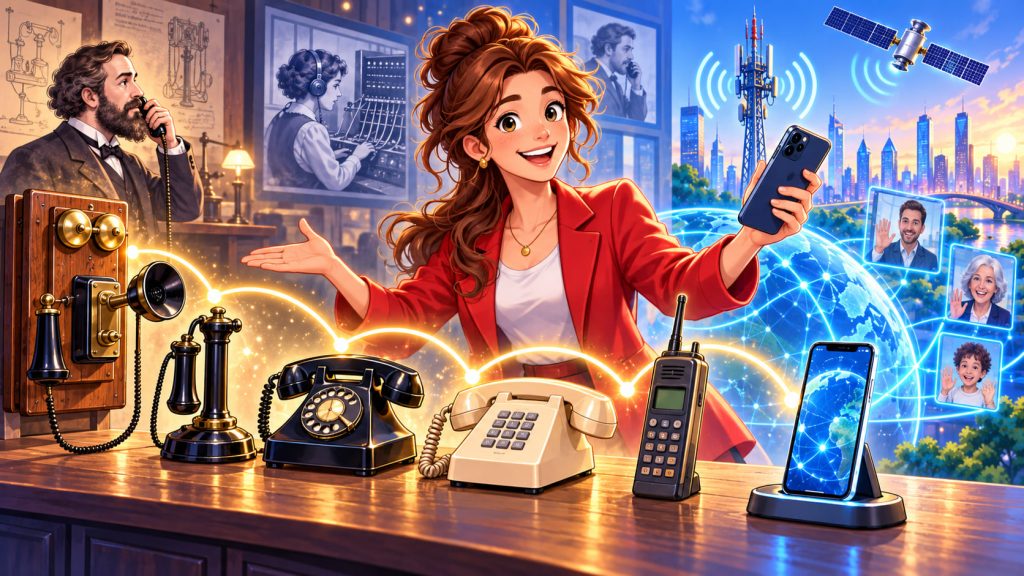
The telephone is one of the most transformative inventions in modern history. What began as an experimental device for carrying the human voice over wires eventually became a global communication system connecting billions of people.
Today, a smartphone can make calls, send messages, navigate cities, record video, access the internet, manage finances, translate languages, and connect to satellites.
But the basic idea remains surprisingly simple: convert sound into an electrical or digital signal, transmit it, and reconstruct it at the other end.
The journey from the first telephone experiments to modern mobile communication took nearly 150 years of engineering, competition, and constant reinvention.
Before the Telephone: The Age of the Telegraph
The telephone did not appear from nowhere.
Its technological ancestor was the electric telegraph.
By the 19th century, telegraph networks allowed coded messages to travel rapidly over wires. Systems based on Morse code became essential for governments, railways, businesses, newspapers, and military communication.
But telegraphy had an important limitation.
It transmitted symbols, not natural speech.
A trained operator usually had to convert words into code and then decode the message at the destination.
Inventors began asking a new question: could the human voice itself travel through an electrical wire?
The Race to Transmit Speech
Several inventors worked on this problem.
Antonio Meucci experimented with devices designed to carry voice electrically. Johann Philipp Reis built an early telephone-like apparatus in Germany. Elisha Gray developed important ideas for transmitting sounds electrically.
The most famous figure, however, was Alexander Graham Bell.
Bell had a deep interest in acoustics and speech, partly influenced by his work with deaf students and his family’s research into vocal communication.
In 1876, Bell received a major U.S. patent for his telephone system.
That same year, he successfully transmitted intelligible speech.
The famous early demonstration marked a turning point.
The telephone had moved from theory into practical communication.
Why Bell Became So Important
Bell was not the only inventor working on telephone technology.
His historical importance comes from a combination of technical success, patent protection, commercialization, and rapid development of a working communication system.
The early telephone converted sound vibrations into electrical variations.
At the receiving end, those electrical changes caused another device to recreate the original sound.
The quality was poor by modern standards, but the principle was revolutionary.
A person could speak naturally and be heard somewhere else almost immediately.
Early Telephones Were Very Simple
The first telephones looked nothing like modern devices.
Many early models had separate transmitters and receivers.
Users might speak into a fixed mouthpiece while holding a receiver to the ear.
There were no screens, buttons, apps, or electronic menus.
At first, telephones were often connected directly between two locations.
This worked for a small number of users but became impractical as telephone ownership grew.
The solution was the telephone exchange.
Telephone Exchanges Created Networks
An exchange allowed many subscribers to connect through a central switching point.
Early exchanges depended heavily on human operators.
A caller would contact the operator and request a particular person or number.
The operator physically connected the required circuits using plugs and cables.
This created a flexible network.
Instead of needing a separate wire connecting every pair of telephones, many users could share one switching system.
The telephone became truly powerful when individual devices were connected into networks.
Telephone Numbers Changed Communication
As telephone networks expanded, names alone became inefficient.
Telephone numbers provided a standardized way to identify subscribers.
Switchboards became more complicated, especially in large cities.
Eventually, engineers developed automatic exchanges.
These systems reduced the need for operators to manually connect every call.
The rotary dial became one of the most recognizable telephone technologies of the 20th century.
Users turned the dial to send electrical pulses corresponding to each digit.
Automatic switching equipment interpreted those pulses and routed the call.
Long-Distance Calling Became Possible
Early telephone signals weakened over long distances.
This made long-distance communication difficult.
Engineers developed amplifiers, loading coils, improved cables, and later vacuum-tube repeaters to strengthen signals.
Long-distance telephone lines gradually connected cities and regions.
Submarine cables eventually carried telephone communication beneath oceans.
Radio also became important for international calling.
By the middle of the 20th century, telephone networks were becoming truly global.
The Telephone Entered Everyday Life
During the early decades of telephone history, a private telephone was often a luxury.
Over time, falling costs and expanding infrastructure brought phones into homes and offices.
The telephone changed social behavior.
People could make appointments without traveling.
Businesses could negotiate instantly.
Families could communicate across long distances.
Emergency services became easier to reach.
News could spread faster.
By the mid-20th century, the home telephone had become a central part of daily life in many countries.
From Rotary Dials to Push Buttons
Rotary phones dominated for decades.
Later, push-button telephones became increasingly common.
Instead of sending dial pulses, many used dual-tone multi-frequency signaling, or DTMF.
Each button generated a unique combination of two audio frequencies.
Telephone systems could detect those tones and interpret the number being entered.
This made dialing faster and helped support automated services.
The familiar telephone keypad became a standard interface for generations.
The First Mobile Phones
The idea of mobile telephone communication appeared long before modern smartphones.
Early mobile systems were often installed in cars.
They used powerful radio transmitters and required large equipment.
Capacity was limited because only a small number of calls could be handled in a given area.
The major breakthrough was the cellular network.
Instead of treating an entire city as one radio zone, engineers divided coverage into smaller areas called cells.
Radio frequencies could then be reused in different cells.
This dramatically increased network capacity.
The Handheld Mobile Phone Arrives
In the 1970s, engineers demonstrated handheld cellular phones.
Early commercial mobile phones were large, heavy, and extremely expensive.
Battery life was short.
Coverage was limited.
Despite these problems, the idea was revolutionary: the telephone no longer had to be tied to a wall, desk, or vehicle.
During the 1980s and 1990s, mobile phones became smaller and more practical.
Digital cellular networks improved voice quality, security, and capacity.
The telephone had become a personal device carried everywhere.
SMS Changed the Way People Used Phones
Mobile phones soon became useful for more than voice calls.
Short Message Service, or SMS, allowed users to exchange text messages.
The first SMS message was sent in the early 1990s.
Texting became enormously popular because it was fast, quiet, and convenient.
Phones gradually gained contact lists, calendars, alarms, simple games, cameras, and internet features.
By the early 2000s, the mobile phone was already evolving into a multipurpose digital device.
The Smartphone Revolution
Smartphones existed in various forms before the modern touchscreen era, but a major transformation occurred when manufacturers combined powerful computing, touch interfaces, mobile internet, cameras, sensors, and downloadable applications into one device.
The smartphone became less like a telephone and more like a pocket computer.
Calls became only one feature among many.
Modern smartphones now commonly include:
- High-resolution cameras
- GPS navigation
- Internet access
- Video calling
- Messaging
- Biometric security
- Mobile payments
- Streaming
- Artificial intelligence features
- Health and fitness sensors
- Satellite communication capabilities on some models
The modern phone is a communication platform, camera, computer, navigator, wallet, entertainment system, and personal assistant in one object.
From Analog to Digital Networks
Early telephone networks carried analog electrical signals.
Modern systems are overwhelmingly digital.
Digital technology converts sound into numerical data.
That data can be compressed, encrypted, transmitted, copied, and processed efficiently.
Mobile networks evolved through several generations.
2G introduced widespread digital cellular communication.
3G expanded mobile internet access.
4G made high-speed data practical for video streaming and app-based services.
5G increased capacity, reduced latency in many situations, and improved support for large numbers of connected devices.
The telephone network has effectively merged with the internet.
Expert Perspective
Historians of technology often emphasize that the telephone was not a single invention frozen in 1876.
It was an evolving system built from many interconnected technologies.
Microphones, amplifiers, switching systems, undersea cables, radio transmission, semiconductors, digital networks, satellites, batteries, touchscreens, and software all contributed.
Bell’s early telephone proved that voice could be transmitted electrically.
Modern smartphones demonstrate what happens when that original idea is combined with more than a century of advances in electronics and computing.
What Do We Have Today?
Today, billions of people carry devices far more powerful than early computers.
A modern smartphone can connect to distant servers, communicate through cellular towers, Wi-Fi networks, Bluetooth devices, and in some cases satellites.
Voice calls themselves have also changed.
Many are no longer transmitted as traditional dedicated telephone circuits.
Instead, speech is often converted into digital data packets and sent through internet-based systems.
Video communication has become equally normal.
The telephone has therefore completed a remarkable transformation.
It began as a machine designed to transmit the human voice.
Now it is a universal gateway to digital life.
Interesting Facts
- Alexander Graham Bell received a major telephone patent in 1876.
- Several inventors, including Antonio Meucci and Elisha Gray, worked on voice transmission during the same general period.
- Early telephone exchanges relied on human operators manually connecting calls.
- Rotary dialing sent electrical pulses corresponding to each digit.
- Push-button phones commonly use combinations of audio tones known as DTMF.
- Early mobile telephone systems were often installed in cars.
- Cellular networks dramatically increased capacity by dividing coverage areas into smaller cells.
- The first handheld mobile phones were large and expensive compared with modern devices.
- SMS became one of the most influential mobile communication technologies of the 1990s.
- Smartphones combine technologies that were once found in many separate devices.
- Modern voice calls can travel partly or entirely through internet-based digital networks.
- Some current smartphones can communicate with satellites when ordinary cellular coverage is unavailable.
Glossary
- Telephone — A device or communication system designed to transmit speech over distance.
- Telegraph — A system that sends coded electrical signals over long distances.
- Telephone Exchange — A switching system that connects calls between telephone subscribers.
- Switchboard — Equipment used, especially historically, to manually connect telephone circuits.
- Rotary Dial — A circular dialing mechanism that sends electrical pulses to represent numbers.
- DTMF — Dual-tone multi-frequency signaling, a system in which keypad buttons generate pairs of audio tones.
- Cellular Network — A mobile communication network divided into geographic coverage areas called cells.
- Cell — A small geographic area served by a particular mobile network base station.
- Base Station — Radio equipment that connects mobile phones to a cellular network.
- SMS — Short Message Service, a system for sending text messages between mobile devices.
- Analog Signal — A continuously varying signal representing information such as sound.
- Digital Signal — Information represented numerically, usually in binary form.
- Smartphone — A mobile phone combining communication with advanced computing functions.
- GPS — Global Positioning System, a satellite-based navigation system used to determine location.
- 5G — A modern generation of cellular network technology designed for high data capacity, fast communication, and large numbers of connected devices.