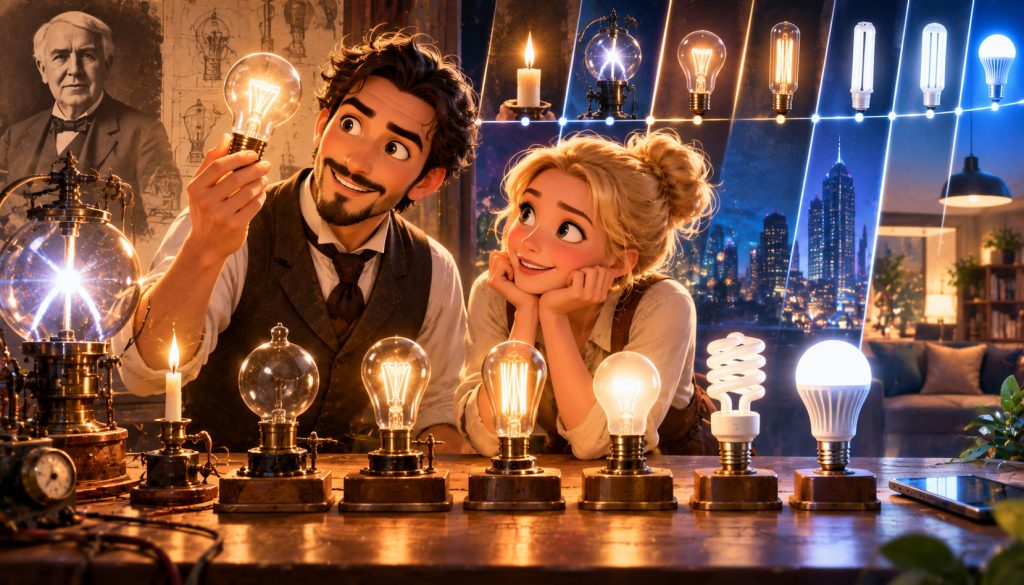
The light bulb is one of the most familiar inventions in everyday life, yet its history is far more complex than the popular story that one person simply “invented” it.
Electric lighting emerged from decades of experiments involving batteries, glowing wires, vacuum technology, carbon filaments, electrical resistance, and eventually modern semiconductor materials.
From fragile incandescent lamps to fluorescent tubes and highly efficient LEDs, the light bulb has undergone a dramatic transformation.
The real history of the light bulb is the story of making electric light brighter, safer, cheaper, and longer-lasting.
Before the Light Bulb: The First Electric Light
The earliest electric lighting experiments did not use glowing filaments.
At the beginning of the 19th century, inventors discovered that electricity could create an intense arc between two carbon electrodes.
This produced the arc lamp.
Arc lamps were extremely bright, making them useful for streets, factories, theaters, and large public spaces.
However, they had serious drawbacks.
They were too bright for ordinary homes, required frequent adjustment, and consumed substantial amounts of electricity.
A smaller, more practical source of electric light was still needed.
The Idea of Incandescence
The solution came from a different principle: incandescence.
When an electrical current passes through a material with enough resistance, the material heats up.
If it becomes hot enough, it begins to glow.
Early inventors experimented with platinum wires and other materials.
The challenge was enormous.
If the filament became hot enough to produce bright light, it often oxidized, melted, or burned out quickly.
The key was to find a material that could glow at high temperature for a useful length of time.
Why a Vacuum Was So Important
One major breakthrough was removing air from the bulb.
In ordinary air, a red-hot filament reacts rapidly with oxygen and burns.
Inside a partial vacuum, much less oxygen is available.
That allows the filament to remain hot for longer without immediately being destroyed.
Improved vacuum pumps in the 19th century therefore became essential to practical incandescent lighting.
The invention of the usable light bulb depended as much on vacuum technology as on the filament itself.
Who Actually Invented the Light Bulb?
There was no single inventor.
Many researchers contributed.
Humphry Davy demonstrated electric lighting in the early 1800s.
Warren de la Rue experimented with a platinum filament inside a vacuum tube.
Joseph Swan in Britain developed practical incandescent lamps using carbonized filaments.
Thomas Edison and his team in the United States developed commercially successful incandescent systems during the late 1870s.
Edison’s major achievement was not simply producing a glowing filament.
He worked on the entire system: bulbs, wiring, switches, generators, sockets, meters, and electricity distribution.
The practical electric light became successful because a complete infrastructure was created around it.
Edison and Swan
Joseph Swan demonstrated incandescent lamps in Britain before Edison’s commercially successful system became widely known.
Both men worked with carbon filaments.
Their designs became similar enough that patent disputes followed.
Eventually, their business interests were combined in Britain.
This is why historians generally avoid presenting Edison as the sole inventor of the light bulb.
He was one of the most important developers and commercializers, but the technology was the result of many experiments.
Carbon Filaments Were the First Practical Solution
Early practical incandescent bulbs commonly used carbon filaments.
These filaments were made by carbonizing organic materials such as paper, cotton thread, or bamboo.
Carbon could withstand high temperatures better than many earlier materials.
However, carbon filaments were still relatively inefficient.
Most of the electrical energy became heat rather than visible light.
The bulbs also had limited lifespans.
Engineers continued searching for something better.
Tungsten Changed Everything
The most important improvement in incandescent lighting was tungsten.
Tungsten has an exceptionally high melting point.
That means it can operate at much higher temperatures than carbon without melting.
A hotter filament emits more visible light and produces a brighter, whiter glow.
By the early 20th century, tungsten filaments became standard in incandescent bulbs.
Later, manufacturers filled bulbs with inert gases such as argon or nitrogen.
These gases reduced filament evaporation and helped extend lamp life.
Why Incandescent Bulbs Burn Out
An incandescent filament operates at extremely high temperature.
Even tungsten slowly evaporates.
Over time, atoms leave the filament and may deposit on the inside of the glass bulb.
The filament gradually becomes thinner.
Eventually, one section becomes too weak.
When the bulb is switched on, the rapid temperature increase can cause that thin section to break.
That familiar flash when an old bulb fails is often the final moment of filament damage.
Incandescent bulbs fail mainly because their glowing filament slowly destroys itself during normal use.
The Efficiency Problem
Traditional incandescent bulbs are inefficient.
Only a relatively small fraction of their electrical energy becomes visible light.
Most becomes infrared radiation and heat.
This is why an incandescent bulb becomes extremely hot.
For decades, engineers searched for technologies that could produce more light while wasting less energy.
This led to fluorescent lamps and later LEDs.
How Fluorescent Lamps Work
Fluorescent lighting uses a completely different mechanism.
An electric discharge passes through low-pressure mercury vapor inside a tube.
This produces ultraviolet radiation.
A phosphor coating on the inside of the tube absorbs the ultraviolet energy and emits visible light.
Fluorescent lamps are much more efficient than incandescent bulbs.
Compact fluorescent lamps, or CFLs, were later designed to fit ordinary household sockets.
However, they have drawbacks.
They contain small amounts of mercury, may take time to reach full brightness, and depend on electronic control components that can fail.
LEDs Revolutionized Lighting
The modern LED, or light-emitting diode, is not a hot filament.
It is a semiconductor device.
When electrical current passes through the semiconductor junction, electrons release energy in the form of photons.
This process is called electroluminescence.
LEDs are much more efficient than incandescent lamps.
They also operate at lower temperatures and can last many times longer.
Modern white LEDs usually combine a blue LED with phosphor materials that convert part of the blue light into other wavelengths.
The result appears white to the human eye.
LED lighting represents a fundamental shift from heating material until it glows to producing light directly through semiconductor physics.
Why LED Bulbs Still Fail
LEDs can theoretically operate for tens of thousands of hours.
So why do LED bulbs sometimes stop working much sooner?
The LED chips themselves are often not the first component to fail.
The weak point can be the electronic driver inside the bulb.
LEDs need electronics to regulate current and convert household electricity into suitable power.
Heat can damage capacitors, solder joints, and other components.
Poor ventilation makes the problem worse.
Cheap materials and poor manufacturing can also reduce lifespan dramatically.
Heat Is Still the Enemy
Even though LEDs are much more efficient than incandescent bulbs, they still generate heat.
That heat is concentrated around the semiconductor and electronics.
Good LED bulbs include heat sinks designed to move heat away.
If the bulb is installed inside a sealed fixture, the temperature can rise significantly.
Higher temperatures accelerate electronic aging.
This is why some LEDs fail prematurely even though their packaging advertises very long lifetimes.
An LED’s lifespan depends heavily on temperature management and component quality.
Why Switching Can Damage Bulbs
Different lamp types respond differently to frequent switching.
Incandescent bulbs experience thermal shock every time they are turned on.
A cold tungsten filament has lower electrical resistance.
That means a large surge of current can flow during the first fraction of a second.
This is why incandescent bulbs often fail at the moment they are switched on.
Fluorescent lamps can also suffer from repeated starting cycles.
LED bulbs generally handle frequent switching better, but their electronic drivers still experience electrical stress.
What Does “25,000 Hours” Really Mean?
A rated lifespan is not usually a promise that every bulb will suddenly fail at exactly that number of hours.
For LEDs, lifespan is often based on a reduction in light output.
An LED may still function but gradually become dimmer.
Manufacturers may use ratings based on the point at which light output has fallen to a certain percentage of its original brightness.
Real-world lifetime also depends on voltage quality, temperature, enclosure design, usage pattern, and manufacturing quality.
Two bulbs with the same advertised lifespan can therefore perform very differently.
Is Planned Obsolescence the Main Reason?
The idea that manufacturers deliberately make every bulb fail quickly is too simplistic.
There is, however, an important historical episode behind this belief.
In the 1920s, major lamp manufacturers formed the Phoebus cartel, which coordinated aspects of the international light-bulb market.
Among its controversial activities was standardizing incandescent lamp life around roughly 1,000 hours.
Longer-lasting incandescent bulbs were technically possible, but there was a trade-off.
A filament designed for extremely long life often operated at lower temperature and produced less efficient or less attractive light.
Economic motives also clearly played a role.
This historical case helped create the modern association between light bulbs and planned obsolescence.
Expert Perspective
Lighting engineers generally emphasize that lamp longevity is a trade-off between temperature, brightness, efficiency, materials, electronics, and cost.
In incandescent bulbs, a hotter filament produces better light efficiency but shortens filament life.
In LED bulbs, the semiconductor itself may be highly durable, while the driver electronics become the limiting factor.
This means that simply designing a bulb to “last forever” is not straightforward.
Every lighting technology involves compromises.
Why We Still Keep Buying New Bulbs
Modern bulbs last much longer than early incandescent lamps, but no manufactured product is completely permanent.
Materials age.
Electronic components degrade.
Heat causes chemical and mechanical changes.
Power surges can damage circuits.
Solder joints can weaken.
Phosphors slowly lose efficiency.
Seals can fail.
In inexpensive LED bulbs, cost-cutting may also reduce durability.
The good news is that lighting lifespan has improved dramatically.
A high-quality LED can last many years under normal household use while consuming a fraction of the energy required by a traditional incandescent bulb.
Interesting Facts
- Electric arc lamps existed decades before practical incandescent bulbs.
- Thomas Edison was not the only inventor of the incandescent lamp.
- Joseph Swan independently developed practical electric lighting in Britain.
- Early incandescent bulbs often used carbonized plant fibers as filaments.
- Tungsten became ideal for incandescent bulbs because of its extremely high melting point.
- Incandescent bulbs convert most of their energy into heat rather than visible light.
- Fluorescent lamps produce ultraviolet radiation before phosphors convert it into visible light.
- LEDs create light using semiconductor physics rather than a glowing wire.
- LED chips can outlast the electronic components that power them.
- Excessive heat can shorten LED lifespan dramatically.
- Incandescent bulbs often fail when switched on because of the initial current surge.
- The Phoebus cartel became famous for coordinating incandescent bulb lifespan standards during the 20th century.
- Modern LED lamps can use roughly a fraction of the electricity required by traditional incandescent bulbs for similar light output.
Glossary
- Incandescence — The emission of visible light from a material heated to a high temperature.
- Filament — A thin wire or material heated by electrical current inside an incandescent lamp.
- Tungsten — A metal with an exceptionally high melting point, widely used in incandescent filaments.
- Vacuum — A space containing very little gas, used in early bulbs to reduce filament oxidation.
- Inert Gas — A gas that reacts very little chemically, used inside some incandescent bulbs to protect the filament.
- Fluorescence — The emission of visible light after a material absorbs higher-energy radiation.
- Phosphor — A material that absorbs energy and emits visible light.
- LED — Light-emitting diode, a semiconductor device that produces light when electrical current passes through it.
- Semiconductor — A material whose electrical properties can be precisely controlled and used in electronic devices.
- Electroluminescence — The production of light directly from an electrical process within a material.
- LED Driver — Electronic circuitry that regulates the electrical power supplied to LEDs.
- Heat Sink — A component designed to remove heat from electronic devices.
- Current Surge — A brief increase in electrical current, often occurring when a device is switched on.
- Rated Lifespan — An estimated operating life based on standardized testing conditions.
- Planned Obsolescence — The practice or strategy of designing a product with a deliberately limited useful life.
- Phoebus Cartel — A historical international association of major light-bulb manufacturers formed in the 1920s.