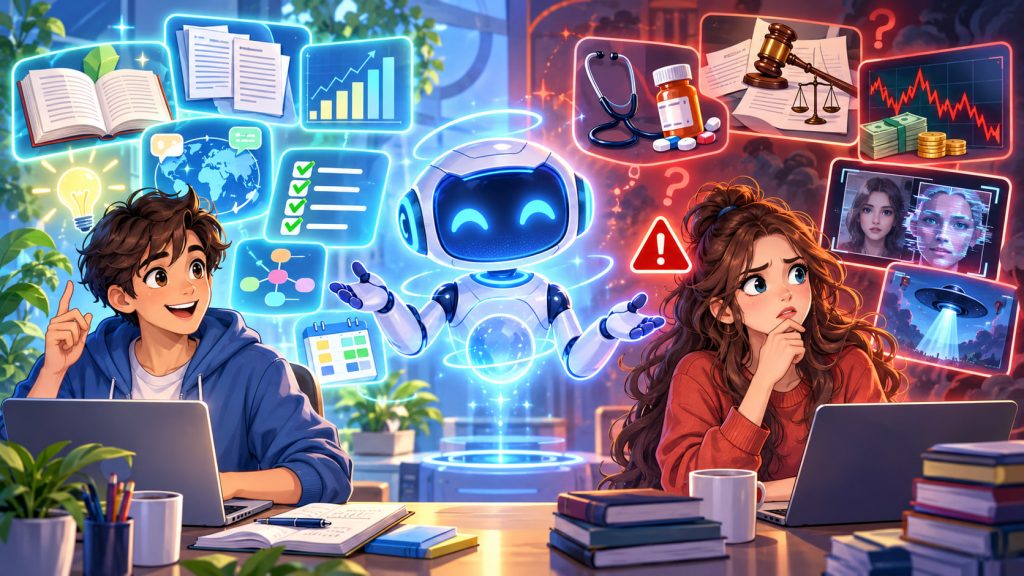
Artificial intelligence has become part of everyday life. People use AI to write emails, summarize documents, generate ideas, translate text, analyze data, plan trips, explain difficult concepts, and even help with medical or financial questions.
The technology is powerful, but it is not infallible.
The most useful way to think about modern AI is simple: it is an extremely capable assistant, not an unquestionable authority. AI can save time, organize information, and reveal patterns, but it can also produce convincing mistakes.
Knowing where AI is reliable — and where human judgment is still essential — is becoming an important digital skill.
Why AI Can Sound More Certain Than It Really Is
Modern generative AI systems are trained on enormous amounts of text, images, code, and other data.
When they answer a question, they do not simply retrieve a perfect fact from a database. Instead, they generate a response based on learned patterns and the context of the conversation.
This is why AI can explain complicated ideas remarkably well.
It is also why it can sometimes produce information that sounds completely plausible but is wrong.
These errors are often called hallucinations.
The dangerous part is not that AI makes mistakes. Humans make mistakes too.
The important difference is that AI can present an incorrect statement in fluent, confident language, making the error harder to notice.
Where AI Is Usually Most Useful
AI tends to perform well when the task involves transforming, organizing, or generating information rather than making a high-stakes factual judgment.
For example, AI can be very useful for:
- Summarizing long documents
- Improving grammar and writing style
- Brainstorming ideas
- Creating outlines
- Explaining general concepts
- Translating common language
- Reformatting information
- Generating draft emails or reports
- Producing study questions
- Comparing options based on clearly provided criteria
These tasks are relatively forgiving because the user can usually inspect the result.
If AI rewrites a paragraph, you can immediately see whether the new version is better.
If it generates ten ideas, you can choose the useful ones and ignore the weak ones.
AI is especially trustworthy when the result can be quickly checked by a human.
AI Is Good at First Drafts, Not Final Authority
One of the strongest uses of artificial intelligence is creating a first version of something.
It can produce a draft article, business plan, presentation structure, software function, marketing concept, or research outline in seconds.
That dramatically reduces the time required to start.
However, the final version should still be reviewed.
AI may misunderstand context, overlook important details, invent references, use outdated assumptions, or produce language that sounds correct while hiding a logical weakness.
The best workflow is often:
AI creates, humans verify and refine.
This approach combines machine speed with human judgment.
Facts Require More Caution
AI can answer factual questions accurately much of the time, especially when the information is widely known and stable.
Questions such as basic scientific definitions, historical events, mathematics, grammar, or general geography are often handled well.
Problems become more likely when the information is:
- Very recent
- Highly specialized
- Politically sensitive
- Ambiguous
- Poorly documented
- Dependent on exact numbers
- Changing quickly
For example, the current price of a product, today’s market data, a recently announced law, an election result, or a newly published scientific finding may require up-to-date verification.
The more important and time-sensitive the fact, the more important independent checking becomes.
Never Treat AI as a Doctor
AI can explain medical terminology, help users prepare questions for a doctor, summarize general information about diseases, or make medical documents easier to understand.
Those can be valuable uses.
But AI should not independently diagnose serious medical conditions or replace professional medical care.
Symptoms often have multiple possible causes. Proper diagnosis may require a physical examination, laboratory testing, medical imaging, patient history, and clinical judgment.
A system working only from a text description cannot fully reproduce that process.
AI can support healthcare decisions, but serious medical decisions should involve qualified healthcare professionals.
Financial Decisions Also Need Human Verification
AI can explain concepts such as inflation, diversification, mortgages, compound interest, or investment risk.
It can also help organize budgets or compare financial scenarios.
But it should not be treated as a guaranteed predictor of markets.
Stock prices, currencies, property markets, and economic conditions are influenced by countless variables.
No language model can reliably promise which investment will rise next.
The same applies to taxes, insurance, contracts, and complex financial planning.
AI can help you understand a decision, but it should not make the decision blindly for you.
Legal Advice Is Another High-Risk Area
Artificial intelligence can explain general legal concepts and help users understand complicated legal language.
It may also be useful for drafting questions, organizing evidence, or reviewing the structure of a document.
However, laws vary by country, state, jurisdiction, and time.
A small legal detail can completely change the meaning of a case.
For important contracts, criminal matters, immigration issues, lawsuits, employment disputes, or significant financial agreements, professional legal advice remains essential.
Be Careful With AI-Generated Numbers
AI can perform calculations and explain mathematical reasoning, but errors can still occur.
This becomes particularly important when a task involves many steps, units, conversions, financial assumptions, or large datasets.
An answer may look mathematically sophisticated while containing a simple mistake early in the calculation.
For important numbers, it is wise to verify them with a calculator, spreadsheet, specialized software, or another independent method.
Never assume that a detailed-looking calculation is automatically correct.
Images and Videos Require a New Kind of Skepticism
Generative AI can now produce extremely realistic photographs, voices, videos, and documents.
This creates a new challenge.
For many years, people assumed that photographic or video evidence was difficult to fake convincingly.
That assumption is becoming less reliable.
AI-generated content can imitate faces, voices, locations, documents, news footage, and historical scenes.
As a result, visual evidence should increasingly be evaluated using context.
Ask:
Who created it?
Where did it first appear?
Does another reliable source confirm it?
Does the image contain unusual details or inconsistencies?
Seeing something is no longer the same as proving that it happened.
AI Should Not Replace Human Judgment
AI can process enormous amounts of information faster than any individual human.
What it does not possess in the same way humans do is lived experience, personal responsibility, social context, and genuine moral accountability.
That matters in decisions involving relationships, careers, parenting, ethics, hiring, conflict, and major life changes.
AI can help someone explore possibilities.
It can ask useful questions, compare scenarios, or reveal overlooked options.
But the final decision should remain with the person who understands the real-world consequences.
Expert Perspective
Computer scientist and AI pioneer Geoffrey Hinton has repeatedly emphasized both the extraordinary potential of artificial intelligence and the importance of understanding its risks.
A central lesson from AI research is that highly capable systems can still behave unpredictably outside the situations in which they perform best.
This is why experts increasingly focus not only on making AI more powerful, but also on AI alignment, reliability, transparency, testing, and human oversight.
The goal is not to avoid artificial intelligence.
The goal is to use it intelligently.
A Simple Rule for Deciding Whether to Trust AI
A useful rule is to ask what happens if the answer is wrong.
If the consequence is minor — such as choosing a dinner recipe or rewriting a paragraph — extensive verification may not be necessary.
If the consequence could affect health, money, legal rights, personal safety, employment, or another person’s future, verification becomes much more important.
The higher the stakes, the less appropriate blind trust becomes.
Use AI confidently for assistance. Use independent judgment for consequences.
Interesting Facts
- Generative AI can produce completely invented names, books, studies, quotations, and statistics while making them appear realistic.
- AI often performs better when users provide detailed context instead of vague instructions.
- Asking the same AI question in several different ways can sometimes reveal inconsistencies in its answers.
- AI systems can be highly capable in one domain while making surprisingly simple mistakes in another.
- Human review remains important even when AI performance is statistically very strong.
- AI-generated images can contain subtle inconsistencies in reflections, text, anatomy, lighting, or background objects.
- Providing AI with reliable source material can significantly improve the accuracy of many tasks.
- Confidence of wording is not the same thing as confidence of knowledge.
Glossary
- Artificial Intelligence (AI) — Computer systems designed to perform tasks that normally require human-like intelligence.
- Generative AI — Artificial intelligence that creates new text, images, audio, video, code, or other content.
- Hallucination — A confident but incorrect or invented answer produced by an AI system.
- Language Model — An AI system trained to understand and generate language based on patterns in data.
- Prompt — The instruction, question, or information given to an AI system.
- Human Oversight — Human review and supervision of decisions or outputs produced by automated systems.
- AI Alignment — Research focused on making AI systems behave according to intended human goals and constraints.
- Deepfake — Synthetic or manipulated media designed to imitate a real person’s appearance or voice.
- Verification — The process of checking whether information is accurate using independent evidence.
- High-Stakes Decision — A decision in which an error could cause significant harm involving health, safety, money, rights, or major life consequences.