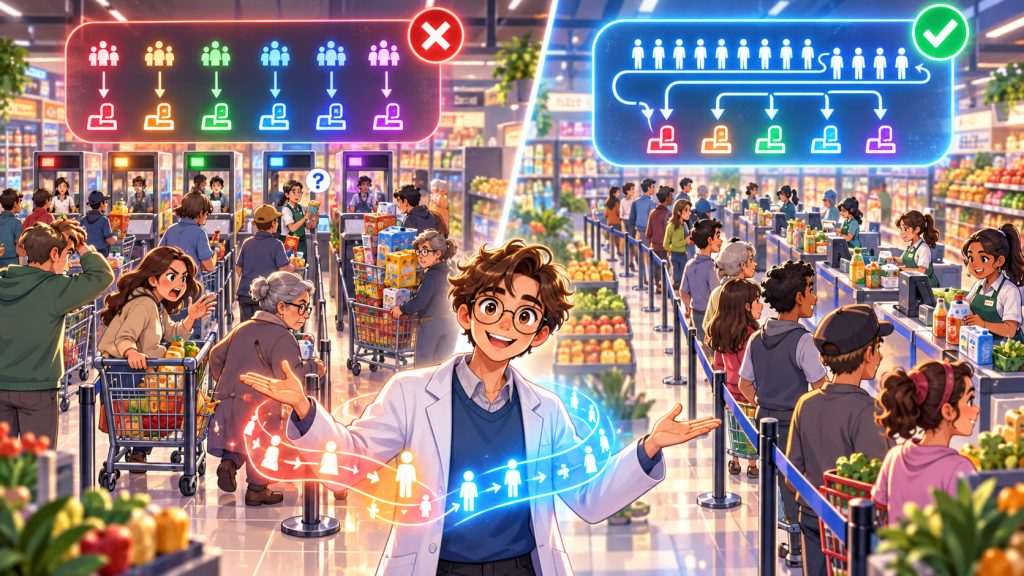
Anyone who has stood in a supermarket checkout line knows the frustration of choosing the “wrong” queue.
You pick the shortest line. Then someone ahead needs a price check. Another customer pays with a complicated method. Meanwhile, the line next to you moves twice as fast.
Queueing theory explains why this happens — and why one shared line feeding several cashiers is often more efficient than several separate lines.
The idea is simple: a single queue allows the system to use all available servers more evenly, reducing the impact of randomness.
What Is Queueing Theory?
Queueing theory is the mathematical study of waiting lines.
It analyzes systems in which customers, tasks, vehicles, messages, or other “jobs” arrive, wait, receive service, and leave.
A typical queueing system contains several basic elements:
- Arrivals
- A waiting line
- One or more servers
- Service times
- A rule for deciding who is served next
The same mathematics applies to supermarket checkouts, airport security, hospital emergency departments, call centers, computer servers, traffic systems, and manufacturing lines.
The central question is how to reduce waiting while using limited resources efficiently.
Why Five Separate Lines Create Problems
Imagine a supermarket with five cashiers.
In the traditional setup, each cashier has a separate line.
At first glance, this seems reasonable. Customers can choose the shortest line.
But the problem is that service times are unpredictable.
One cashier may process customers quickly, while another may encounter:
- A large shopping cart
- A missing barcode
- A coupon problem
- A declined payment
- A customer asking questions
- A product return
When that happens, everyone behind that customer is delayed.
Meanwhile, another cashier may suddenly become free.
The system has spare capacity, but the customers in the slow line cannot benefit from it.
One Shared Line Uses Cashiers More Efficiently
Now imagine the same five cashiers, but all customers stand in one large line.
The next available cashier simply takes the next customer.
If one cashier becomes temporarily slow, the queue continues moving through the other four.
This is called pooling.
Pooling combines several separate queues into one shared queue.
The major advantage is that random differences in service time are spread across the whole system.
One unusually slow transaction affects the entire line only slightly instead of trapping a small group of unlucky customers.
The Mathematics of Variability
The key reason shared lines work is variability.
Customer arrivals are random.
Service times are also random.
When separate queues exist, each line experiences its own random fluctuations.
One line may temporarily receive several difficult customers, while another receives only quick transactions.
A single shared queue averages out these differences.
Think of it like five small buckets versus one large reservoir.
If each small bucket must independently handle unpredictable demand, some may overflow while others remain partly empty.
A larger shared system can distribute the load more effectively.
This is one of the most important principles in operations research:
Pooling resources usually reduces the cost of variability.
Why the Shortest Line Is Not Always the Fastest
People often choose a queue by counting customers.
But the number of people is only part of the story.
A line with three customers may move slower than a line with six if the three customers have full carts while the six have only a few items each.
The cashier’s speed matters too.
So do payment methods, equipment problems, and unexpected interruptions.
Humans are not very good at estimating all these variables.
A single shared queue removes the need to guess.
You simply wait until the first cashier becomes available.
The Psychological Problem: One Big Line Looks Worse
There is a catch.
A single line can look intimidating.
A queue of 15 people may appear much worse than five lines of three people each, even when the 15-person queue moves faster.
This is a psychological effect.
People often react to visible queue length rather than actual expected waiting time.
A long line may feel inefficient even if it is mathematically superior.
That is why airports, banks, and some large retailers often use winding barriers or serpentine lines.
They create one shared queue while making the waiting area organized and predictable.
Fairness Is Another Major Advantage
Separate queues create another problem: unfairness.
Two customers who arrive at nearly the same time can experience very different waits simply because they choose different lines.
Someone arriving later may finish earlier if they happen to choose a faster cashier.
A shared queue usually follows a simple rule:
first come, first served.
This makes waiting times more predictable and reduces the feeling of being punished for making a bad choice.
Perceived fairness is important because customers often judge service not only by how long they wait, but also by whether the process feels fair.
What Happens During Busy Periods?
Shared queues become especially valuable when demand is high.
Suppose five cashiers can each process an average of one customer every two minutes.
The system’s total capacity is much larger than that of a single cashier.
But with separate queues, capacity can be wasted.
One cashier may have no customers while another has six people waiting.
With one shared queue, an idle cashier immediately pulls the next customer.
That means the available workforce is used more continuously.
The busier the system becomes, the more important efficient resource sharing can be.
The Role of Utilization
Queueing theory pays close attention to utilization.
Utilization describes how busy the servers are.
If cashiers are busy only 40% of the time, queues usually remain short.
But if they are busy 95% of the time, waiting can increase dramatically.
This surprises many people.
A system running close to maximum capacity may look efficient from a staffing perspective, but small fluctuations can produce long queues.
There needs to be some spare capacity to absorb unpredictable demand.
This principle applies far beyond retail.
Hospitals, data centers, airports, and call centers all face the same problem.
Little’s Law: A Famous Queueing Principle
One of the best-known formulas in queueing theory is Little’s Law.
It states that the average number of customers in a system is related to the arrival rate and the average time each customer spends in the system.
In simple terms:
more arrivals or longer service times create more people waiting.
The remarkable thing about Little’s Law is that it applies to a huge range of systems.
It can describe people waiting in a supermarket, orders inside a factory, requests on a computer network, or patients moving through a hospital.
When Separate Lines Can Still Make Sense
A single queue is not always the best option.
Separate lines can work well when customers require very different types of service.
For example:
- Express checkout for customers with very few items
- Special counters for returns
- Self-checkout areas
- Priority service for specific customers
These systems intentionally separate customers because the service process itself is different.
Physical space can also matter.
A single long queue may be difficult to organize in a small store.
So the best design depends on both mathematics and practical constraints.
Expert Perspective
Operations researchers have long emphasized that pooling servers reduces variability and usually lowers average waiting time.
This principle is widely used in service design.
Banks often use one line for multiple tellers.
Airport security checkpoints may feed several screening stations from a shared queue.
Call centers automatically send the next caller to whichever agent becomes available.
Cloud-computing systems also distribute incoming tasks among many servers rather than permanently assigning each user to one machine.
The supermarket example is therefore part of a much larger idea: flexible resource sharing makes complex systems more efficient.
Why Queueing Theory Matters Beyond Shopping
Modern life is full of queues, even when we cannot see them.
Internet requests wait for servers.
Planes wait for runways.
Emergency patients wait for doctors.
Delivery orders wait for drivers.
Manufacturing jobs wait for machines.
Software processes wait for computing resources.
The same mathematical principles repeatedly appear.
Whenever random demand meets limited capacity, a queue can form.
Understanding how to organize that queue can save time, money, energy, and frustration.
Interesting Facts
- A single shared queue usually produces more consistent waiting times than several independent queues.
- The “wrong line” problem mainly exists because service times vary randomly.
- Queueing theory became especially important in the early development of telephone networks.
- Call centers use queueing models to estimate how many agents are needed at different times.
- Computer operating systems use scheduling rules that resemble queue management.
- Very high server utilization can cause waiting times to rise sharply even when demand increases only slightly.
- Airports often use shared queues because they reduce both average waiting time and variation between passengers.
- Queueing theory is an important branch of operations research.
- Self-checkout systems can also be analyzed using queueing models.
- A fair queue can improve customer satisfaction even when average waiting time stays the same.
Glossary
- Queueing Theory — The mathematical study of waiting lines and service systems.
- Queue — A line of customers, tasks, or requests waiting for service.
- Server — A person, machine, or system that performs the service.
- Arrival Rate — The average number of customers or tasks entering a system during a given period.
- Service Time — The amount of time required to serve one customer or process one task.
- Pooling — Combining several separate queues or resources into one shared system.
- Utilization — The proportion of time a server is busy.
- Variability — Random differences in arrival times, service times, or workload.
- First Come, First Served — A queue rule in which customers are served in the order they arrive.
- Little’s Law — A fundamental queueing relationship connecting the average number of items in a system, arrival rate, and average time spent in the system.
- Operations Research — A field that uses mathematics and analytical methods to improve complex decision-making and systems.