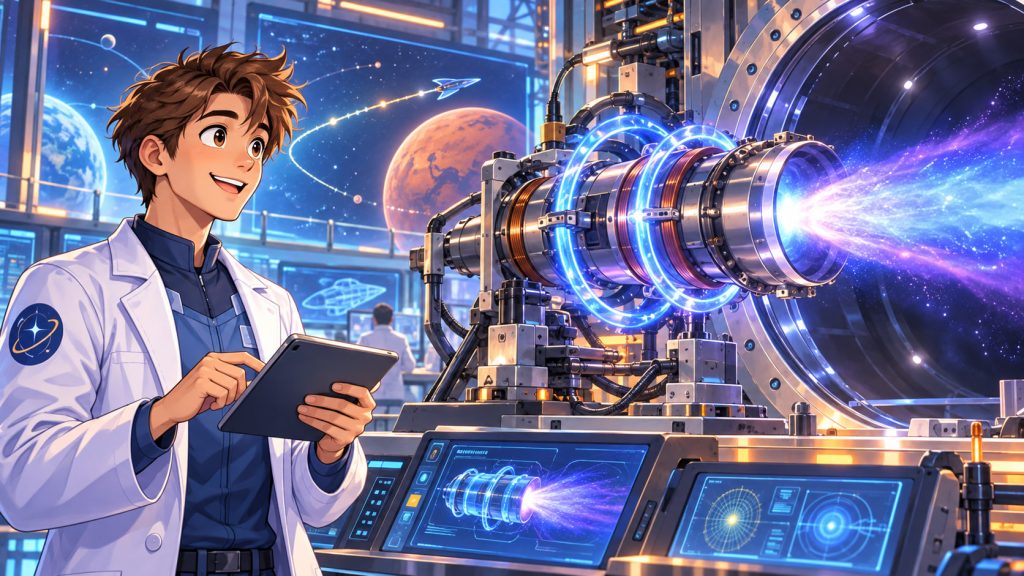
A new Russian plasma rocket engine has attracted attention because of an extraordinary promise: spacecraft powered by advanced electric propulsion could eventually travel through deep space far more efficiently than vehicles relying only on conventional chemical rockets.
The technology is being developed by scientists at the Troitsk Institute for Innovation and Fusion Research, part of Rosatom. In 2025, the team announced a laboratory prototype of a plasma electric rocket engine based on a magnetic plasma accelerator. Reported parameters include at least 6 newtons of thrust, an exhaust-related specific-impulse figure of at least 100 kilometers per second, and average power reaching about 300 kilowatts in pulsed operation.
Those figures are impressive for electric propulsion. But this is an important distinction: the device is currently an experimental prototype, not a flight-ready engine already carrying spacecraft to Mars.
What Is a Plasma Rocket Engine?
A conventional chemical rocket burns fuel and oxidizer, producing extremely hot gases that rush out of a nozzle.
A plasma engine works differently.
Plasma is an electrically charged state of matter consisting of ions and electrons. Instead of relying mainly on chemical combustion, an electric propulsion system uses electrical and magnetic fields to accelerate charged particles and eject them at extremely high speed.
The spacecraft moves in the opposite direction according to the same basic principle that drives every rocket.
The crucial advantage is efficiency.
Electric propulsion can accelerate its exhaust much faster than many chemical engines, allowing a spacecraft to obtain much more momentum from a given amount of propellant.
What Makes the Russian Prototype Interesting?
The Rosatom prototype uses a magnetic plasma accelerator.
Rather than creating enormous instantaneous thrust, its purpose is to provide efficient propulsion during extended periods in space.
The developers report thrust of at least 6 newtons. That sounds tiny compared with launch rockets, which can generate millions of newtons.
But the comparison is misleading.
A launch vehicle must fight Earth’s gravity and accelerate a massive spacecraft rapidly. A deep-space propulsion system operates after the spacecraft has already reached space, where even relatively modest continuous thrust can gradually produce enormous changes in velocity.
The prototype’s reported average electrical power is around 300 kW, placing it in a very different class from the small electric thrusters commonly used for routine satellite station-keeping.
Why Exhaust Velocity Matters So Much
One of the most important measurements in rocket propulsion is specific impulse.
In conventional aerospace engineering, specific impulse is normally expressed in seconds. It describes how efficiently a propulsion system uses propellant.
Electric engines can achieve much higher effective exhaust velocities than chemical rockets.
The Russian developers describe their system with a figure of at least 100 kilometers per second.
For perspective, chemical rocket exhaust velocities are typically only several kilometers per second.
That does not mean a spacecraft instantly starts traveling at 100 km/s. Instead, it means the engine can expel propellant at extremely high velocity, allowing the spacecraft to accumulate speed gradually.
High exhaust velocity can dramatically reduce the amount of propellant required for large changes in spacecraft velocity.
Could It Really Reach Mars in 30–60 Days?
This is the headline that generated the most attention.
Rosatom researchers have discussed future missions in which plasma propulsion could potentially reduce travel times associated with Mars expeditions to approximately 30–60 days, compared with many months for conventional mission profiles. Alexey Voronov, a senior scientist involved with the project, has described shorter travel time as especially valuable because astronauts would spend less time exposed to deep-space radiation.
However, a fast Mars mission would require much more than the engine itself.
A complete spacecraft would need:
- An extremely powerful electrical energy source
- Large thermal-management systems
- Reliable long-duration plasma operation
- Lightweight power electronics
- Radiation protection
- Navigation and communication systems
- A propulsion architecture capable of accelerating and later decelerating the spacecraft
The 30–60-day figure should therefore be understood as a future mission concept, not a journey already demonstrated by the prototype.
Why a Plasma Engine Needs So Much Electricity
Chemical rockets carry chemical energy inside their propellants.
Electric propulsion requires an external source of electrical power.
For small satellites, solar panels can often supply enough electricity. But a high-power plasma engine designed for ambitious interplanetary travel would demand far more energy.
This is why the Russian project is closely connected with ideas for nuclear-powered space transport systems, sometimes described as nuclear space tugs.
A nuclear reactor could theoretically supply large amounts of electricity even far from the Sun, where solar power becomes less practical.
The reactor would not necessarily heat the propellant directly. Instead, it could generate electricity that powers the plasma accelerator.
This architecture is known broadly as nuclear-electric propulsion.
Plasma Propulsion Is Not a Completely New Idea
The fundamental concept of electric propulsion has existed for decades.
Ion engines and Hall-effect thrusters have already operated successfully on numerous spacecraft.
Russia and the former Soviet Union have especially long experience with Hall thrusters, while electric propulsion systems developed in several countries are now routinely used on commercial and scientific satellites.
What makes newer plasma concepts interesting is the attempt to move toward dramatically higher power and thrust.
Traditional ion engines are extremely efficient but produce small thrust.
The challenge for future interplanetary propulsion is to maintain the efficiency of electric propulsion while increasing power enough to move much larger spacecraft within practical travel times.
Why It Cannot Replace Launch Rockets
A plasma engine would not normally launch a spacecraft from Earth’s surface.
Its thrust-to-weight ratio is far too low for that job.
Chemical rockets remain exceptionally effective when enormous thrust is needed for a few minutes.
Plasma engines become attractive once the spacecraft is already in orbit.
This creates a complementary system:
Chemical propulsion gets the spacecraft into space; electric or plasma propulsion could perform efficient long-distance acceleration afterward.
Future spacecraft could therefore use several propulsion technologies during different phases of the same mission.
The Giant Vacuum Chamber Behind the Project
Testing advanced plasma propulsion on Earth is difficult because the engine is designed to operate in near-vacuum conditions.
The Troitsk facility has been developing a large experimental test stand containing a vacuum chamber approximately 4 meters in diameter and 14 meters long.
Powerful vacuum pumps and heat-removal equipment are intended to reproduce important aspects of the space environment and allow engineers to study extended engine operation.
This stage is critical.
A propulsion concept may perform well briefly but still encounter challenges involving overheating, erosion, plasma instability, electrical components, or continuous operation.
Expert Perspective: The Prototype Is Only One Part of the System
Alexey Voronov has described creation of the prototype as an important stage in determining whether such propulsion could ultimately be suitable for future nuclear space tugs.
That highlights one of the central realities of advanced space propulsion.
The engine cannot be evaluated independently from its power source.
A 300-kW propulsion system requires a spacecraft capable of generating, controlling, and disposing of enormous amounts of energy and heat.
Future megawatt-class systems would make this engineering challenge even larger.
The most important technological progress may therefore come not from one revolutionary component, but from combining high-power plasma propulsion, nuclear energy, lightweight radiators, and durable spacecraft systems.
Why the Russian Plasma Engine Matters
The prototype represents a serious attempt to push electric propulsion toward much higher-power deep-space applications.
If this class of technology becomes practical, it could reduce propellant requirements, allow spacecraft to accumulate much higher velocities, and enable new types of cargo or crewed interplanetary missions.
The next major questions concern endurance, power supply, thermal management, reliability, and eventual testing as part of an integrated spacecraft.
The important achievement today is not that a 30-day Mars spacecraft already exists, but that researchers are building and testing propulsion hardware intended for a future generation of high-power space transportation.
Interesting Facts
- Plasma is often called the fourth state of matter, alongside solids, liquids, and gases.
- Stars, including the Sun, consist largely of plasma.
- Electric propulsion can operate for months or even years because it uses propellant very efficiently.
- Six newtons of thrust is roughly comparable to the weight force of a little over half a kilogram on Earth.
- High-power plasma engines are mainly intended for space operation rather than launch from Earth’s surface.
- Electric propulsion has already been used successfully on hundreds of satellites and several deep-space missions.
- A spacecraft can eventually reach very high speed with low thrust if the engine operates continuously for a long time.
- Nuclear-electric propulsion and nuclear-thermal propulsion are different technologies: one generates electricity for an electric engine, while the other heats propellant directly.
- Deep-space engines must eventually slow a spacecraft down as well as accelerate it.
- Large radiators could become one of the most visually distinctive components of future nuclear-electric spacecraft because excess heat must be released into space.
Glossary
- Plasma — An electrically charged state of matter containing ions and free electrons.
- Plasma Rocket Engine — A propulsion system that accelerates ionized gas to create thrust.
- Electric Propulsion — Space propulsion that uses electrical energy to accelerate propellant.
- Magnetic Plasma Accelerator — A device that uses electromagnetic forces to accelerate plasma.
- Thrust — The force produced by a rocket engine to accelerate a spacecraft.
- Newton (N) — The standard unit used to measure force.
- Specific Impulse — A measure of how efficiently a rocket engine uses its propellant.
- Exhaust Velocity — The speed at which propellant leaves a rocket engine.
- Nuclear-Electric Propulsion — A system in which nuclear energy generates electricity that powers an electric propulsion engine.
- Nuclear Space Tug — A proposed spacecraft using nuclear power to move payloads between orbits or across deep space.
- Vacuum Chamber — A sealed test facility from which most air is removed to reproduce low-pressure conditions similar to space.
- Thermal Management — The systems used to control and remove excess heat from spacecraft equipment.