For decades, transporting antimatter sounded like something that belonged in science fiction. Antimatter disappears when it touches ordinary matter, releasing energy through a process called annihilation. Keeping even tiny quantities alive long enough to study them requires extraordinary laboratory technology.
In March 2026, scientists at CERN crossed a remarkable technological threshold: antimatter was successfully transported by truck for the first time.
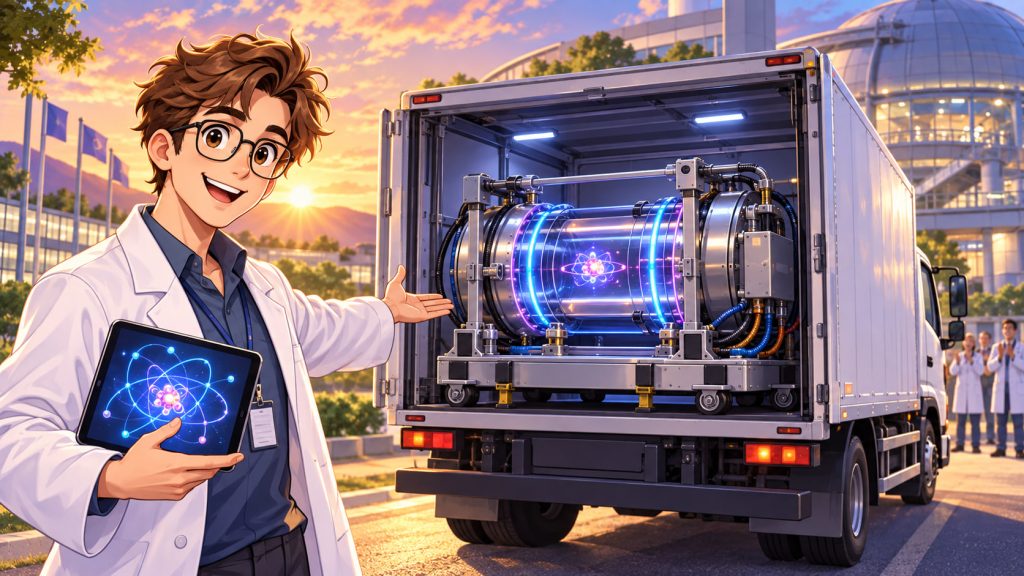
Researchers from CERN’s BASE experiment trapped a cloud of 92 antiprotons, disconnected their transport system from the accelerator facility, loaded it onto a truck, drove it across CERN’s site, and continued working with the particles afterward.
The achievement does not mean that trucks will soon carry kilograms of antimatter along highways. The amount involved was unimaginably small. What matters is that scientists demonstrated something previously considered extremely difficult: antimatter can survive transportation outside the accelerator environment that created it.
What Exactly Was Transported?
The cargo was not a container filled with visible antimatter.
Scientists transported antiprotons — the antimatter counterparts of ordinary protons.
A proton has a positive electric charge. An antiproton has the same mass but the opposite charge.
When an antiproton encounters normal matter, the two can annihilate, converting their mass into other particles and energy.
That makes ordinary storage containers impossible.
You cannot simply place antiprotons inside a metal bottle because contact with the walls would destroy them.
Instead, researchers must keep the particles suspended without touching ordinary material.
The Special Trap That Made the Journey Possible
The key technology is called BASE-STEP, a transportable cryogenic Penning-trap system.
A Penning trap uses magnetic and electric fields to confine charged particles inside a vacuum.
The antiprotons effectively remain suspended away from the walls of the device.
BASE-STEP is autonomous enough to operate while being moved and was specifically engineered to tolerate vibrations and bumps associated with road transportation. Its equipment weighs roughly a tonne, with much of that mass coming from the superconducting magnet.
So while the vehicle carrying it resembles ordinary road transport, the cargo system itself is anything but ordinary.
The real breakthrough was building a mobile laboratory capable of keeping antimatter alive while the entire apparatus was moving.
Why Was Transporting Antimatter So Difficult?
Antiprotons require several demanding conditions.
They must remain in an extremely good vacuum so that they do not collide with stray gas molecules.
They must also stay confined by precisely controlled electromagnetic fields.
The superconducting magnet must continue operating, cooling systems must remain stable, and the experiment must tolerate acceleration, vibration, turns, and road irregularities.
A stationary antimatter experiment can be carefully isolated from disturbance.
A truck introduces exactly the opposite conditions.
Before attempting the antimatter journey, the BASE-STEP team successfully demonstrated the transport system with ordinary protons. That earlier test showed that trapped charged particles could survive several hours of autonomous operation during transportation.
Why Move Antimatter Away From CERN’s Accelerators?
CERN is one of the best places in the world to produce antiprotons.
But strangely, the accelerator environment is not always the best place to perform the most delicate measurements.
Large accelerators and surrounding equipment create tiny magnetic-field disturbances and other environmental noise.
For ordinary experiments, these fluctuations may be irrelevant.
For researchers trying to compare matter and antimatter with extraordinary precision, they can become a serious limitation.
The BASE team therefore wants to produce and capture antiprotons at CERN and then transport them to quieter laboratories designed specifically for precision measurements.
One planned destination is Heinrich Heine University Düsseldorf in Germany, where dedicated facilities are being developed for advanced antimatter experiments.
What Scientists Want to Learn From Antiprotons
One of the biggest mysteries in physics is simple to state:
Why does our universe appear to contain overwhelmingly more matter than antimatter?
Current physics suggests that the early universe should have produced matter and antimatter in nearly equal quantities.
If perfectly equal amounts had survived and annihilated each other, stars, planets, and humans might never have formed.
Yet matter dominates the observable universe.
Physicists therefore compare particles and antiparticles with extraordinary precision, searching for tiny differences that could reveal new physics.
The BASE experiment has performed some of the world’s most precise comparisons between protons and antiprotons.
Moving antiprotons into ultra-quiet laboratories could allow even more accurate measurements.
A seemingly small improvement in precision could expose differences that existing experiments cannot detect.
Was the Antimatter Dangerous?
The word “antimatter” immediately brings to mind enormous explosions.
In theory, matter-antimatter annihilation releases an impressive amount of energy per unit of mass.
But mass is the crucial word.
The truck carried only 92 antiprotons.
That is an extraordinarily tiny quantity of antimatter — far smaller than anything capable of producing a dangerous explosion.
CERN explains that even hundreds or thousands of trapped antiparticles contain a minuscule amount of annihilation energy compared with everyday mechanical actions.
The danger of the experiment was not that the antimatter might destroy the truck. The challenge was preventing the precious particles from disappearing.
Creating antiprotons requires enormous scientific infrastructure, so losing even a tiny trapped sample would represent an experimental failure rather than a public hazard.
How Far Did the Antimatter Travel?
The historic test remained within CERN’s Meyrin site.
The transport covered several kilometers before the apparatus returned with its antiprotons successfully confined.
That may sound modest compared with international transportation.
But the goal was not to break a distance record.
The purpose was to prove that the complete transport system could survive real road movement while maintaining the conditions required to preserve antimatter.
The next major objective is much more ambitious: transporting antiprotons from CERN to laboratories elsewhere in Europe.
BASE researchers ultimately want a distribution system in which antimatter created at a major accelerator could be delivered to specialized precision laboratories.
Could Antimatter Eventually Be Shipped Between Countries?
Technically, that is exactly the direction of the BASE-STEP project.
The transport system was designed with laboratories outside CERN in mind.
A future journey to Germany would require the apparatus to remain operational much longer than during the CERN-site demonstration.
Researchers would need to manage cooling, magnetic stability, vibration, power, safety procedures, border logistics, and continuous particle monitoring.
But the first truck experiment demonstrated that the fundamental idea works.
Antimatter no longer has to remain permanently tied to the accelerator complex where it was produced.
That could fundamentally change how antimatter research is organized.
Expert Perspective: A New Era of Precision Antimatter Physics
Christian Smorra, who leads the BASE-STEP effort, has explained that the project is intended to deliver trapped antiprotons to dedicated precision laboratories where measurements can be performed without much of the noise produced by CERN’s accelerator infrastructure.
The scientific importance is therefore larger than the road trip itself.
The truck is essentially a bridge between two previously separated capabilities: producing antimatter at a giant accelerator and studying it in an exceptionally quiet laboratory.
If researchers can routinely connect those environments, experiments comparing matter and antimatter could reach new levels of precision.
This Is Not Yet “Antimatter Shipping” in the Everyday Sense
The achievement is extraordinary, but antimatter remains one of the most difficult substances humans can produce and store.
Only tiny numbers of antiparticles were transported.
The apparatus is sophisticated, heavy, cryogenic, and dependent on superconducting magnets and ultra-high vacuum.
Producing macroscopic quantities of antimatter would require vastly more energy and technology than anything available today.
So we are not approaching an era of antimatter fuel tanks or commercial antimatter deliveries.
What has changed is more scientifically important: antimatter has become mobile.
For fundamental physics, that is a major step.
Interesting Facts
- The historic CERN transport carried 92 antiprotons.
- Antiprotons have the same mass as protons but the opposite electric charge.
- Antimatter annihilates when it encounters corresponding ordinary matter.
- BASE-STEP uses electromagnetic fields to prevent antiprotons from touching the walls of their container.
- Much of the transport apparatus weighs hundreds of kilograms because of its superconducting magnet.
- The amount of antimatter transported contained far too little energy to create a dangerous explosion.
- CERN can store antiprotons for exceptionally long periods under carefully controlled conditions.
- The team previously transported ordinary protons before attempting the experiment with antiprotons.
- Future plans include transporting antiprotons to specialized laboratories outside CERN.
- Precision antimatter experiments could help scientists investigate why the universe contains much more matter than antimatter.
- Producing antimatter is enormously more difficult than transporting an equivalent amount of ordinary material.
Glossary
- Antimatter — Matter composed of antiparticles corresponding to ordinary particles but with opposite quantum properties such as electric charge.
- Antiproton — The antimatter counterpart of the proton, with the same mass and a negative electric charge.
- Annihilation — A process in which a particle and its antiparticle interact and convert their energy into other particles or radiation.
- Penning Trap — A device using electric and magnetic fields to confine charged particles.
- BASE — The Baryon Antibaryon Symmetry Experiment at CERN, which performs precision comparisons of protons and antiprotons.
- BASE-STEP — A transportable trapping system designed to move antiprotons between research facilities.
- Cryogenic — Operating at extremely low temperatures.
- Superconducting Magnet — A powerful magnet using materials that conduct electricity with essentially zero resistance when sufficiently cold.
- Vacuum — A region containing extremely little matter, essential for preventing trapped antiparticles from colliding with gas molecules.
- CERN — The European laboratory for particle physics near Geneva, home to major accelerator facilities.
- Antimatter Factory — CERN’s facility for producing and slowing antiprotons for scientific experiments.
- Precision Measurement — An experiment designed to determine a physical property with extremely small uncertainty.