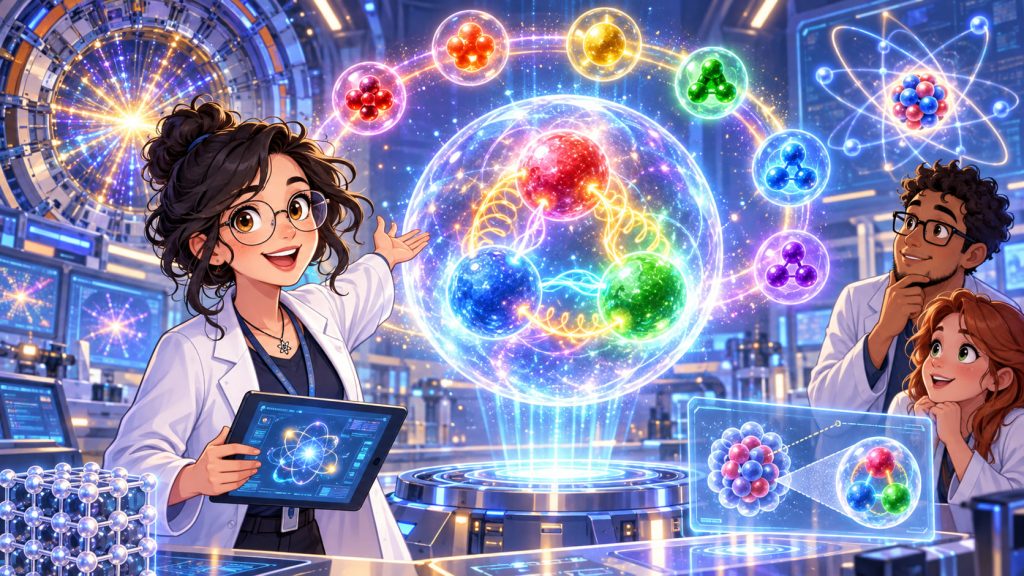
Everything around us — rocks, oceans, planets, living organisms, and even our own bodies — is built from matter. Atoms form molecules, atomic nuclei contain protons and neutrons, and inside those protons and neutrons lie even smaller particles called quarks.
Quarks are among the most fundamental particles known to physics. As far as current experiments can determine, they are not made from anything smaller.
They behave in ways that are very different from familiar objects. Quarks carry fractional electric charges, experience one of nature’s strongest forces, and cannot normally be isolated individually.
Understanding quarks reveals how ordinary matter is assembled at its deepest known level.
What Is a Quark?
A quark is an elementary particle described by the Standard Model of particle physics.
Quarks belong to the group of particles known as fermions, which are the basic constituents of matter.
Unlike protons and neutrons, quarks currently show no experimentally confirmed internal structure.
There are six known types, or flavors, of quark:
- Up
- Down
- Strange
- Charm
- Top
- Bottom
These six quarks are arranged into three generations.
The first generation contains up and down quarks. These are the quarks that make up nearly all ordinary atomic nuclei.
Protons and Neutrons Are Made of Quarks
A proton is not an indivisible particle.
It contains three principal, or valence, quarks:
two up quarks and one down quark.
A neutron contains:
one up quark and two down quarks.
This small change produces an important difference in electric charge.
An up quark has an electric charge of +2/3 of the elementary charge.
A down quark has a charge of −1/3.
Two up quarks and one down quark therefore produce the proton’s total charge of +1.
One up quark and two down quarks add up to the neutron’s charge of zero.
Quarks Have Fractional Electric Charges
Fractional charge is one of the strangest properties of quarks.
Other familiar fundamental particles, such as electrons, have integer multiples of the elementary electric charge.
Quarks are different.
Up, charm, and top quarks have charge +2/3.
Down, strange, and bottom quarks have charge −1/3.
Yet physicists do not normally observe isolated particles carrying these fractional charges because quarks are confined inside larger composite particles.
The Strong Force Holds Quarks Together
Quarks interact through the strong nuclear force, one of the four fundamental interactions of nature.
The theory describing this interaction is called quantum chromodynamics, or QCD.
Quarks exchange force-carrying particles called gluons.
Gluons continually interact with quarks and even with other gluons, creating an extremely dynamic environment inside protons and neutrons.
The strong force is powerful enough to keep quarks permanently bound under ordinary conditions.
What Is Color Charge?
Electricity involves electric charge.
The strong interaction has a different type of property known as color charge.
Despite the name, color charge has nothing to do with actual visible colors.
Physicists use three labels:
- Red
- Green
- Blue
Antiquarks carry corresponding anticolors.
Particles made from quarks combine their color charges in ways that produce an overall color-neutral state.
The concept allows quantum chromodynamics to mathematically describe how quarks and gluons interact.
Why Can’t We Pull a Quark Out?
One of the most unusual features of quark physics is confinement.
Imagine trying to separate two quarks.
With many familiar forces, such as gravity or electromagnetism, the force becomes weaker as objects move farther apart.
The strong interaction behaves differently over the relevant distances.
As quarks are pulled apart, the energy stored in the strong field increases.
Eventually, instead of freeing an individual quark, there can be enough energy to create a new quark-antiquark pair.
The result is new composite particles rather than a lone quark.
No free quark has ever been conclusively observed.
Hadrons: Particles Made From Quarks
Particles constructed from quarks are called hadrons.
There are two major traditional categories.
Baryons contain three valence quarks.
Protons and neutrons are the most familiar baryons.
Mesons consist primarily of a quark and an antiquark.
Hundreds of different hadrons have been discovered in particle experiments.
Modern research has also revealed more unusual combinations, including tetraquarks and pentaquarks, which contain four or five valence quark components.
Antiquarks: The Antimatter Partners
Every quark has an antimatter counterpart called an antiquark.
An antiquark has the same mass as its corresponding quark but opposite electric and other relevant charges.
For example, an up antiquark carries electric charge −2/3.
Quarks and antiquarks can be created in high-energy collisions.
When suitable particles and antiparticles interact, their energy can be transformed into other particles.
Quark-antiquark systems also form mesons.
The Strange, Charm, Bottom, and Top Quarks
Up and down quarks dominate ordinary stable matter, but the other four flavors are extremely important in particle physics.
The strange quark was introduced to explain unusual properties of particles discovered in cosmic rays and accelerators.
The charm quark helped complete an important pattern in the Standard Model.
The bottom quark is much heavier and plays a major role in studies of particle decays and differences between matter and antimatter.
The top quark is the heaviest known elementary particle.
It is so unstable that it decays extremely rapidly.
Unlike other quarks, the top quark generally decays before it has time to form conventional hadrons.
Quarks Come in Three Generations
The six quarks are organized into pairs:
First generation:
Up and down
Second generation:
Charm and strange
Third generation:
Top and bottom
Particles in the second and third generations are heavier and generally unstable.
They eventually decay into lighter particles.
That is why ordinary matter around us consists overwhelmingly of first-generation particles.
The Inside of a Proton Is More Complicated Than Three Quarks
It is convenient to describe a proton as containing two up quarks and one down quark, but the true quantum picture is much more complicated.
Inside a proton, gluons are constantly being exchanged.
Temporary quark-antiquark pairs also appear as part of the quantum dynamics.
Physicists often distinguish the proton’s three valence quarks from a fluctuating “sea” of quarks, antiquarks, and gluons.
A proton is therefore not simply three tiny balls sitting beside one another.
It is a highly dynamic quantum system filled with interacting quark and gluon fields.
Where Does the Proton’s Mass Come From?
One surprising fact is that the masses of the proton’s valence quarks account for only a small fraction of the proton’s total mass.
Most of the mass arises from the energy associated with the strong interaction — including the motion and interactions of quarks and gluons.
Einstein’s famous relationship between mass and energy helps explain why this internal energy contributes to the proton’s mass.
This means that much of the mass of everyday matter comes from QCD energy inside protons and neutrons, rather than simply from adding up the intrinsic masses of their quarks.
Expert Perspective: Quarks Show How Energy Becomes Ordinary Matter
Nobel Prize-winning physicist Frank Wilczek has frequently highlighted one of the most remarkable consequences of quantum chromodynamics: most of the mass of familiar matter emerges from the energy of quark and gluon interactions.
This is a profound result.
The Higgs field contributes to the intrinsic masses of elementary particles, but most of the mass of protons and neutrons emerges from strong-interaction energy inside them.
In that sense, the mass of ordinary objects is deeply connected to quantum fields and the dynamics of quarks and gluons.
How Scientists Discovered Quarks
Quarks were proposed independently in the 1960s by physicists Murray Gell-Mann and George Zweig.
At first, the idea was largely a mathematical way of organizing the rapidly growing collection of discovered particles.
Experiments later provided strong evidence that protons and neutrons really contain smaller point-like constituents.
High-energy scattering experiments were particularly important.
By firing energetic particles at protons, researchers could study internal structures in a way conceptually similar to using scattering to explore an object too small to see directly.
Today, quarks are a fundamental part of the Standard Model.
Interesting Facts
- There are six known quark flavors: up, down, strange, charm, top, and bottom.
- Protons contain two up valence quarks and one down valence quark.
- Neutrons contain one up and two down valence quarks.
- Quarks have fractional electric charges of either +2/3 or −1/3.
- The top quark is the heaviest known elementary particle.
- Top quarks decay before they normally have time to form hadrons.
- Quarks interact through gluons.
- Gluons themselves carry color charge, allowing them to interact with one another.
- Most of a proton’s mass comes from strong-interaction energy rather than simply from the masses of its three valence quarks.
- The word “quark” was chosen by Murray Gell-Mann after encountering the phrase “Three quarks for Muster Mark” in James Joyce’s Finnegans Wake.
- Tetraquarks and pentaquarks show that quarks can form structures more complex than traditional three-quark baryons and quark-antiquark mesons.
Glossary
- Quark — A fundamental particle that combines with other quarks to form hadrons such as protons and neutrons.
- Flavor — One of the six types of quarks: up, down, strange, charm, top, or bottom.
- Fermion — A class of particles that includes quarks and leptons and forms the basic constituents of matter.
- Hadron — A composite particle made from quarks and held together by the strong interaction.
- Baryon — A hadron whose conventional valence structure contains three quarks, such as a proton or neutron.
- Meson — A hadron primarily consisting of a quark and an antiquark.
- Antiquark — The antimatter counterpart of a quark.
- Gluon — The force-carrying particle of the strong interaction.
- Quantum Chromodynamics (QCD) — The quantum theory describing interactions between quarks and gluons.
- Color Charge — The property of quarks and gluons responsible for the strong interaction.
- Confinement — The phenomenon that prevents quarks from normally existing as isolated free particles.
- Valence Quark — A quark contributing to the defining quantum properties of a hadron.
- Quark Sea — The constantly fluctuating population of quarks and antiquarks inside hadrons generated by quantum interactions.
- Tetraquark — An exotic hadron with four valence quark or antiquark components.
- Pentaquark — An exotic hadron with five valence quark or antiquark components.
- Standard Model — The modern theory describing known fundamental particles and three of the four fundamental forces.