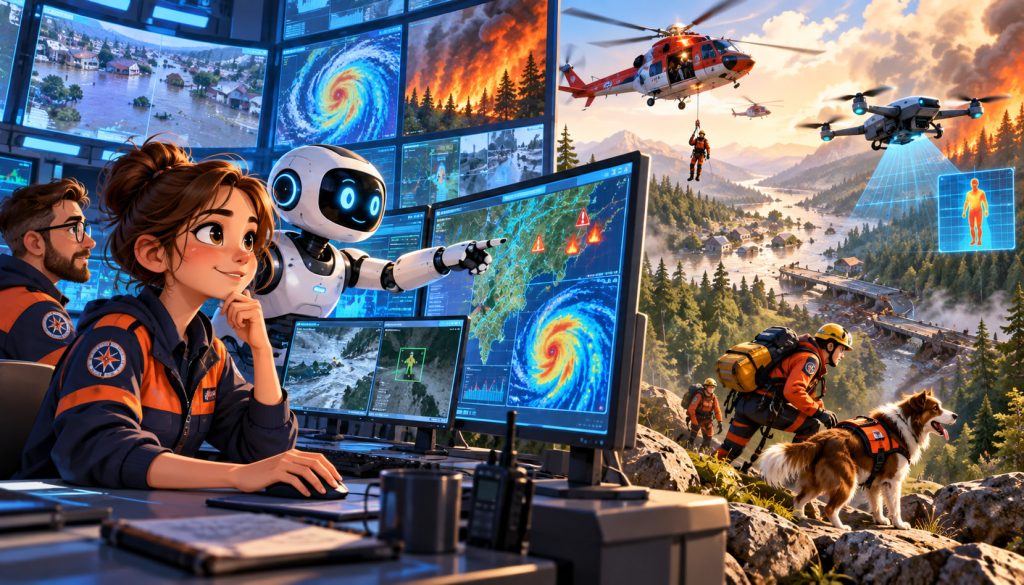
Artificial intelligence is increasingly becoming part of emergency response, disaster forecasting, public safety, and rescue operations.
From predicting floods and wildfires to analyzing emergency calls and guiding rescue teams, AI can process enormous amounts of information much faster than humans alone.
Its greatest value is not replacing rescuers, doctors, firefighters, or emergency managers, but helping them make faster and better-informed decisions when every minute matters.
As sensors, satellites, drones, cameras, weather models, and digital communication systems improve, AI is becoming one of the most powerful tools for protecting human life.
How AI Supports Emergency Services
Emergency agencies receive huge amounts of information during major incidents.
A single disaster can generate:
- Emergency calls
- Weather data
- Satellite images
- Drone footage
- Traffic information
- Social media reports
- Building data
- Medical information
- Sensor alerts
Humans cannot analyze all of this information instantly.
AI systems can help identify patterns, prioritize urgent cases, detect unusual events, and highlight areas where people may be in danger.
The goal is to turn large volumes of raw data into useful decisions.
Predicting Floods Before They Happen
Flood forecasting is one of the most important applications of artificial intelligence in disaster management.
AI models can analyze rainfall, river levels, soil moisture, topography, weather forecasts, and historical flood data.
By combining these factors, systems can estimate where flooding is likely to occur and how severe it may become.
Earlier warnings give emergency services more time to evacuate vulnerable areas, close dangerous roads, move equipment, and prepare shelters.
In some regions, machine-learning models are also being used to improve forecasts for smaller rivers where traditional monitoring systems may be limited.
AI and Wildfire Detection
Wildfires can spread rapidly, especially during hot, dry, and windy conditions.
Artificial intelligence can help detect fires at an early stage by analyzing satellite images, infrared sensors, cameras, and weather conditions.
Computer vision systems can identify smoke or heat patterns that may indicate a developing fire.
AI can also help estimate how a wildfire may spread.
Models can combine information about wind speed, vegetation, terrain, humidity, and temperature to produce possible fire paths.
The earlier a fire is detected, the greater the chance that firefighters can respond before it becomes uncontrollable.
Earthquake Response and Damage Assessment
Earthquakes remain extremely difficult to predict precisely.
However, AI can still play an important role before and after an earthquake.
Machine-learning systems can analyze seismic data and identify patterns more quickly than traditional methods.
After an earthquake, AI can examine satellite and drone images to identify collapsed buildings, blocked roads, damaged bridges, and isolated communities.
This can help rescue teams prioritize areas where people are most likely to need immediate assistance.
AI-assisted mapping can be especially valuable when communication networks are damaged and access to affected areas is difficult.
Drones Become Intelligent Rescue Tools
Drones have become increasingly useful in emergency response.
Equipped with cameras, thermal sensors, and AI software, they can search areas that may be too dangerous or difficult for human rescuers.
For example, drones can:
- Search forests for missing people
- Detect body heat through thermal imaging
- Inspect damaged buildings
- Survey flooded regions
- Monitor wildfire fronts
- Deliver small emergency supplies
- Map disaster zones
AI can automatically analyze drone images rather than requiring a person to inspect every frame manually.
A system might identify a human-shaped heat signature, damaged roof, blocked road, or unusual movement and immediately alert rescue teams.
Finding Missing People Faster
Search-and-rescue operations are often limited by time.
A missing person may be hidden by trees, snow, debris, darkness, or difficult terrain.
Artificial intelligence can help analyze aerial images and thermal-camera data to identify possible human figures.
It can also help predict where someone might travel based on terrain, weather, age, mobility, and known behavior patterns.
Search teams can then concentrate resources on the most likely areas instead of covering enormous regions equally.
AI can help rescuers search smarter, not simply search more territory.
Smarter Emergency Call Centers
Emergency dispatch centers often receive thousands of calls during major incidents.
AI systems can assist operators by analyzing speech, identifying keywords, detecting location information, and classifying the type of emergency.
For example, software may recognize signs of:
- Fire
- Medical emergency
- Traffic collision
- Violence
- Flooding
- Structural collapse
AI can also help detect whether multiple calls describe the same incident.
This allows dispatchers to organize information more efficiently and direct emergency resources where they are most urgently needed.
Human operators remain essential because emergency conversations are often complex, emotional, and unpredictable.
AI in Ambulance and Medical Emergencies
Artificial intelligence is also being tested and used in emergency medicine.
Algorithms can analyze vital signs, medical histories, electrocardiograms, and other clinical data.
In some cases, AI can help identify patients at higher risk of deterioration.
Emergency teams may use decision-support systems to recognize warning signs of stroke, cardiac problems, sepsis, or other time-sensitive conditions.
Ambulance routing can also benefit from AI.
Traffic conditions, hospital capacity, travel times, and patient needs can be analyzed to determine which hospital may be the most appropriate destination.
Predicting Extreme Weather
Weather forecasting has always depended heavily on mathematics and computing.
Artificial intelligence is adding new capabilities.
Modern AI weather models can analyze huge historical datasets and identify complex relationships in atmospheric conditions.
They can support forecasts for storms, heavy rainfall, extreme temperatures, and other hazardous events.
Improved forecasting can help emergency agencies prepare resources before disasters occur.
For example, authorities can position rescue vehicles, medical teams, generators, and emergency supplies closer to areas expected to be affected.
Smart Cities and Automatic Detection
Cities increasingly use networks of cameras, environmental sensors, traffic systems, and connected infrastructure.
AI can monitor these systems for unusual activity.
It may detect smoke, sudden crowd movements, traffic disruptions, water leaks, abnormal temperatures, or infrastructure failures.
Automatic alerts can reduce the time between the beginning of an incident and the arrival of emergency services.
Smart traffic-control systems can also adjust signals to create faster routes for ambulances and fire engines.
Robots Can Enter Places Humans Cannot
Disaster environments can be extremely dangerous.
Collapsed buildings may contain unstable structures, toxic gases, fire, radiation, or unexploded hazards.
Robots equipped with cameras, microphones, sensors, and AI navigation systems can enter areas that would place rescuers at unnecessary risk.
Small robots can move through narrow spaces and search for survivors.
Larger machines may help inspect industrial accidents or transport equipment.
AI allows these robots to navigate more independently and recognize objects or people in complex environments.
Expert Perspective: AI Should Support Human Judgment
Emergency-management specialists generally emphasize that artificial intelligence works best as a decision-support tool.
AI systems can process data quickly, but emergencies often contain incomplete information, unusual conditions, and ethical decisions that software may not fully understand.
Human judgment remains essential, especially when lives depend on uncertain information.
The strongest systems combine machine speed with professional experience.
A rescue commander, firefighter, doctor, or dispatcher can use AI-generated information while still making the final operational decision.
The Problem of False Alerts
Artificial intelligence is not perfect.
A camera may mistake fog for smoke.
A predictive system may overestimate flood risk.
A rescue algorithm may fail to recognize a person partly hidden by debris.
False alarms can waste resources, while missed detections can be dangerous.
For this reason, emergency AI systems require careful testing, high-quality data, backup procedures, and human supervision.
Reliability is often more important than simply using the newest technology.
Privacy and Security Matter
Emergency systems may process sensitive information, including medical data, phone calls, location information, and camera footage.
Protecting that information is essential.
Cybersecurity is equally important.
An AI-powered emergency network could become a valuable target for hackers if it controls communications, infrastructure, or rescue coordination.
Systems designed to protect lives must also be protected against manipulation and failure.
AI Can Move Emergency Response From Reaction to Prevention
Traditional emergency response often begins after something has already gone wrong.
Artificial intelligence makes it increasingly possible to detect dangerous conditions earlier.
A river can be monitored before it floods.
A forest can be watched before a fire becomes enormous.
Infrastructure can be inspected before a failure becomes catastrophic.
Crowds can be monitored before congestion becomes dangerous.
This shift from reaction toward prediction may become one of the most important contributions of AI to public safety.
Interesting Facts
- Thermal cameras can help drones locate people even when normal cameras cannot see them clearly.
- AI can analyze satellite images covering enormous areas much faster than manual inspection.
- Emergency-routing systems can combine traffic data with hospital capacity to improve ambulance decisions.
- Machine learning can help distinguish different types of seismic signals.
- Some wildfire detection systems continuously analyze camera feeds for early signs of smoke.
- AI-assisted mapping can identify damaged roads and bridges after natural disasters.
- Search-and-rescue algorithms can combine terrain data with likely human movement patterns.
- Smart traffic lights can potentially create faster routes for emergency vehicles.
Glossary
- Artificial Intelligence (AI) — Computer systems designed to perform tasks that normally require human intelligence.
- Machine Learning — A type of AI that learns patterns from data instead of relying only on fixed instructions.
- Computer Vision — Technology that allows computers to analyze images and video.
- Predictive Model — A system that uses existing data to estimate what may happen in the future.
- Thermal Imaging — Technology that detects heat rather than visible light.
- Disaster Forecasting — The use of data and models to estimate the likelihood or development of hazardous events.
- Decision-Support System — Software designed to help professionals make informed decisions.
- Seismic Data — Measurements of vibrations and waves traveling through the Earth.
- Smart City — An urban area that uses connected sensors and digital systems to manage infrastructure and services.
- Sensor Network — A group of connected devices that measure environmental or physical conditions.
- False Positive — An alert indicating that a dangerous event exists when it actually does not.
- Cybersecurity — The protection of digital systems, networks, and data from unauthorized access or attack.