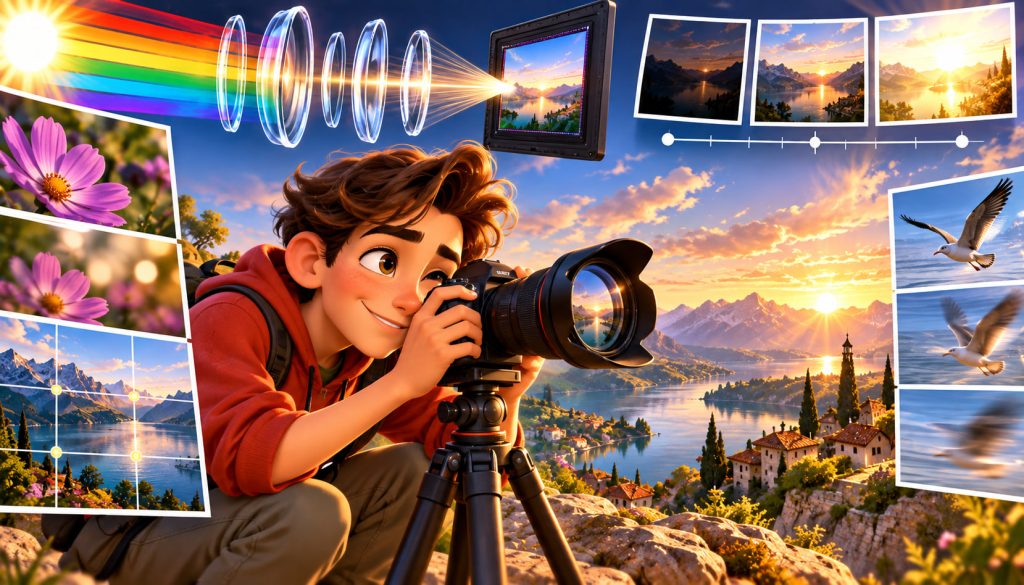
Photography often feels artistic and intuitive, but every photograph begins with physics. Before an image becomes a portrait, landscape, or dramatic street scene, light must travel through space, interact with objects, pass through a lens, and finally reach a sensor or film.
At the same time, physics alone does not make a compelling photograph. The photographer must decide where to place the subject, how to organize shapes, which areas should remain bright or dark, and what the viewer should notice first.
This combination of light physics and visual composition is what turns photography into both a science and an art.
Photography Begins With Light
Without light, photography cannot exist.
Light is electromagnetic radiation, and the portion visible to human eyes occupies only a small part of the electromagnetic spectrum.
When light reaches an object, several things can happen. Some wavelengths may be absorbed, while others are reflected or transmitted.
The reflected light that reaches the camera determines much of the color and brightness recorded in the photograph.
A red apple appears red because its surface reflects certain wavelengths more strongly than others.
A camera does not photograph objects directly. It records the light coming from them.
This simple idea explains why the same subject can look completely different under morning sunlight, cloudy skies, studio lamps, or candlelight.
How a Camera Lens Controls Light
A camera lens is designed to collect and focus light.
When light passes from air into glass, its direction changes because its speed changes. This process is called refraction.
Curved lens elements use refraction to redirect incoming rays so that they converge and form an image on the camera sensor.
Modern lenses may contain many separate optical elements.
These components help control distortion, improve sharpness, reduce unwanted color effects, and focus light across the image.
The lens also determines how much of the scene appears inside the frame.
Wide-angle lenses capture a broad field of view, while telephoto lenses magnify distant subjects and create a narrower perspective.
Aperture: The Eye of the Camera
Inside most photographic lenses is an adjustable opening called the aperture.
A wide aperture allows more light to reach the sensor.
A narrow aperture allows less.
Aperture is measured using f-numbers such as f/1.8, f/4, f/8, or f/16.
Interestingly, smaller f-numbers represent larger openings.
Aperture also influences depth of field, the distance range that appears acceptably sharp.
A wide aperture can isolate a subject against a blurred background. A narrow aperture often keeps more of a landscape or architectural scene in focus.
This makes aperture both a physical control and a creative tool.
Shutter Speed and the Physics of Motion
The shutter controls how long the camera sensor is exposed to light.
A fast shutter speed captures only a brief moment.
This can freeze movement such as a flying bird, splashing water, or a racing athlete.
A slow shutter speed allows light to accumulate for longer.
Moving objects may create streaks or blur, while stationary objects remain sharp if the camera does not move.
Long exposures can transform car headlights into glowing trails or make moving water appear smooth and mist-like.
Photography does not simply capture motion. Shutter speed determines how motion is represented.
ISO and the Brightness of the Image
ISO describes how the camera processes the signal produced by the sensor.
Increasing ISO makes it possible to create a brighter image when less light is available.
However, higher ISO settings can increase visible noise and reduce image quality.
This creates an important balance between aperture, shutter speed, and ISO.
Together, these settings are commonly known as the exposure triangle.
A photographer might open the aperture, reduce the shutter speed, or increase ISO to create a brighter exposure.
But each choice changes something else about the photograph.
Why Light Direction Matters
The direction of light dramatically changes the appearance of a subject.
Front lighting reduces shadows and can make surfaces appear flatter.
Side lighting creates stronger contrast and reveals texture.
Backlighting places the main light source behind the subject, sometimes producing silhouettes, glowing edges, or dramatic atmosphere.
Light from above and below can also change how faces and objects appear.
The same person photographed from the same position can look completely different simply because the light source moves.
Shadows provide information about shape, depth, texture, and distance.
That is why professional photographers often spend more time controlling light than adjusting the camera itself.
Hard Light and Soft Light
Light quality is strongly influenced by the apparent size of the light source relative to the subject.
A small or distant light source tends to create hard light with sharp-edged shadows.
A large light source creates softer transitions between light and shadow.
The midday Sun often produces hard shadows because it behaves like a relatively small source in the sky.
An overcast sky acts like an enormous diffuser, spreading light across a much larger area.
Studio photographers use softboxes, umbrellas, reflectors, and diffusers to control these effects.
Soft light is often used for portraits, while harder light can emphasize texture and create drama.
Color Temperature and Mood
Not all white light looks identical.
Different light sources contain different mixtures of wavelengths.
Photography describes these differences using color temperature, measured in kelvins.
Daylight, candlelight, shade, and artificial lamps can produce noticeably different color casts.
Warm light appears more yellow or orange, while cooler light appears more blue.
Camera white balance helps compensate for these differences.
Photographers can also deliberately preserve or exaggerate color temperature to influence mood.
A golden sunset may feel warm and nostalgic, while blue evening light can create a cooler and quieter atmosphere.
What Makes Composition So Important?
Physics determines how the image is captured, but composition determines how the viewer experiences it.
Composition is the arrangement of visual elements inside the frame.
A strong composition directs attention toward important subjects and creates relationships between shapes, lines, colors, and empty spaces.
One of the best-known guidelines is the rule of thirds.
Instead of placing the subject exactly in the center, photographers may position it near imaginary lines dividing the frame into thirds.
This can create a more dynamic image.
However, composition rules are guidelines rather than laws.
Centered compositions, symmetry, unusual cropping, and deliberate imbalance can also work extremely well.
Leading Lines, Symmetry, and Negative Space
Human vision naturally follows lines.
Roads, fences, rivers, shadows, walls, and architectural edges can guide attention toward the main subject.
These are known as leading lines.
Symmetry creates a different effect.
When the two sides of an image mirror or balance one another, the result can feel orderly and stable.
Negative space works by leaving large areas relatively empty.
This gives the subject visual separation and can create simplicity, calmness, or tension.
Good composition is largely about controlling where the viewer looks and how the eye moves through the frame.
Perspective Changes the Story
Camera position can completely transform a photograph.
Photographing from a low angle can make a subject appear larger or more dominant.
A high viewpoint may reveal patterns that are invisible from ground level.
Moving closer exaggerates differences between near and distant objects, especially with wide-angle lenses.
Moving farther away and using a telephoto lens can make distant objects appear visually compressed together.
Perspective therefore influences not only geometry but also emotional interpretation.
Expert Perspective: Ansel Adams and the Importance of Visualization
Photographer Ansel Adams became famous for technically precise black-and-white landscape photography and for his deep understanding of exposure and tonal control.
He emphasized the importance of visualizing the final photograph before pressing the shutter.
This approach reflects a central principle of photographic science: the camera records light mechanically, but the photographer decides how that light should become an image.
Adams also helped develop the Zone System, a method for controlling exposure and tonal relationships in photography.
His work demonstrated how technical understanding can expand artistic control rather than limit creativity.
Why Great Photography Combines Science and Art
A photographer may understand lenses, sensors, exposure, and optics perfectly and still create an uninteresting image.
Another photographer may have excellent artistic instincts but struggle to reproduce the effect they imagined without technical knowledge.
The strongest photography combines both.
Light determines what the camera can record.
Optics determine how the scene is projected.
Exposure controls brightness and motion.
Composition determines how visual information is organized.
Photography becomes powerful when scientific control supports creative intention.
Interesting Facts
The word photography comes from Greek roots meaning roughly “drawing with light.”
Modern camera sensors contain millions of light-sensitive elements called photosites.
A wide aperture can produce shallow depth of field, helping separate a subject from the background.
Very slow shutter speeds can record motion that the human eye never sees as a single continuous image.
Overcast skies often create naturally soft lighting because clouds scatter sunlight.
Telephoto lenses can make distant objects appear visually closer together within a photograph.
The human eye constantly changes its sensitivity and focus, while a photograph freezes one selected exposure and viewpoint.
Early photographic exposures could require minutes or even hours, making portraits far more difficult than modern photography.
Glossary
Aperture — The adjustable opening inside a lens that controls how much light enters the camera.
Shutter Speed — The amount of time the camera sensor or film is exposed to light.
ISO — A camera setting related to the amplification or processing of the sensor signal, affecting image brightness and visible noise.
Exposure — The total amount of light used to create a photograph.
Refraction — The bending of light as it passes between materials with different optical properties.
Focal Length — A lens characteristic that strongly influences field of view and image magnification.
Depth of Field — The range of distances in a photograph that appear acceptably sharp.
Color Temperature — A way of describing the warm or cool appearance of a light source, usually measured in kelvins.
White Balance — A camera adjustment used to compensate for the color characteristics of different light sources.
Composition — The arrangement of subjects, shapes, lines, colors, and empty spaces within an image.
Leading Lines — Visual lines that guide the viewer’s attention through a photograph.
Negative Space — Relatively empty areas surrounding the main subject.
Dynamic Range — The range between the darkest and brightest details a camera can record.
Photosite — A light-sensitive element on a digital image sensor that contributes information used to create the final photograph.